
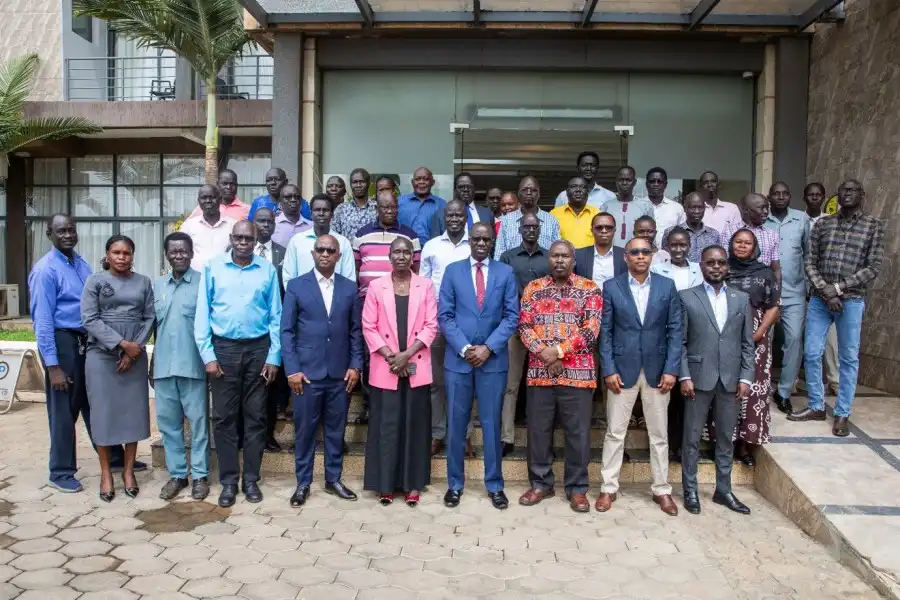
Opening session of the workshop in Juba, showing participation from government institutions, FAO, and other development partners (© FAO)
South Sudan has taken a significant step toward strengthening its national agricultural statistics system with the successful completion of an FAO technical support mission conducted from 20 April to 1 May 2026 in Juba. Implemented under the TCP/SSD/4001 project, the mission supported the Government of South Sudan in advancing preparations for the country’s first-ever Census of Agriculture- a critical milestone for evidence‑based agricultural planning, food security monitoring, and rural development.
The mission brought together national data users and producers to assess priority agricultural statistics needs and to advance the development of core technical documents required for the census. FAO consultants supported the process, working closely with national counterparts to ensure that the census methodology, tools, and outputs are aligned with international standards while remaining adapted to South Sudan’s national context.
Strong national leadership and a shared vision for data
The mission officially commenced with a user–producer workshop on agricultural statistics, convening representatives from ministries, departments, and agencies, research institutions, academia, development partners, and technical experts. In his opening remarks, Dr Augustino T. Mayai, Director General of the National Bureau of Statistics, underscored the critical importance of agricultural data for national development. He noted that “agricultural data are not merely statistical outputs, but a fundamental pillar for evidence‑based policymaking, resource allocation, and monitoring progress toward national development objectives.” He emphasized the need to strengthen engagement between data producers and data users to ensure that statistics are timely, relevant, accessible, and effectively utilized in decision‑making processes.
The Director General further highlighted that ensuring the production of high‑quality agricultural statistics is a shared responsibility, calling for sustained dialogue and collaboration among institutions involved in data production, analysis, and use, particularly for policy formulation, research, and sector planning. His remarks set a strong foundation for a participatory and inclusive approach to the mission’s activities.
On behalf of FAO, Nicholas Kerandi, Technical Adviser at FAO South Sudan, commended the government for its continued commitment to development initiatives and its productive collaboration with FAO across multiple programmes. He highlighted the consistent leadership and support provided by the Director General in advancing joint FAO–National Bureau of Statistics activities, particularly in implementing shared initiatives to strengthen the national agricultural statistics system. Mr. Kerandi concluded his remarks by expressing appreciation to all participants for their active engagement and reaffirmed FAO’s commitment to supporting the country’s efforts to enhance evidence‑based decision-making in the agricultural sector.
From needs assessment to technical preparation
Building on this shared vision, the mission focused on evaluating South Sudan’s agricultural statistics needs and translating them into clear indicators that can be captured through census and surveys. Through extensive technical sessions, national experts and FAO consultants jointly worked on the development and refinement of key census documents, including questionnaires for household and non‑household agricultural holdings, a community‑level questionnaire, detailed data collection instruction manuals, and a census tabulation plan.
The technical work was structured to ensure that the census will capture comprehensive information on the structure of agriculture, including crops, livestock, land use, and institutional and community‑level characteristics. Particular attention was given to ensuring consistency across data collection tools and clarity for future census enumerators, laying a solid operational foundation for successful census implementation.
Building sustainable capacity for the future
Beyond the development of technical documents, the mission placed strong emphasis on national capacity strengthening. National staff were actively engaged in each stage of the process, reinforcing ownership of the census methodology and enhancing their ability to independently manage future phases of the Census of Agriculture. This hands‑on approach is expected to support the long-term sustainability of agricultural statistics production in South Sudan.
The mission also strengthened collaboration among institutions involved in agricultural data, fostering a more coordinated national statistical system. By bringing producers and users of data together, the process helped align statistical outputs with policy needs, national strategies, and international reporting requirements, including commitments related to food security and agricultural development.
Looking ahead
With the technical groundwork now advanced, South Sudan is better positioned to move forward with the next steps of its Census of Agriculture. FAO will continue to support the country in the next phases, including further refinement of technical documents, capacity development, and preparation for data collection and analysis. The successful completion of this mission marks an important milestone toward a more robust, reliable, and responsive agricultural statistics system - one that will play a key role in informing policies, guiding investments, and supporting sustainable development across South Sudan’s agricultural sector.
Newer articles:
- Mass Deportations from Sudan Add Pressure on South Sudan’s Humanitarian Crisis - 15/05/2026 14:12
- More than 61 killed in South Kordofan tribal clashes, Sudan Doctors Network says - 15/05/2026 14:05
- IBSA Delegation Applauds Progress in Women and Youth-Led Agriculture Initiatives - 15/05/2026 14:03
- US Slaps South Sudan Officials with Visa Bans Over Peace Deal - 13/05/2026 12:30
- Juba County Cracks Down on Illegal Land Grabbing and Unauthorized Demarcation - 13/05/2026 12:26
Older news items
- The enduring commitment of religious congregations to South Sudan’s recovery - 13/05/2026 12:15
- Tanzania, South Sudan asked to remove roadblocks for EAC traders - 13/05/2026 12:11
- UNHCR Sudan - South Sudanese Refugees in Sudan Dashboard as of 30 April 2026 - 13/05/2026 12:05
- East African Procurement Leaders Gather in Juba for 17th Regional Forum - 11/05/2026 20:02
- One Year After Old Fangak Hospital Bombing, No Accountability as MSF Warns of Healthcare Collapse in Jonglei - 11/05/2026 19:58
Latest news items (all categories):
- Op-Ed - Breaking the Double-Standard Lens on China's Population Shifts - 23/10/2026 14:23
- South Sudan ceasefire monitors warn of rising violence ahead of December elections - 23/10/2026 13:39
- UNMISS SRSG visits Malakal, emphasizes that peace begins with collective action - 23/10/2026 13:36
- How Technology is Accelerating South Sudan’s Next Oil Discovery - 23/10/2026 13:34
- South Sudan’s Patriot make case in their opener against Urunani - 23/10/2026 13:12
See also (all categories):
Random articles (all categories):
- South Sudan Sees No Agreement on Peace Before Aug. 17 Deadline - 11/08/2015 15:04
- Sudan, South Sudan leaders meet over disputes; UN urges access for aid ... - Washington Post - 15/07/2012 14:28
- Fifteen years of independence for South Sudan, but still little to celebrate - 10/07/2026 21:23
- Kenya, South Sudan: Investigate Critics’ Disappearance - 11/02/2019 20:30
- S. Sudan: UN urges parties to form transitional gov't - 17/02/2020 07:39
Popular articles:
- Who is the darkest person in the world, according to Guinness World Record? - 25/10/2022 02:34 - Read 151202 times
- School exam results in South Sudan show decline - 01/04/2012 17:58 - Read 28342 times
- Top 10 weakest currency exchange rates in Africa in 2023 - 19/07/2023 00:24 - Read 25440 times
- No oil in troubled waters - 25/03/2014 15:02 - Read 24660 times
- NDSU student from South Sudan receives scholarship - In-Forum - 29/09/2012 01:44 - Read 22633 times
