
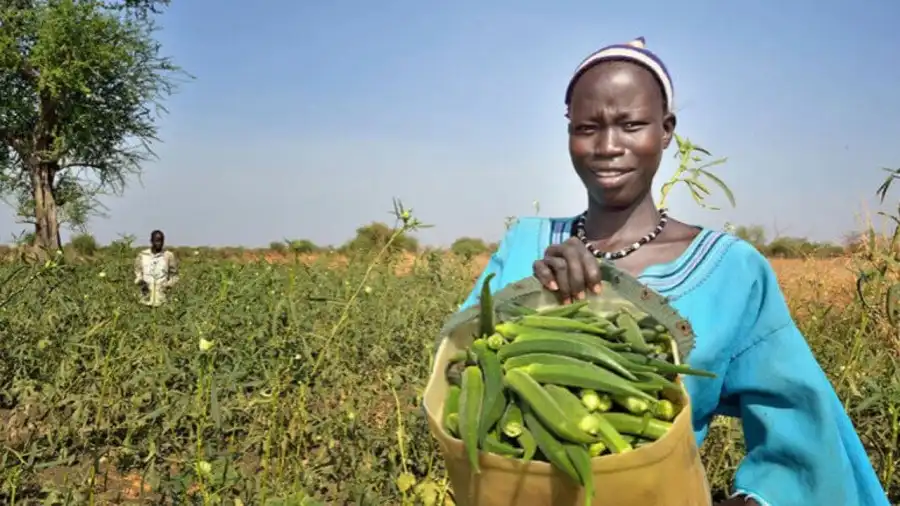
Catholic religious congregation in Solidarity with South Sudan - supporting agriculture (Photo Credit: Vatican News)
In 2008, religious congregations established “Solidarity with South Sudan” as a joint effort in response to a plea from the Sudanese Bishops’ Conference. The goal was to tackle urgent educational, health, and pastoral challenges that emerged after many years of war. Their efforts gained momentum after an exploratory visit in 2006, laying the groundwork for tangible support. The question on everyone’s lips: How do you build in a place that had lost almost everything?
Christine Masivo, CPS – Vatican City
At the time, facing dire need, the Bishops appealed to religious leaders in Rome for help from their congregations worldwide. Their simple request was for the universal church to stand with them and help build institutions. This led to the birth of Solidarity with South Sudan.
When South Sudan gained independence on 9 July 2011, the expectations from citizens became urgent.
A shared mission
The first group sent to South Sudan landed in 2008. Fr Callistus Joseph, a Claretian Missionary, was one of the pioneers, serving as the director of the projects and coordinating them all. Speaking recently to Vatican News, Fr Callistus explains that Solidarity with South Sudan was formed as a collaborative effort between the leaders of religious congregations and the local bishops. Rather than work independently, the initiative focused on shared responsibilities and common goals.
At that time, nineteen missionaries from 16 countries volunteered to serve, bringing with them their diverse skills in teaching, nursing, agriculture, and pastoral work. United by a commitment to walk alongside the people of South Sudan, they immediately recognised urgent needs in teacher training, healthcare, pastoral formation, and agriculture. There were only a small number of trained teachers and very few doctors, qualified nurses, and midwives.
Rebuilding from scratch

Fr Callistus Joseph, a Claretian Missionary (Photo Credit: Vatican News)
Education was a priority because the country had chosen to switch from Arabic to English as a language of instruction. There was a great need for English-speaking teachers. “We established the teachers' training Centre in Yambio and Malakal,” said Fr. Callistus. “These institutions aimed to train both current and future educators.” The few teachers available, had kept education alive during the war, teaching under trees, in churches, and in refugee camps. Solidarity’s goal was not to replace them but to strengthen them.
Malakal College was later closed due to renewed conflicts in 2013, and Yambio College continues to operate, training teachers for the country’s schools. Eventually, South Sudan began producing its own qualified teachers.
In the health sector, Solidarity helped restore and run health training institutes in Wau starting in 2018. Supported by partner organisations and working with government ministries, the institutions began training nurses and midwives in 2019. These initiatives have since produced the country’s healthcare workforce.
Similarly, agriculture also developed as a practical means of supporting communities and institutions. A farming project near Yambio not only provided food for students and staff but also created work opportunities for displaced people. The project has grown with the support of local leaders and international partners.
Pastoral formation and peacebuilding remained central to mission. To support these aims, a centre was built offering affordable training for catechists, church leaders, youths, and peace workers. This reduced costs and expanded diocesan access to nationwide ongoing formation.
Solidarity and mission in action
According to Fr. Callistus, one of the clear outcomes of mission is its example. He explained that religious men and women from different backgrounds living together and offering visible models of cooperation in a country marked by division was a living testimony to what can be achieved when communities come together. He added that this daily witness, alongside education and training, has contributed to a growing sense of shared national identity.
The future ahead
Looking ahead, despite South Sudan’s current socio-political challenges, Solidarity remains focused on training, peace education, and self-sustainability for the local church. While international funding continues to play an important role, the long-term aim is for local communities to fully manage and sustain these institutions. The mission experience demonstrates that sustainable collaboration can yield lasting results in even the most difficult contexts.
“Despite the renewed violence in 2024, Solidarity with South Sudan has remained present,” said Fr. Callistus. He emphasised that the long-term presence of religious men and women living and working together has been central to the initiative's impact, reflecting their shared commitment to helping South Sudanese communities rebuild skills and take responsibility for their own future.
Newer articles:
- More than 61 killed in South Kordofan tribal clashes, Sudan Doctors Network says - 15/05/2026 14:05
- IBSA Delegation Applauds Progress in Women and Youth-Led Agriculture Initiatives - 15/05/2026 14:03
- US Slaps South Sudan Officials with Visa Bans Over Peace Deal - 13/05/2026 12:30
- Juba County Cracks Down on Illegal Land Grabbing and Unauthorized Demarcation - 13/05/2026 12:26
- Strengthening South Sudan’s agricultural statistics through census preparation - 13/05/2026 12:20
Older news items
- Tanzania, South Sudan asked to remove roadblocks for EAC traders - 13/05/2026 12:11
- UNHCR Sudan - South Sudanese Refugees in Sudan Dashboard as of 30 April 2026 - 13/05/2026 12:05
- East African Procurement Leaders Gather in Juba for 17th Regional Forum - 11/05/2026 20:02
- One Year After Old Fangak Hospital Bombing, No Accountability as MSF Warns of Healthcare Collapse in Jonglei - 11/05/2026 19:58
- President Salva Kiir Mayardit Travels to Uganda Ahead of Yoweri Kaguta Museveni Inauguration Ceremony - 11/05/2026 19:50
Latest news items (all categories):
- Op-Ed - Breaking the Double-Standard Lens on China's Population Shifts - 23/10/2026 14:23
- South Sudan ceasefire monitors warn of rising violence ahead of December elections - 23/10/2026 13:39
- UNMISS SRSG visits Malakal, emphasizes that peace begins with collective action - 23/10/2026 13:36
- How Technology is Accelerating South Sudan’s Next Oil Discovery - 23/10/2026 13:34
- South Sudan’s Patriot make case in their opener against Urunani - 23/10/2026 13:12
See also (all categories):
Random articles (all categories):
- South Sudan: Voices of Independence past - 09/07/2018 03:36
- South Sudan: The fallout of a civil war - 02/05/2015 18:39
- Turkish Red Crescent distributes food to 870 families in South Sudan - 25/04/2022 01:01
- Attacks and displacement spread in Sudan's Darfur - 18/07/2023 02:56
- South Sudan Minority Leader: No Elections Before Peace - 06/01/2015 19:06
Popular articles:
- Who is the darkest person in the world, according to Guinness World Record? - 25/10/2022 02:34 - Read 151229 times
- School exam results in South Sudan show decline - 01/04/2012 17:58 - Read 28358 times
- Top 10 weakest currency exchange rates in Africa in 2023 - 19/07/2023 00:24 - Read 25453 times
- No oil in troubled waters - 25/03/2014 15:02 - Read 24672 times
- NDSU student from South Sudan receives scholarship - In-Forum - 29/09/2012 01:44 - Read 22645 times
