
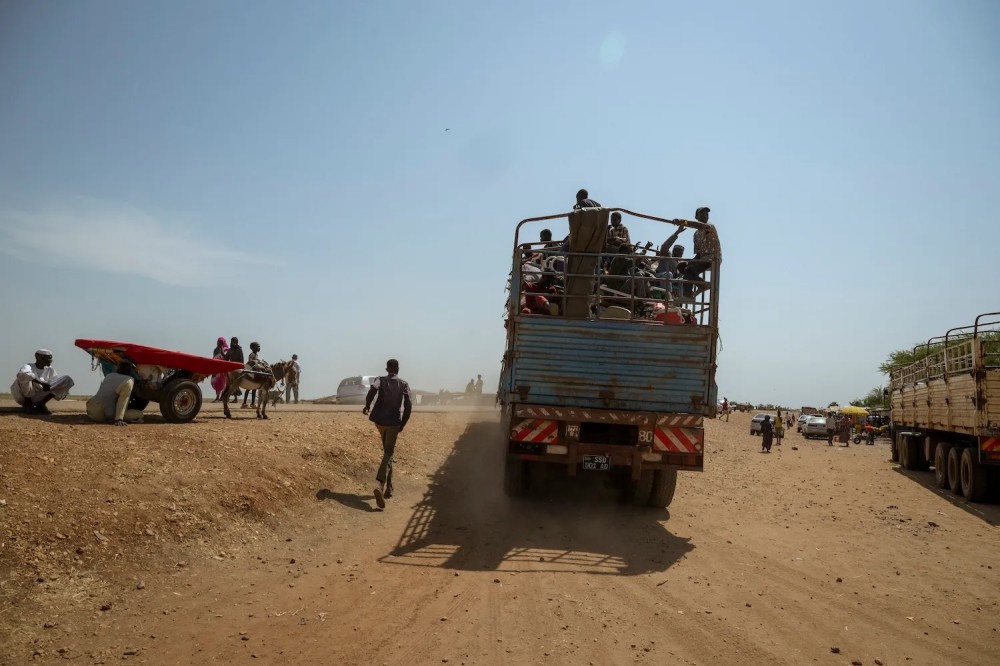
The Sudanese Armed Forces (SAF) captured more than 10 South Sudanese nationals fighting alongside the paramilitary Rapid Support Forces (RSF) in central Sudan’s Kordofan region last week, SAF sources told Al Jazeera. The incident highlights growing tensions between the SAF and South Sudan, which the former has accused of supporting the RSF in Sudan’s civil war.
The ongoing siege in Kordofan risks further drawing South Sudan into the conflict, even as the country is on the cusp of civil war itself, facing an ongoing power struggle between President Salva Kiir and opposition leader Riek Machar.
South Sudan gained independence from Sudan in July 2011, ending decades of civil war. Two years later, another civil war erupted in South Sudan after Kiir sacked Machar, his vice president. The conflict killed around 400,000 people and ended with a 2018 power-sharing deal, which deteriorated last March.
Since late 2024, the SAF has alleged that armed groups from South Sudan are fighting alongside the RSF. Last February, the RSF formed an alliance with the Sudan People’s Liberation Movement-North (SPLM-N), led by Abdelaziz al-Hilu—an offshoot of South Sudan’s SPLM, which spearheaded the country’s independence push and now runs the government under Kiir.
Last March, then-Sudanese Minerals Minister Mohamed Bashir Abunommo accused South Sudan of allowing the United Arab Emirates—a key RSF backer—to establish an “aggression base” under the guise of a field hospital in Aweil East near the Sudanese border. Abunommo also alleged that the South Sudanese government was ignoring the recruitment of its citizens into the RSF and facilitating Sudanese gold smuggling to the UAE. South Sudan denied the claims.
In July, the RSF and SPLM-N formed a parallel Sudanese government along with other armed supporters. Sudan’s military believes that Kiir is backing this new RSF alliance.
Analysts fear that oil may further drag Juba into Sudan’s conflict. Landlocked South Sudan relies on oil for more than 90 percent of government revenue, and its oil passes through pipelines in Sudan’s bordering Heglig oil field in West Kordofan state.
After the RSF announced that it had seized Heglig on Dec. 8, Juba reached a rare tripartite agreement with the SAF and RSF to allow South Sudanese troops to secure the facility and guarantee exports of oil via Heglig to Port Sudan. The facility processes about 130,000 barrels of South Sudanese oil per day. By deploying its army to Heglig, South Sudan is now directly involved in managing a strategic flashpoint in Sudan’s civil war.
Meanwhile, in Sudan, intense fighting in South Kordofan has driven more than 1,500 civilians into the city of Kosti in neighboring White Nile state. Camps in the city’s outskirts are overcrowded amid mass displacement and an international aid shortage.
The United Nations World Food Program announced last month that it would cut back on food rations in Sudan due to a lack of funding, even as the country is gripped by famine.
In November, the Integrated Food Security Phase Classification confirmed famine in the country for the second time in less than a year, noting that an estimated 21.2 million people—nearly half of the population—face acute food insecurity. Around 825,000 children are projected to suffer from severe malnutrition in 2026, according to UNICEF.
U.N. human rights chief Volker Turk has said the Kordofan region could face a wave of atrocities similar to the widespread sexual abuse and killings documented in El Fasher last year.
Source: https://foreignpolicy.com/2026/01/07/south-sudan-sudanese-armed-forces-conflict-rsf-oil/
Newer articles:
- Rwanda: Musanze’s ‘Tshabalala’ joins South Sudan’s El Merriekh Bentiu - 12/01/2026 11:08
- Sudan’s Burhan orders release of 400 female inmates accused of cooperating with RSF - 12/01/2026 11:02
- South Sudan denies U.S. accusations of obstructing humanitarian assistance - 12/01/2026 10:58
- Trump administration halts foreign assistance in South Sudan’s Ayod County amid abuse claims - 09/01/2026 13:20
- South Sudan: Business Environment, Risks, and Market Opportunities - 09/01/2026 13:09
Older news items
- Gor Mahia have completed the signing of South Sudan international Jackson Dwang - 09/01/2026 13:00
- Human Rights Watch (HRW) : South Sudan - Abusive ‘Anti-Gang’ Crackdown - 07/01/2026 14:58
- In South Sudan, young musicians refuse to let war divide them - 07/01/2026 14:49
- A nurse responds to flooding and fire in Old Fangak - 06/01/2026 17:08
- Tanzanian driver reunited with family after South Sudan ordeal - 06/01/2026 17:01
Latest news items (all categories):
- South Sudan Opens 14 Oil Blocks, Courts Investors Ahead of SSOP 2026 - 26/10/2026 15:08
- Jambojet Explores South Sudan Expansion After Talks with Juba Regulator - 26/10/2026 15:05
- Kiir swears in 5 officials ahead of South Sudan elections - 26/10/2026 14:53
- South Sudan cattle battles leaves 10 dead: official - 26/10/2026 14:49
- Churches urge world 'not to forget South Sudan' ahead of first elections - 26/10/2026 14:47
See also (all categories):
Random articles (all categories):
- South Sudan U-17 national team returns to Juba affer CECAFA Qualifiers - 19/10/2026 14:09
- South Sudan Opposition Feuds as Ruling SPLM Meets - Voice of America - 07/03/2013 14:35
- Manuela - fleeing South Sudan - 29/05/2018 00:32
- Protesters Block UN Mission in Bor for 2nd Day - 04/09/2020 02:18
- South Sudan President Does About-Face, Heads to Peace Talks - 16/08/2015 07:50
Popular articles:
- Who is the darkest person in the world, according to Guinness World Record? - 25/10/2022 02:34 - Read 151290 times
- School exam results in South Sudan show decline - 01/04/2012 17:58 - Read 28385 times
- Top 10 weakest currency exchange rates in Africa in 2023 - 19/07/2023 00:24 - Read 25491 times
- No oil in troubled waters - 25/03/2014 15:02 - Read 24695 times
- NDSU student from South Sudan receives scholarship - In-Forum - 29/09/2012 01:44 - Read 22671 times
