
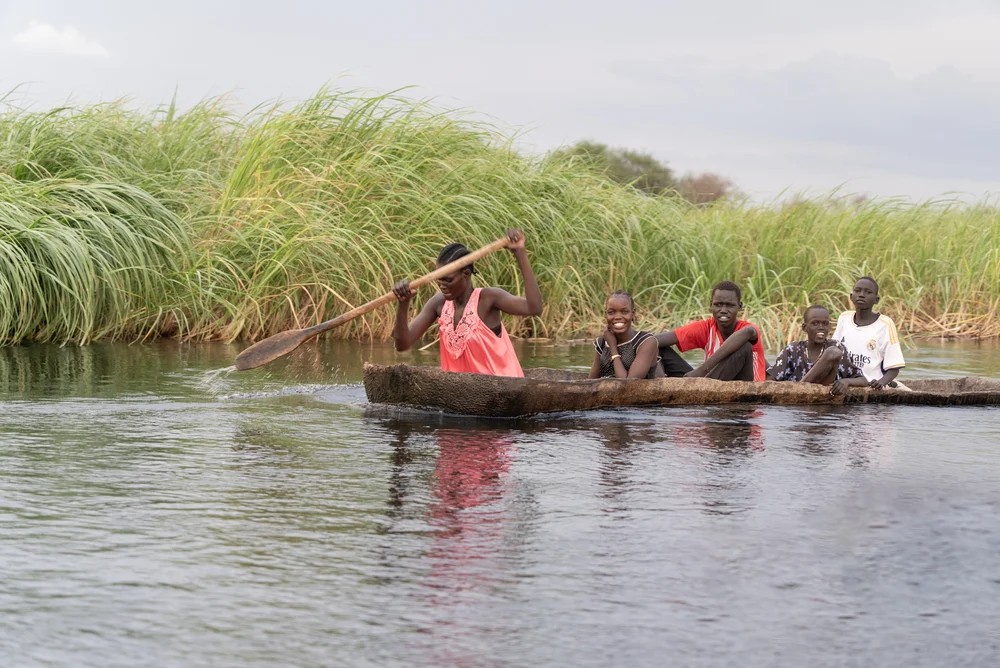
In the vast wetlands of northeastern South Sudan, NZ nurse Natasha Allan learned firsthand about the challenges people face as unprecedented flooding continues to disrupt their lives and health, and how they continue to adapt. But during her assignment life was disrupted yet again, when an aerial attack struck MSF’s hospital in Old Fangak, and the town.
The Sudd wetlands are considered one of the largest floodplain wetlands in the world, spanning several northeastern states of South Sudan. But due to climate change, the once seasonal cycle of floodplain expansion and contraction has been broken, and ever-rising water levels have pushed people’s livelihoods to the margins.
“Since about 2019, due to climate change there have been extreme flooding events and more and more land lost,” said Natasha. “This has led not only to food insecurity, where communities have had to adapt to the loss of land for crops and cows, but also to the uncertainty of whether your home will be safe. Even material to make the traditional thatch grass roofs for houses has become difficult to access.
“This means that the communities are very mobile, often moving out of necessity to a fishing camp for work. There used to be land for farming but now a lot of people earn money fishing, selling the dried fish either independently or to barges that transport it elsewhere.”
A new outreach set-up
MSF’s Old Fangak project was established to provide a range of primary and secondary services to a dispersed community of 110,000 people. Natasha arrived as outreach manager in February 2025. “MSF had built a new static clinic with community engagement on a site in Haat that was central to the islands where people lived, replacing the previous mobile clinics,” Natasha said. “This change ensured healthcare would be available more consistently than before. To improve access, MSF also donated five canoes to the community.”
Canoes are essential for moving even short distances in the Sudd, but not everyone has access to one. Even with a canoe, being able to cross from island to island is not always guaranteed. “The local canoes are small craft that sit quite low in the water, and it's not always safe to travel. Especially if it's really windy, there are areas where the river is so wide it’s more like a lake, and the waves can be quite big,” Natasha said.
"It’s a very difficult place to live, but the communities do the best they can."
“My role was to assess and strengthen the systems in place. The clinic was designed to be community-led, with support from MSF. The community was very much on board and the staff worked hard to provide their community with the best service they could.”
The clinic was staffed by members of the community with the relevant qualifications, and one MSF staff member. MSF assisted by paying the staff using the incentive model common under the health system in South Sudan. Surrounding islands were also served by 17 community health workers, trained by MSF using the Integrated Community Case Management strategy. The iCCM strategy is designed to reduce deaths in children under five, focussing on diarrhoea, malaria and malnutrition. Community volunteers referred children to the clinic when simple management was ineffective.
Natasha mixed remote support with spending time in Haat and the catchment area. “As it was about an eight-hour round trip to the Haat area, I camped in the community near to our clinic when possible to allow me to work with the staff and visit the communities on the surrounding islands,” she said. “The rest of the time I worked remotely, providing support including organising the supply of medicines and other logistics, as well as clinical support for complicated presentations and organising responses to emergency situations such as cholera outbreaks.
“Communication with the clinic staff was difficult with only patchy satellite phone reception. Staff had to travel in a canoe via a three-hour return trip to access the internet.”
Natasha also worked with three new starters. “We employed two nutrition assistants to oversee and improve the iCCM system, and an outreach supervisor to work alongside me and take over the outreach role when my contract finished. He was a very energetic man who had worked with MSF in the past, working in the cholera response, and was very experienced in outreach including having done a hepatitis E vaccination campaign.”
A shocking attack
At the end of April, Natasha went on a two-week break to Egypt. Early in the morning on Saturday 3 May 2025, two helicopter gunships launched an attack on Old Fangak. MSF’s Old Fangak hospital was directly fired upon and bombed, setting fire to the hospital’s pharmacy, and injuring staff, a patient and two caregivers. The gunships also fired on the town and a drone bombed the Old Fangak market, killing at least seven people and injuring 27, including four MSF staff.
“After the attack MSF’s team evacuated to Toch, about an hour away by boat, as there was no guarantee Old Fangak would not be targeted again,” Natasha said. “MSF then sent a plane to Toch to evacuate the most critical patients that required surgical care. A few international and local staff stayed to help manage the patients and set up a mass casualty stabilisation clinic in a tent borrowed from the primary healthcare centre.”
As part of the security response, all international staff were evacuated within a few days. Natasha was delegated to remotely manage the medical response, from Juba, South Sudan’s capital. “Our locally hired colleagues continued to manage patients from Old Fangak and trauma patients, as well as seeing new presentations daily,” Natasha said. “None of the staff were expected to work; we could not assure their safety and they had been displaced from their homes in Old Fangak. Some people relocated to the surrounding islands, but some chose to continue to work.
“Meanwhile in Toch, we didn't have the capacity – infrastructure, pharmacy or staff – to re-start our hospital services like in Old Fangak, but we continued to respond to ongoing mass casualty events. We managed to refer a couple of patients to our partner, South Sudan Medical Relief from Old Fangak, which had moved to another island. We had been the only inpatient, secondary healthcare facility in the area, so the gap was huge,” she said.
"We had been the only inpatient, secondary healthcare facility in the area, so the gap was huge."
Traumatic mass casualty events
“Unfortunately, during the weeks that followed there were more mass casualty incidents,” Natasha said. “The biggest day involved about 70–75 patients arriving in Toch, one to two small speedboats at a time. The patients came from hours upriver. As a result, some did not survive, having had no medical care prior to entering the boat.
“It was very complicated and traumatic for the staff because the level of staffing, assistance and supplies was drastically reduced. The staff had also been survivors of the attack themselves, and some had family or friends injured or killed. To try to avoid running out of medications and consumables we had to triage how we used the stock until the next supply could arrive. The team managed very well under very trying circumstances."
“Of the 70-odd people that arrived on that day and night about 35 needed evacuation, mostly due to gunshot wounds. The other patients were able to be managed locally, but with a lack of staff to manage all the patients, the team referred patients on to surrounding islands for ongoing care. Just sheltering all the patients was a problem. It was handy if people knew someone in the community to stay with—but that's a lot of people to house. Even so, the community got together and sorted out where people could stay,” Natasha said.
The situation was new for Natasha. “I hadn't dealt with mass casualties before and trying to assist remotely was challenging. Luckily, I knew a lot of the staff, because I had done some work in the hospital in Old Fangak, as I had been transitioning to fill the Nurse Activity Manager gap there before I went on leave.”
As Natasha’s assignment ended, the MSF’s coordination team in the capital was developing the plan to reorganise activities and ensure longer-term continuity of healthcare, in the face of the loss of services in Old Fangak.
Join our team
Our teams of medical and non-medical professionals provide healthcare to millions of people caught in crises in over 70 countries around the world.
For nurses in 2026, we are actively seeking nursing activity managers and dialysis nurses, in addition to neonatal and paediatric nurses. If you meet the essential criteria for all international staff, we encourage you to apply.
Newer articles:
- South Sudan: Business Environment, Risks, and Market Opportunities - 09/01/2026 13:09
- Will South Sudan Get Dragged Into Sudan’s Civil War? - 09/01/2026 13:04
- Gor Mahia have completed the signing of South Sudan international Jackson Dwang - 09/01/2026 13:00
- Human Rights Watch (HRW) : South Sudan - Abusive ‘Anti-Gang’ Crackdown - 07/01/2026 14:58
- In South Sudan, young musicians refuse to let war divide them - 07/01/2026 14:49
Older news items
- Tanzanian driver reunited with family after South Sudan ordeal - 06/01/2026 17:01
- South Sudanese government minister James Hoth Mai overturns police seizure of luxury Melbourne home - 06/01/2026 16:54
- The South Sudan Roadmap on Anticipatory Action 2025 -2030 - 06/01/2026 16:40
- KRA to Auction Tons of Sugar Destined for South Sudan - 03/01/2026 14:55
- Sudan sources say South Sudanese among captured RSF members as war rages - 03/01/2026 14:47
Latest news items (all categories):
- South Sudan Opens 14 Oil Blocks, Courts Investors Ahead of SSOP 2026 - 26/10/2026 15:08
- Jambojet Explores South Sudan Expansion After Talks with Juba Regulator - 26/10/2026 15:05
- Kiir swears in 5 officials ahead of South Sudan elections - 26/10/2026 14:53
- South Sudan cattle battles leaves 10 dead: official - 26/10/2026 14:49
- Churches urge world 'not to forget South Sudan' ahead of first elections - 26/10/2026 14:47
See also (all categories):
Random articles (all categories):
- The Divergence From The Real Visions And Ideas Of The Struggle Has Negatively Affected South Sudan - 23/08/2021 11:39
- America Owes Apology To The Beautiful Danmark - 13/02/2025 19:27
- South Sudan Operation Overview - December 2019 - 10/01/2020 01:11
- South Sudan: Sanctions Aren't Working, but They Could. Here's How. - 04/06/2018 00:26
- South Sudan Displacement Crisis: Kapoeta Town Road Monitoring - Kapoeta South County, Eastern Equatoria State, South Sudan (September 2018) - 10/12/2018 16:39
Popular articles:
- Who is the darkest person in the world, according to Guinness World Record? - 25/10/2022 02:34 - Read 151281 times
- School exam results in South Sudan show decline - 01/04/2012 17:58 - Read 28379 times
- Top 10 weakest currency exchange rates in Africa in 2023 - 19/07/2023 00:24 - Read 25484 times
- No oil in troubled waters - 25/03/2014 15:02 - Read 24691 times
- NDSU student from South Sudan receives scholarship - In-Forum - 29/09/2012 01:44 - Read 22664 times
