
(Image generated with AI)
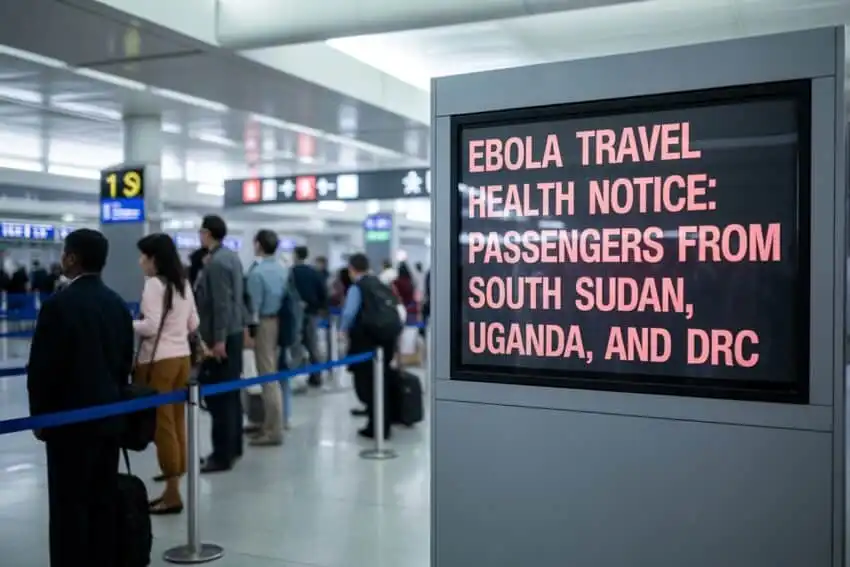
When a health crisis hits a vulnerable region, the tremors are felt across the entire globe. In a decisive response to a fast-moving and complex viral threat, the United States government has officially implemented stringently targeted travel restrictions for individuals arriving from East and Central Africa. Driven by growing anxieties over an escalating Ebola virus outbreak, the Centers for Disease Control and Prevention (CDC) has placed a temporary moratorium on entry for non-US passport holders who have recently passed through South Sudan, Uganda, or the Democratic Republic of Congo (DRC).
The emergency measure—enacted under a temporary 30-day Title 42 public health directive—comes on the immediate heels of the World Health Organization (WHO) declaring the multi-country surge a Public Health Emergency of International Concern. While health experts emphasize that the immediate threat to the general American public remains low, the aggressive move highlights a tense race to contain a rare strain of the virus before it can establish a foothold in major global travel hubs.
The Trigger: A Strain with No Medical Shield
What makes this active public health response uniquely urgent is the specific genetic profile of the virus currently spreading through the region. Rather than the highly studied Zaire variant, this current wave is driven by the Bundibugyo ebolavirus—a rare variant that carries a mortality rate ranging between 25% to 50%.
Compounding the anxiety for health professionals is a stark scientific reality: there are currently no approved vaccines or targeted antiviral therapies engineered to neutralize the Bundibugyo strain. Treatment is limited strictly to aggressive supportive care, such as heavy rehydration and addressing localized organ stress.
The outbreak has already claimed at least 100 lives, with hundreds of more suspected cases filtering through overwhelmed medical clinics. The regional crisis struck a deeply personal chord for the international aid community when a prominent American missionary doctor, Peter Stafford, tested positive for the virus while operating at Nyankude Hospital in the northeastern DRC. While Dr. Stafford and his exposed family members are being medically evacuated to Germany for specialized biocontainment isolation, the incident crystallized the immediate danger for border security teams in Washington.
The Mechanics of the Title 42 Restrictions
Signed into action by federal health authorities, the emergency order imposes a strict 21-day look-back window. Under the new protocol, any foreign national or non-US passport holder who has physically stepped foot inside South Sudan, Uganda, or the DRC within the past three weeks will be completely turned away at US ports of entry.
To maintain essential humanitarian and diplomatic pathways, the sweeping mandate does explicitly outline a short list of standard exceptions. The entry suspension does not apply to:
- United States citizens
- Lawful permanent residents (Green Card holders)The Independent
- Active military personnelThe Independent
- Accredited foreign government officials and their immediate families
For American citizens returning home from these specific territories, travel remains legal, but it will no longer be smooth. Returning citizens are being systematically routed through designated gateway airports equipped with enhanced physical health screenings, strict contact-tracing questionnaires, and localized monitoring regimens managed directly by port health protection authorities.
A Controversial Frontier Protocol
While the administration describes the temporary travel suspension as a necessary “buffer zone” to buy American hospitals time to ramp up laboratory diagnostic testing and isolation ward readiness, the move has ignited an intense debate among global health policy experts.
Public health advocacy groups, including the Infectious Diseases Society of America (IDSA), have voiced strong concerns regarding the efficacy of unilateral travel bans. Epidemiologists consistently point out that highly transmissible viruses do not recognize national boundaries or legal passports. Critics argue that isolating countries like South Sudan during a highly sensitive health emergency can inadvertently complicate the crisis by choking off logistical access for volunteer medical personnel, driving tracking mechanisms underground, and stalling local economic recovery.
However, federal policy coordinators maintain that the 30-day window is a vital precautionary circuit breaker. Concurrently, the US has activated a comprehensive interagency response task force involving the State Department and the Department of Defense to actively assist international health teams on the ground with contact tracing and containment operations within East Africa.
The Fragile Reality for South Sudan
For South Sudan—the world’s youngest sovereign nation—this health emergency introduces an incredibly heavy burden at an already volatile historical moment. The country is currently steering through an intensely fragile political transition, with long-delayed national elections tentatively rescheduled for late December 2026.
The domestic infrastructure is already severely strained by localized civil unrest, high rates of poverty, and severe displacement events. Layering a highly lethal, un-vaccinable virus and severe international travel isolation on top of an active humanitarian crisis creates a complex web of logistical challenges for local authorities trying to secure their communities.
Global Vigilance in an Interconnected World
As airport screening kiosks adjust their software to flag recent travel to Juba, Kampala, or Goma, the global travel landscape enters a brief period of holding its breath. The deployment of Title 42 travel restrictions is a sobering reminder that in a modern, interconnected ecosystem, a highly concentrated medical emergency in Central Africa is instantly tethered to the arrival gates of New York, London, or Los Angeles.
For the next 30 days, the absolute priority remains absolute containment at the source. The world watches closely, hoping that swift scientific intervention, regional cooperation, and rigorous monitoring can quietly close the chapter on the Bundibugyo threat before more lives are upended.
Source: https://www.travelandtourworld.com/news/article/36hpn9asewpu/
Newer articles:
- Situation in South Sudan - Report of the Secretary-General (S/2026/316) [EN/AR] - 22/05/2026 14:17
- President Kiir Launches Upgraded Presidential Website to Strengthen Government Communication - 20/05/2026 16:04
- South Sudan Launches Independent Air Traffic Management System - 20/05/2026 14:07
- Central Bank of South Sudan and FSD Discuss Cross-Border Payment System for East Africa - 20/05/2026 14:03
- Cry our beloved Gaza, but what about South Sudan? - 20/05/2026 13:59
Older news items
- MSF Accuses South Sudan Forces of Weaponizing Aid - 20/05/2026 13:24
- Electricity Blackout Disrupts Court Session in Machar trial - 18/05/2026 14:28
- London Court Bars South Sudan From New Oil-Backed Prepayment Deals - 18/05/2026 14:20
- UNMISS shores up patrols in Nasir as communities cautiously return - 18/05/2026 12:04
- Canada Opposes Extradition of Cobourg Man to South Sudan - 18/05/2026 11:59
Latest news items (all categories):
- South Sudan Opens 14 Oil Blocks, Courts Investors Ahead of SSOP 2026 - 26/10/2026 15:08
- Jambojet Explores South Sudan Expansion After Talks with Juba Regulator - 26/10/2026 15:05
- Kiir swears in 5 officials ahead of South Sudan elections - 26/10/2026 14:53
- South Sudan cattle battles leaves 10 dead: official - 26/10/2026 14:49
- Churches urge world 'not to forget South Sudan' ahead of first elections - 26/10/2026 14:47
See also (all categories):
Random articles (all categories):
- US Concerned Sudan Might Revert to Civil Conflict - 10/12/2020 06:45
- A new Sudan faces corona with little support - 26/03/2020 08:39
- Abyei: A land stuck in the middle - Geographical - 08/12/2023 05:52
- Dr. Lam Akol Prominent opposition leader returns to South Sudan - 07/02/2019 04:33
- South Sudan accuses US of blocking path to country’s peace - 10/05/2018 13:08
Popular articles:
- Who is the darkest person in the world, according to Guinness World Record? - 25/10/2022 02:34 - Read 151298 times
- School exam results in South Sudan show decline - 01/04/2012 17:58 - Read 28390 times
- Top 10 weakest currency exchange rates in Africa in 2023 - 19/07/2023 00:24 - Read 25496 times
- No oil in troubled waters - 25/03/2014 15:02 - Read 24701 times
- NDSU student from South Sudan receives scholarship - In-Forum - 29/09/2012 01:44 - Read 22676 times
