
All images (Copyright 2025 The Associated Press)
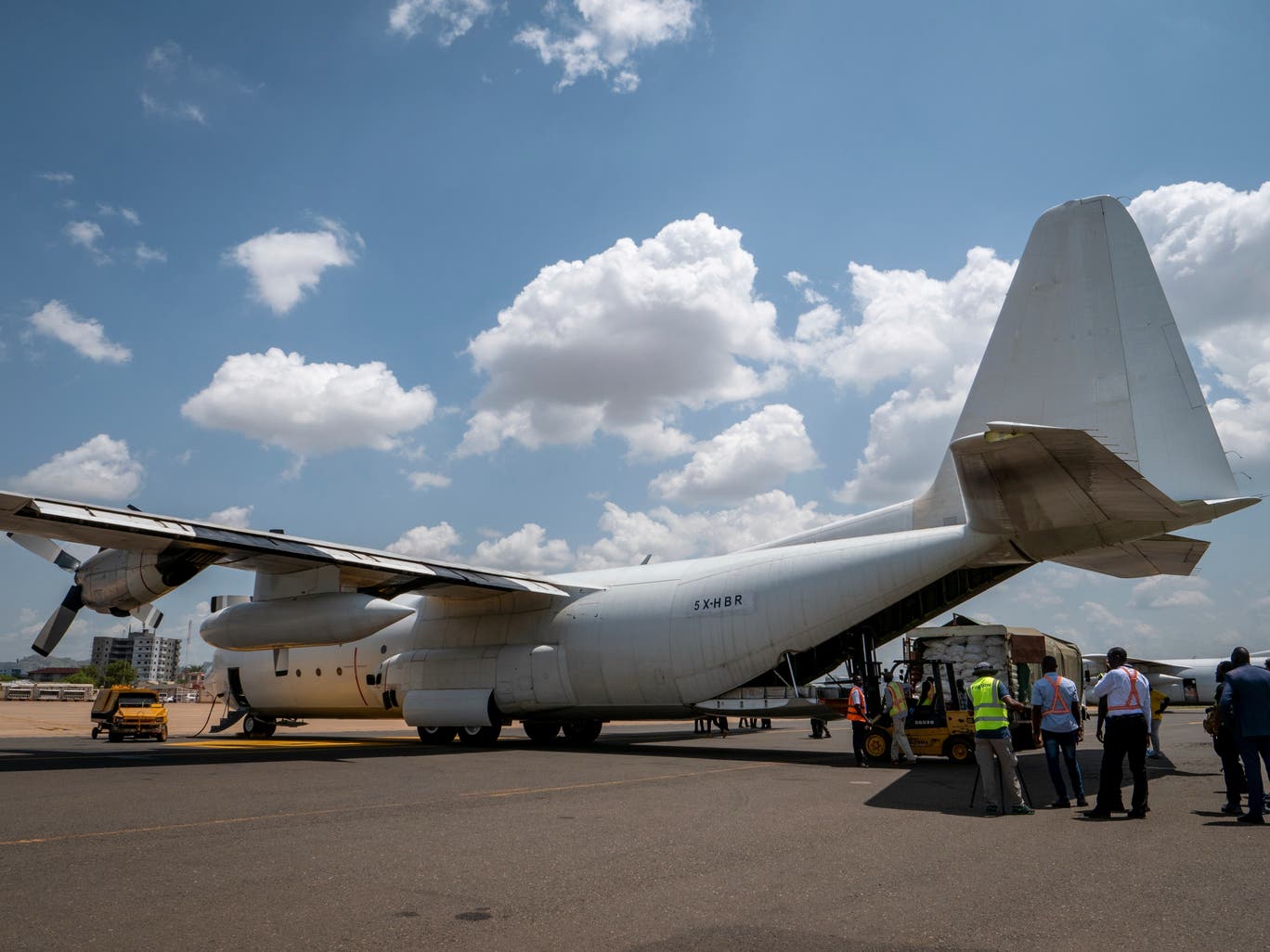
Swooping low over the banks of a Nile River tributary, an aid flight run by retired American military officers released a stream of food-stuffed sacks over a town emptied by fighting in South Sudan, a country wracked by conflict.
Last week's air drop was the latest in a controversial development — private contracting firms led by former U.S. intelligence officers and military veterans delivering aid to some of the world's deadliest conflict zones, in operations organized with governments that are combatants in the conflicts.
The moves are roiling the global aid community, which warns of a more militarized, politicized and profit-seeking trend that could allow governments or combatants to use life-saving aid to control hungry civilian populations and advance war aims.
In South Sudan and Gaza, two for-profit U.S. companies led by American national security veterans are delivering aid in operations backed by the South Sudanese and Israeli governments.
The American contractors say they're putting their security, logistics and intelligence skills to work in relief operations. Fogbow, the U.S. company that carried out last week's air drops over South Sudan, says it aims to be a “humanitarian” force.
“We’ve worked for careers, collectively, in conflict zones. And we know how to essentially make very difficult situations work,” said Fogbow President Michael Mulroy, a retired CIA officer and former senior defense official in the first Trump administration, speaking on the airport tarmac in Juba, South Sudan's capital.
But the U.N. and many leading non-profit groups say U.S. contracting firms are stepping into aid distribution with little transparency or humanitarian experience, and, crucially, without commitment to humanitarian principles of neutrality and operational independence in war zones.
“What we’ve learned over the years of successes and failures is there’s a difference between a logistics operation and a security operation, and a humanitarian operation,” said Scott Paul, a director at Oxfam America.
“‘Truck and chuck’ doesn’t help people,” Paul said. “It puts people at risk.”
‘We don’t want to replace any entity’
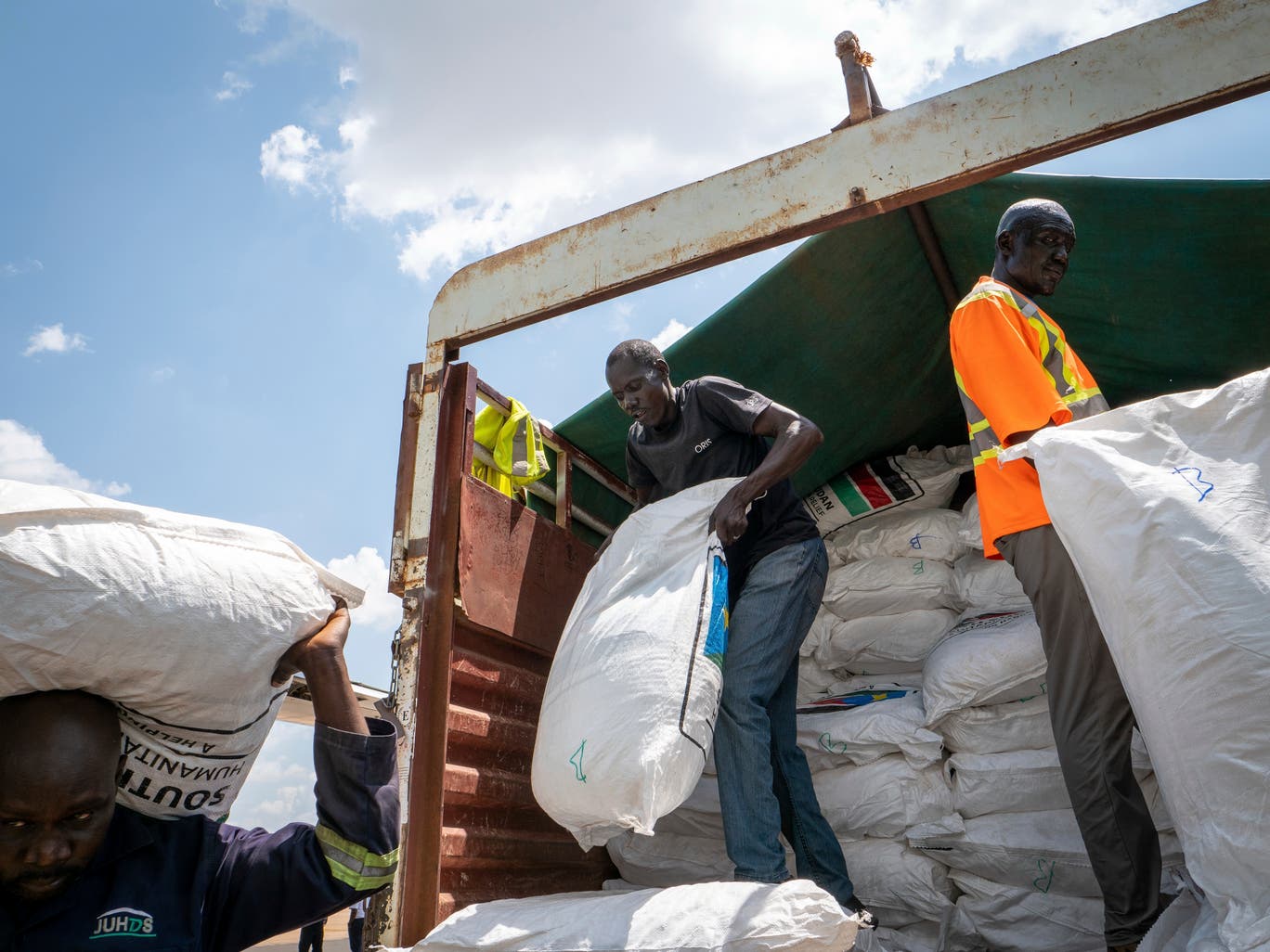
Fogbow took journalists up in a cargo plane to watch their team drop 16 tons of beans, corn and salt for South Sudan's Upper Nile state town of Nasir.
Residents fled homes there after fighting erupted in March between the government and opposition groups.
Mulroy acknowledged the controversy over Fogbow's aid drops, which he said were paid for by the South Sudanese government.
But, he maintained: “We don’t want to replace any entity” in aid work.
Shared roots in Gaza and U.S. intelligence
Fogbow was in the spotlight last year for its proposal to use barges to bring aid to Gaza, where Israeli restrictions were blocking overland deliveries. The United States focused instead on a U.S. military effort to land aid via a temporary pier.
Since then, Fogbow has carried out aid drops in Sudan and South Sudan, east African nations where wars have created some of the world's gravest humanitarian crises.
Fogbow says ex-humanitarian officials are also involved, including former U.N. World Food Program head David Beasley, who is a senior adviser.
Operating in Gaza, meanwhile, Safe Reach Solutions, led by a former CIA officer and other retired U.S. security officers, has partnered with the Gaza Humanitarian Foundation, a U.S.-backed nonprofit that Israel says is the linchpin of a new aid system to wrest control from the U.N., which Israel says has been infiltrated by Hamas, and other humanitarian groups.
Starting in late May, the American-led operation in Gaza has distributed food at fixed sites in southern Gaza, in line with Prime Minister Benjamin Netanyahu's stated plan to use aid to concentrate the territory's more than 2 million people in the south, freeing Israel to fight Hamas elsewhere. Aid workers fear it's a step toward another of Netanyahu’s public goals, removing Palestinians from Gaza in “voluntary” migrations.
Since then, several hundred Palestinians have been killed and hundreds more wounded in near daily shootings as they tried to reach aid sites, according to Gaza's Health Ministry. Witnesses say Israeli troops regularly fire heavy barrages toward the crowds in an attempt to control them.
The Israeli military has denied firing on civilians. It says it fired warning shots in several instances, and fired directly at a few “suspects” who ignored warnings and approached its forces.
It’s unclear who is funding the new operation in Gaza. No donor has come forward, and the U.S. says it’s not funding it.
In response to criticism over its Gaza aid deliveries, Safe Reach Solutions said it has former aid workers on its team with “decades of experience in the world’s most complex environments” who bring "expertise to the table, along with logisticians and other experts.“
South Sudan's people ask: Who's getting our aid drops?
Last week's air drop over South Sudan went without incident, despite fighting nearby. A white cross marked the drop zone. Only a few people could be seen. Fogbow contractors said there were more newly returned townspeople on previous drops.
Fogbow acknowledges glitches in mastering aid drops, including one last year in Sudan’s South Kordofan region that ended up with too-thinly-wrapped grain sacks split open on the ground.
After gaining independence from Sudan in 2011, South Sudan has struggled to emerge from a civil war that killed nearly 400,000 people. Rights groups say its government is one of the world’s most corrupt, and until now has invested little in quelling the dire humanitarian crisis.
South Sudan said it engaged Fogbow for air drops partly because of the Trump administration’s deep cuts in U.S. Agency for International Development funding. Humanitarian Minister Albino Akol Atak said the drops will expand to help people in need throughout the country.
But two South Sudanese groups question the government's motives.
“We don’t want to see a humanitarian space being abused by military actors ... under the cover of a food drop," said Edmund Yakani, head of the Community Empowerment for Progress Organization, a local civil society group.
Asked about suspicions the aid drops were helping South Sudan's military aims, Fogbow's Mulroy said the group has worked with the U.N. World Food Program to make sure “this aid is going to civilians.”
“If it wasn't going to civilians, we would hope that we would get that feedback, and we would cease and desist,” Mulroy said.
In a statement, WFP country director Mary-Ellen McGroarty said: “WFP is not involved in the planning, targeting or distribution of food air-dropped” by Fogbow on behalf of South Sudan's government, citing humanitarian principles.
A ‘business-driven model’
Longtime humanitarian leaders and analysts are troubled by what they see as a teaming up of warring governments and for-profit contractors in aid distribution.
When one side in a conflict decides where and how aid is handed out, and who gets it, “it will always result in some communities getting preferential treatment,” said Jan Egeland, executive director of the Norwegian Refugee Council.
Sometimes, that set-up will advance strategic aims, as with Netanyahu's plans to move Gaza's civilians south, Egeland said.
The involvement of soldiers and security workers, he added, can make it too “intimidating” for some in need to even try to get aid.
Until now, Western donors always understood those risks, Egeland said. But pointing to the Trump administration's backing of the new aid system in Gaza, he asked: “Why does the U.S. ... want to support what they have resisted with every other war zone for two generations?”
Mark Millar, who has advised the U.N. and Britain on humanitarian matters in South Sudan and elsewhere, said involving private military contractors risks undermining the distinction between humanitarian assistance and armed conflict.
Private military contractors “have even less sympathy for a humanitarian perspective that complicates their business-driven model," he said. “And once let loose, they seem to be even less accountable.”
___
Knickmeyer reported from Washington. Mednick reported from Tel Aviv, Israel.
Source: https://www.independent.co.uk/news/south-sudan-gaza-israeli-africa-palestinians-b2772035.html
Newer articles:
- Bishop Carlassare: South Sudan needs the peace of the Gospel - 30/06/2025 18:35
- South Sudan Approves $9M Budget for National Fiber Optic Network Design - 30/06/2025 18:26
- Funding shortages threaten relief for millions of Sudanese refugees: WFP - 30/06/2025 18:15
- Escalating insecurity forces MSF to close Ulang hospital in South Sudan - 18/06/2025 11:49
- Let’s Embrace, Foster “collective spirit of the Synod on Synodality”: Cardinal in South Sudan to Pastoral Agents - 18/06/2025 11:45
Older news items
- South Sudan’s peace deal at risk of collapse without stronger regional action, warns UN Commission - 13/06/2025 16:40
- The UN has warned of a looming famine in South Sudan's Upper Nile region - 13/06/2025 16:29
- From Gaza to South Sudan, private firms deliver aid and face questions - 13/06/2025 16:26
- RSF seizes Libya-Sudan border zone - 13/06/2025 16:20
- Cholera outbreak in Sudan extends to six states - 13/06/2025 16:14
Latest news items (all categories):
- South Sudan Opens 14 Oil Blocks, Courts Investors Ahead of SSOP 2026 - 26/10/2026 15:08
- Jambojet Explores South Sudan Expansion After Talks with Juba Regulator - 26/10/2026 15:05
- Kiir swears in 5 officials ahead of South Sudan elections - 26/10/2026 14:53
- South Sudan cattle battles leaves 10 dead: official - 26/10/2026 14:49
- Churches urge world 'not to forget South Sudan' ahead of first elections - 26/10/2026 14:47
See also (all categories):
Random articles (all categories):
- Hon. Paul Mayom Akec on a monstrous campaign for Presidency - 06/12/2020 18:28
- The Latest: South Sudan happy with Trump's election victory - 09/11/2016 03:23
- All Gone, But She Needs Your Help Now - 21/03/2008 01:18
- Tanzanian PM wants EAC to heighten FEASSA Games - 19/09/2022 00:40
- South Sudan’s Ministry of Petroleum Encourages Refiners and Traders to Take Part in Upcoming Crude Tenders - 20/03/2019 12:02
Popular articles:
- Who is the darkest person in the world, according to Guinness World Record? - 25/10/2022 02:34 - Read 151298 times
- School exam results in South Sudan show decline - 01/04/2012 17:58 - Read 28390 times
- Top 10 weakest currency exchange rates in Africa in 2023 - 19/07/2023 00:24 - Read 25495 times
- No oil in troubled waters - 25/03/2014 15:02 - Read 24701 times
- NDSU student from South Sudan receives scholarship - In-Forum - 29/09/2012 01:44 - Read 22676 times
