
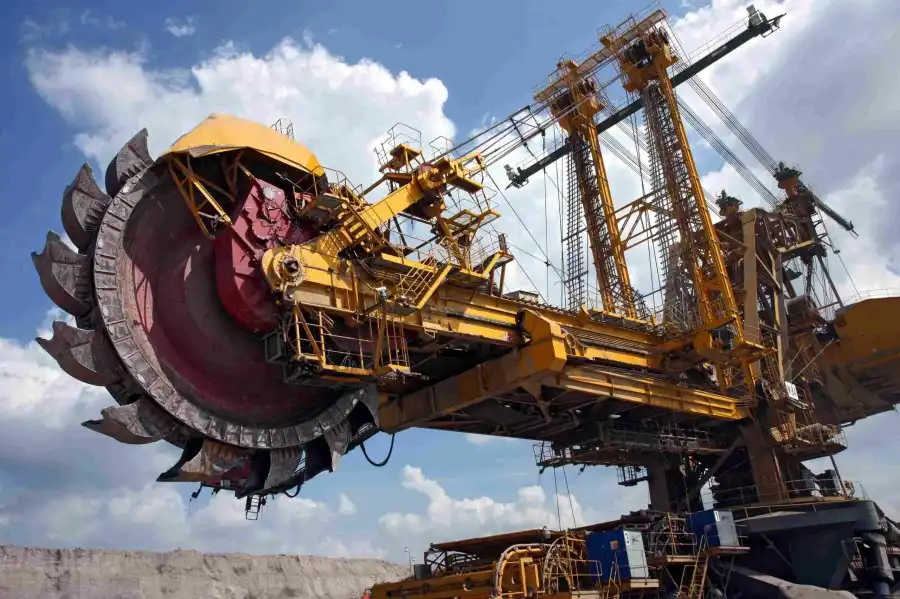
Bucket wheel excavator (Shutterstock)
South Sudan wants to reduce its dependence on oil by developing its mining sector. Yet in a country still shaped by conflict, fragile institutions, and environmental vulnerability, a rush for gold, rare earths, and other minerals could create a new set of problems unless communities, ecosystems, and governance are placed at the center of development.
For most of its short existence as an independent state, South Sudan has relied overwhelmingly on oil. That dependence has become increasingly precarious. According to the IMF, oil generates nearly 90 percent of government revenue and accounts for roughly 95 percent of exports, leaving the country acutely vulnerable to pipeline disruptions, conflict in neighboring Sudan, and fluctuations in global energy markets.
The World Bank has issued similar warnings. Disruptions to oil production since early 2024 have sharply reduced export revenues—by an estimated $7 million per day—placing enormous strain on public finances and limiting the government’s ability to fund basic services. Against that backdrop, mining is increasingly being promoted as a possible economic lifeline.
South Sudan is believed to possess significant deposits of gold, copper, iron ore, and other minerals. The Ministry of Mining has actively marketed the sector to investors, highlighting the Mining Act of 2012, a maximum statutory tax rate of 20 percent, and a legal framework that allows the government to take an optional equity stake of up to 15 percent in large-scale mining projects.
Yet a workshop held this month at the University of Juba highlighted a dilemma that extends far beyond economics. While minerals could help diversify South Sudan’s economy, participants argued that weak safeguards could just as easily deepen displacement, fuel conflict, and accelerate environmental degradation.
That warning emerged during a one-day workshop on community benefits and awareness in mining, organized by African Parks in partnership with the Ministry of Wildlife Conservation and Tourism. The gathering brought together government officials, academics, conservationists, and other stakeholders, many of whom stressed that South Sudan’s emerging mining industry must avoid repeating the mistakes associated with oil.
The argument for diversification is compelling. South Sudan’s dependence on petroleum has repeatedly exposed the country to external shocks. The IMF reported in 2024 that delays in repairing the oil pipeline through Sudan had reduced exports to roughly one-third of previous levels, placing severe pressure on both the national budget and foreign-exchange earnings. The World Bank estimated that production disruptions were costing the country around $7 million each day in lost export revenues.
In that context, mining holds obvious appeal. Gold is already mined informally in several parts of the country, while global demand for rare earth elements and other critical minerals has intensified as governments and industries race to secure supplies needed for new technologies and energy transitions. South Sudan’s Ministry of Mining has sought to position the country as an underexplored frontier for investors, emphasizing its legal framework and comparatively low-tax environment.
But the sector remains young, opaque, and poorly documented. A 2023 report by The Sentry warned that “unimplemented accountability and oversight mechanisms prevail in South Sudan’s mining sector,” noting that artisanal mining remains largely informal despite the existence of a legal framework.
That disconnect between legal ambition and institutional capacity may represent the greatest risk facing the sector. Speaking at the University of Juba workshop, Professor Alikaya Aligo Samson, dean of the School of Architecture, Land Management and Urban and Regional Planning, argued that natural resources can support development only when communities and ecosystems are adequately protected.
“Development must not come at the expense of people and the environment,” Samson said, warning that poorly regulated mining could result in environmental degradation, displacement, loss of livelihoods, and damage to wildlife habitats.
His concerns go to the heart of South Sudan’s broader challenge. Mining can generate revenue, infrastructure, and employment. Yet in fragile states it can also intensify disputes over land, encourage elite capture, and create deep grievances when local communities see little benefit from the wealth extracted around them.
Samson argued that communities living in mining areas should be treated as stakeholders rather than obstacles to development. Their land rights, livelihoods, and access to natural resources, he said, must be protected before large-scale extraction expands.
The environmental stakes are particularly high. South Sudan is home to the Boma-Badingilo landscape, one of Africa’s most important wildlife ecosystems. African Parks, which co-manages Boma and Badingilo National Parks with the government, says the landscape supports approximately six million antelope in what it describes as the largest land mammal migration on Earth.
That ecosystem is more than a conservation success story. It is also a potential economic asset.
“Our wildlife is our new oil,” said Florington Aseervatham, African Parks’ South Sudan country representative, referring to the annual migration of millions of antelope across the Boma-Badingilo landscape.
The remark captures a larger debate about South Sudan’s future. Oil has generated revenue, but it has also left the country vulnerable to corruption, conflict, and dependence on fragile infrastructure. Wildlife tourism, if properly protected and developed, could offer a more sustainable source of income while raising South Sudan’s international profile.
Mining expansion could complicate that vision. UNEP’s first State of Environment and Outlook report for South Sudan warned that the absence of adequate environmental standards and guidelines for exploration and extraction had already contributed to pollution and environmental degradation. UNEP has repeatedly emphasized that extractive industries can contribute to development only when their social and environmental impacts are effectively managed.
Aseervatham urged mining companies to conduct environmental impact assessments and engage local communities before operations begin. His warning carries particular weight in a country where protected areas, migration corridors, and community lands frequently overlap with zones of economic interest.
If mining concessions are awarded without credible assessments, transparent licensing processes, and meaningful community consent, South Sudan risks creating new fault lines around land ownership and access to resources.
Ultimately, the central question is not whether South Sudan possesses valuable minerals. It is whether the country has the institutions capable of managing them responsibly.
Professor Isaac Cleto Rial, Deputy Vice Chancellor of the University of Juba, warned that weak legal frameworks and weak rule of law can discourage responsible investors while increasing risks across the extractive sector.
“The rapid and unprecedented expansion of mining could severely affect our economy, create social divisions and threaten ecological habitats,” Rial said in comments to Radio Tamazuj.
His concerns are reinforced by outside assessments. The Sentry has highlighted persistent weaknesses in transparency surrounding approvals, public payments, and community agreements. Meanwhile, a United States Institute of Peace report examining South Sudan’s postwar mining sector concluded that stronger governance, transparency, and conflict-sensitive regulation are essential if mining is to promote stability rather than exacerbate instability.
South Sudan is not starting from scratch. The Mining Act of 2012 was designed to encourage exploration and production consistent with sustainable development principles. The government has also introduced measures intended to improve transparency, including a mining cadastre portal designed to improve stakeholder communication and reduce opportunities for corruption.
Yet laws and digital platforms alone cannot substitute for effective enforcement.
Mining Minister Losuba Ludoru Wango acknowledged as much during the University of Juba workshop. “If mining is well managed, it can become a major driver of socioeconomic growth,” he said.
At the same time, Wango warned that weak oversight could lead to environmental degradation, displacement, insecurity, and the loss of livelihoods. He called for greater transparency, stronger consultation mechanisms, and a fair distribution of benefits.
“Let this workshop not end as a one-day conversation,” he said. “It should be the beginning of stronger collaboration, practical policy recommendations and sustained public awareness.”
That is the challenge now confronting South Sudan. The country has a rare opportunity to shape its mining sector before large-scale extraction becomes deeply entrenched. It can strengthen environmental regulations, require credible impact assessments, clarify land rights, publish licenses and payments, and ensure that communities benefit from projects developed on or near their land.
Or it can allow mining to follow the path that oil has often taken: high expectations, weak oversight, concentrated rewards, and widespread mistrust.
South Sudan undoubtedly needs new engines of growth. But minerals alone will not deliver development. In a fragile state, resource wealth can finance recovery just as easily as it can deepen instability. The outcome will depend on whether governance, transparency, and environmental protection are treated as the foundations of the sector rather than as obstacles standing in the way of investment.
If you're interested in writing for International Policy Digest - please send us an email via
Source: https://intpolicydigest.org/south-sudan-is-looking-beyond-oil-the-risks-are-familiar/
Newer articles:
- Rampant Junior Starlets crush South Sudan to clinch CECAFA bronze - 23/06/2026 15:26
- Validating Progress Towards Closing Immunity Gaps in South Sudan - 23/06/2026 15:23
- Vietnamese man deported from U.S. to South Sudan is repatriated after months in detention - 19/06/2026 17:11
- South Sudan Holds Joint Ministerial Meeting on EAC Infrastructure and ICT Projects - 19/06/2026 17:08
- Japan extends Self-Defense Forces deployment in South Sudan - 19/06/2026 17:04
Older news items
- UNHCR Calls to Expand Refugee Resettlement Lifeline as Part of Global Solutions Drive - 17/06/2026 13:48
- 46 former LRA returnees to undergo Acholi cultural cleansing rites - 17/06/2026 13:43
- 12th Chinese peacekeeping infantry battalion to South Sudan (Juba) completes armed patrol mission in Mongalla - 17/06/2026 13:40
- UNICEF South Sudan Flash Update External (Focus on Akobo), June 2026 - 17/06/2026 13:36
- South Sudan Approves SSP 11.3 Trillion Budget to Drive Food Security, Economic Diversification and Sustainable Peace - 15/06/2026 19:44
Latest news items (all categories):
- Op-Ed - Breaking the Double-Standard Lens on China's Population Shifts - 23/10/2026 14:23
- South Sudan ceasefire monitors warn of rising violence ahead of December elections - 23/10/2026 13:39
- UNMISS SRSG visits Malakal, emphasizes that peace begins with collective action - 23/10/2026 13:36
- How Technology is Accelerating South Sudan’s Next Oil Discovery - 23/10/2026 13:34
- South Sudan’s Patriot make case in their opener against Urunani - 23/10/2026 13:12
See also (all categories):
Random articles (all categories):
- Mr. Pagan Amum gives lecture in Nairobi University (Arabic) - 18/06/2007 12:10
- Israel keeps silent on mysterious Sudan airstrike - Wilkes Barre Times-Leader - 26/10/2012 18:51
- South Sudan: UN Relief Chief Sees ‘Terrible Situation’ - 07/02/2012 03:03
- منح إرتكاب الجريمة واجب على الكافة. - 09/01/2011 00:00
- Sudan's Bashir fights for survival as protests spread - 27/01/2019 03:57
Popular articles:
- Who is the darkest person in the world, according to Guinness World Record? - 25/10/2022 02:34 - Read 151205 times
- School exam results in South Sudan show decline - 01/04/2012 17:58 - Read 28345 times
- Top 10 weakest currency exchange rates in Africa in 2023 - 19/07/2023 00:24 - Read 25443 times
- No oil in troubled waters - 25/03/2014 15:02 - Read 24662 times
- NDSU student from South Sudan receives scholarship - In-Forum - 29/09/2012 01:44 - Read 22635 times
