
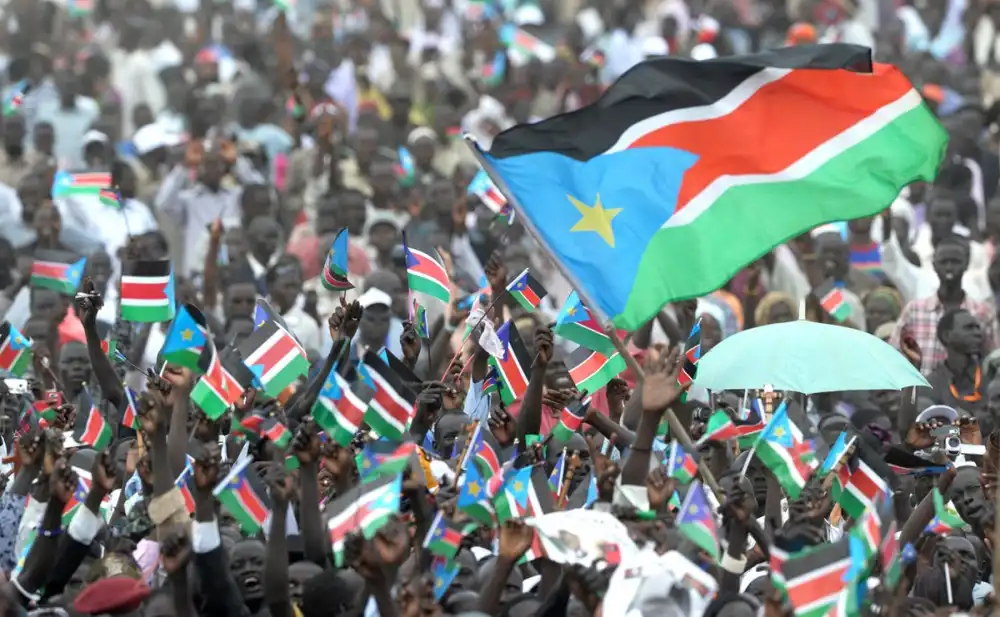
Thousands of South Sudanese wave the flag of their new country during a ceremony in the capital, Juba, on July 9, 2011 to celebrate South Sudan's independence from South Sudan (Photo Credit: Roberto SCHMIDT / GETTY)
By *Amaju Ubur Yalamoi Ayani
(Pachodo.org) - Since it attained independence in 2011, South Sudan has been known for one common thing: conflict everywhere and in any form. Just log into one of the social media platforms right now, and you will come across a disturbing digital warfare in South Sudan. Toxic exchanges, polarizing narratives, and inflammatory songs regularly trade between the youth of neighbouring communities. These localized online confrontations have been viral for many years, but have become intense for nearly two weeks. These are not isolated incidents of internet anger. Rather, they are the visible symptoms of a much deeper acrimony that is currently threatening the core foundation of our nation. When regional rivalries play out in the digital public square, they reveal how deeply communal identities have been weaponized in this country.
In fact, the Republic of South Sudan was built on the promise of shared liberation. Yet, its greatest threat now comes from within. A damaging trend in this scenario is the formal institutionalization of ethnic associations. What once served as cultural mechanisms for community solidarity are being converted into rigid political blocs. This shift is not a grassroot movement. It is a calculated strategy designed by South Sudanese political leaders who benefit directly from keeping the state fractured and citizens divided.
This institutionalization begins by dismantling the foundation of national citizenship. In a functional democratic state, for example, power and resources are negotiated through civic channels—political parties, civil society organizations, and local government. This is not the case in South Sudan. These institutions are normally bypassed in favour of formal ethnic blocs. When its institutions have been overshadowed by societal associations, the state ceases to belong to its people. It can easily be carved up into spheres of influence. Access to employment, security, and public services becomes tied to tribal affiliation rather than constitutional rights.
To understand the mechanics of this system, one must apply political scientist Alex de Waal’s foundational theory detailed in his celebrated book, “The Real Politics of the Horn of Africa: Money, War and the Business of Power”. To de Waal, South Sudan’s politics functions not through durable state institutions, but through a highly dollarized, monetized, and transactional bargaining system known as the “political marketplace”. Political power is entirely commodified: loyalty, public office, and state resources are bartered like commodities on a trading floor. In this volatile environment, ethnic associations have ceased to be cultural custodians. Instead, they operate as formal political enterprises—essentially, ethnic corporations. Elite political entrepreneurs weaponized communal identity to inflate their market value at the national bargaining table. By institutionalizing their ethnic groups, these brokers create captive constituencies, turning social identities into what de Waal terms as “moral populism” to push the central leadership into a corner. Their message to the state is simple: loyalty has a price, and it must be purchased through our corporate ethnic entity.
This transactional framework manifests itself directly in a highly strategic lobbying process for public sector recruitment, where appointments have degenerated into a toxic cycle of sycophancy, nepotism, and hyper-selective targeting. Competence, qualifications, and merit are frequently discarded. Government positions are distributed behind closed doors, dictated by the bargaining power of ethnic associations that aggressively hunt for lucrative ministries, revenue-collecting agencies, and well-funded commissions. These entities are targeted because they yield the hard currency and the resource needed to fund internal patronage networks. Meanwhile, vital but less lucrative public service sectors—such as public education, healthcare, and basic infrastructure—are completely overlooked. To feather their own nests, aspiring individuals no longer campaign on public policy or public service. They grease the palms of tribal elders and youth, and worship at the altar of these powerful patrons to secure an endorsement, ensuring that the state apparatus is staffed by well-connected loyalists who know exactly how to play the ethnic cards.
Once an appointment is successfully secured, the performance of these associations moves from backroom manipulation to public theatre, driven by extreme transactional expectations that inevitably collapse into a bizarre paradox of disappointment. The moment an official is named by a presidential decree or order, the association organizes lavish homecomings where crowds dance, beat drums, ululate, and welcome “their son” or “their daughter” as a conquering hero. Delegations of elders and youth line up to visit the new appointee’s residence and office to assert an unwritten ownership, expecting a complete ethnic monopoly on employment, contracts, and favours. However, if a principled official refuse to convert their office into a clan cash dispenser, the association turns on them with ferocity, labelling them as a traitor who failed to look after their own people.
A sharper contradiction occurs when that official is inevitably dismissed. The very same association that released formal letters of congratulations praising the appointing authority’s wisdom suddenly reacts with deep bitterness, labelling the routine firing as an existential attack on their ethnic group. By validating the authority when they gain a seat but demonizing it when they lose it, these associations reveal that their loyalty is purely opportunistic.
Consequently, this rot trickles down to affect the younger generation, who face immense pressure to rely on ethnic connections to find work. A traditional proverb reminds us, “A single finger cannot wash a face”, highlighting the importance of communal unity. For today’s youth, the concept has been altered into a mandate for survival: if you do not join your institutionalized ethnic fist, you will be crushed alone. Rather than entering a job market built on merit, young graduates find themselves trapped in a competitive sycophancy to secure entry-level employment. This creates widespread disillusionment among young people, who quickly learn that their background matters far more than their qualifications.
Ironically, citizens comply with this system due to a major fallacy: the belief that turning ethnic identity into a formal institution serves as a necessary shield for collective defence. In reality, retreating into tribal silos does not offer safety; it creates deeper insecurity. For example, when communities formalize their ethnic associations into political shields, they naturally increase regional tensions. Long-term security relies on predictable civil laws, professional police forces, and impartial judiciaries. When these institutions are replaced by ethnic factions, communities are pushed into a permanent competition for state dominance. This creates a zero-sum environment where one group’s perceived security is viewed as an existential threat by its neighbour. Equally, this defensive mentality leaves ordinary citizens exposed to exploitation from within their own groups. For instance, political elites benefit from keeping their communities dependent so that they can continue to act as indispensable gatekeepers. By trusting these ethnic institutions for protection, citizens inadvertently sustain the system that keeps them vulnerable.
This fragmentation directly contradicts the foundational ideology of our liberation struggle. Dr. John Garang de Mabior’s “New Sudan Vision” was explicitly built on the idea of a democratic, secular, modern and egalitarian state in which all citizens are equal stakeholders in the affairs of their country. John Garang envisioned a country that transcended ethnic, religious, and regional divisions. His vision focused on the civic empowerment of all citizens—reflected in his principle of “taking towns to the people” in the countryside—rather than dividing people into ethnic enclaves. He warned that a nation built on narrow ethnicity would inevitably face internal collapse. By transforming ethnic groups into political institutions, current elites have inverted Garang’s philosophy, bringing ethnic divisions into urban centres and using them to weaken state institutions.
The primary casualty of this systemic failure remains the individual South Sudanese citizen. Institutionalized ethnicity builds invisible barriers across the country. It signals to a young graduate in a regional hub, for example, that they have no future in the capital, or a trader that they are an outsider outside their ancestral land. This reduces a person’s identity to a single-sanctioned ethnic label. It forces individuals to seek protection from clan elders rather than the rule of law, stalling the growth of an independent civil society.
If South Sudan is to survive as a unified state, this trend must be urgently reversed. Alex de Waal warns that when a political marketplace experiences a cash crunch or a “bear market,” the price of loyalty becomes unmanageable, pushing political entrepreneurs to retreat to extreme sectarian positions, risking complete state meltdown. To avoid this collective destruction, the government must decline to recognize or register associations that use ethnicity as a criterion for political representation or resource allocation. Legitimate cultural preservation belongs in the private and community sphere, completely separate from state machinery and political financing.
Formal ethnic cartels must be dismantled before they permanently harden into internal borders. South Sudan cannot afford to be a collection of separate corporate entities competing for survival in a transactional market. It must be a republic of equal citizens, as originally intended. The politics of exclusion enriches only the brokers who pull the strings. True stability will only be achieved by moving away from the political marketplace and build a nation based on merit, civic duty, and collective prosperity.
About the writer

*Amaju Ubur Yalamoi Ayani is a South Sudanese teacher, researcher, and political commentator. He writes extensively on governance, institutional reform, social cohesion in South Sudan, and international affairs. He can be reached via
Newer articles:
- (INTERNAL MEMO) - The SPLM/A-IO Belongs To The People, Not To Brokers - 15/06/2026 19:58
- Saad Kassis-Mohamed Center Commits 100,000 Litres to Restore the Nile at Khartoum - 15/06/2026 19:55
- SCO at 25: Expanding beyond security into sustainable development - 10/06/2026 19:32
- Shelter Afrique Development Bank Unveils New Brand Identity as it Marks 45th Anniversary - 10/06/2026 19:23
- INTERNAL MEMO - Appeal For Unity And Renewal Within The SPLM/A-IO - 08/06/2026 23:12
Older news items
- Breaking The Evil Political Dominance - 08/06/2026 16:09
- African Professional Summit 2026 to Convene Leaders, Innovators, and Change-Makers in Lagos - 08/06/2026 16:05
- Why Media Literacy Should Become Our Newest National Defence - 29/05/2026 15:49
- The Body Remembers: Behind the Making of Bathing — How interviews with home-bathing specialists shaped an audio drama about aging, dignity, and care in China - 25/05/2026 14:12
- Constitutionalism Cannot Survive Selective Implementation: The Crisis Within the SPLM - 22/05/2026 23:03
Latest news items (all categories):
- China’s new Long March: Why its modernization is a demanding journey - 21/10/2026 12:31
- Drone attack in disputed Sudan-South Sudan border region kills at least 153 - 21/10/2026 12:17
- South Korea - 'Smart camp' system built at Hanbit Unit in South Sudan - 21/10/2026 12:09
- Sudanese refugees in Gorom camp, South Sudan, struggle for water, medicines, security - 21/10/2026 12:05
- South Sudan: A Testing Ground For Democracy While Citizens Struggle To Survive - 19/10/2026 14:31
See also (all categories):
Random articles (all categories):
- After Clashes in South Sudan, Conflict Over the Vice Presidency - 25/07/2016 12:50
- South Sudan to change time zone next month - 15/01/2021 12:21
- Afcon 2023: Sao Tome, Lesotho, Eswatini and South Sudan reach group phase of qualifying - 28/03/2022 01:58
- President Kiir wants to pull the wool over the people’s eyes. - 15/10/2013 21:12
- World Bank projects South Sudan economy to shrink in 2022 - 16/06/2022 09:38
Popular articles:
- The Final Communique of SPLM-DC Third Session of the National Council - 29/03/2011 01:00 - Read 83328 times
- Roles and Definition of Political Parties - 29/04/2011 01:00 - Read 65092 times
- Agriculture in Southern Sudan: Challenges and Investment Opportunities - 06/10/2010 01:45 - Read 57808 times
- Fashoda Youth Forum Rehabilitation of Drainage Culverts in Malakal town Report - 07/08/2008 16:22 - Read 36089 times
- Creation and establishment of the Local Government Councils ( Counties ) (2) - 28/09/2011 01:00 - Read 33969 times
