
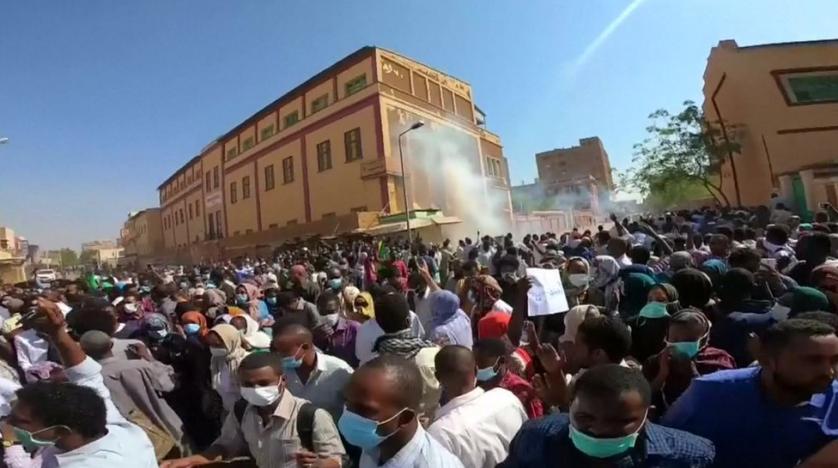
Torture, killing of peaceful protestors, and imposition of a State of Emergency should be major red flags for multinational company investments
February 27, 2019 (Washington, D.C.) – In response to widespread peaceful protests across the country, on Friday, February 21, Sudanese President Omar al-Bashir imposed a year-long State of Emergency, dissolving the federal and state governments and replacing state governors with military generals. As the Sudanese people rise up and speak out against decades of massive corruption, economic mismanagement, human rights abuses, and mass atrocities, the Bashir regime has responded with a brutal crackdown, including the torture and killing of peaceful protestors.
In the context of the government’s violent and unwarranted attacks on its own people, The Enough Project expresses its deep concern about two recent meetings involving the U.S. government related to American investment in Sudan. In Addis Ababa, the Sudanese Foreign Minister was invited to participate in the U.S.-Africa Forum on Trade and Investment on February 12. In Khartoum, the Chargé d’affaires of the U.S. Embassy in Sudan hosted a meeting on Thursday Feb. 7th with a U.S. business representative from Baker Hughes, an oil field services company majority owned by General Electric to discuss investment opportunities in Sudan in the energy, mining, and infrastructure sectors.
John Prendergast, Founding Director of the Enough Project and Co-Founder of The Sentry, commented, “The United States has a unique role to play in support of a peaceful transition away from thirty years of dictatorship and grand corruption in Sudan. At a moment when mass protests are demanding change, it is unfortunate that the U.S. is contributing to a public perception that investment in oil, mining, and other sectors in Sudan is appropriate, which would only reinforce the kleptocratic system and not benefit the Sudanese people. Instead of highlighting that Sudan offers ‘U.S. investment opportunities in energy, mining, and infrastructure sectors,’ a policy response addressing the government’s deep-seated corruption and its brutal crackdowns should be the focus for any U.S. engagement with the regime. It is extremely problematic to be encouraging investment in a country where a thirty-year dictatorship is being challenged by large, peaceful protests throughout the country, and while that regime is killing, arresting, and torturing those protesters. U.S. embassy officials certainly must do their jobs and meet with Americans and American businesses who come through Khartoum, but we believe investments that would reinforce the kleptocratic dictatorship would be counter-productive and should be strongly discouraged. Furthermore, Baker Hughes and its parent company General Electric should understand the negative impact of any planned investment in these strategic sectors at this critical moment. Within numerous mandatory and voluntary frameworks which the United States supports, U.S. businesses are expected to implement due diligence and transparency measures to ensure their operations do not violate internationally-recognized human rights standards.”
Suliman Baldo, Senior Advisor to the Enough Project noted, “The regime’s use of excessive force and daily torture of hundreds of detainees as well as the sexual harassment and beatings of female detainees by security agents must qualify as a serious breach of the commitments the regime undertook in accepting the six track engagement roadmap with the U.S. aimed at removing Sudan from the State Sponsors of Terror List. Forging ahead with the process as bilaterally agreed to last November strengthens the hands of Sudan’s kleptocratic dictatorship against its own people. The United States should stand firmly on the side of Sudan’s peaceful protesters.”
As argued in a previous Enough Project report, while private sector investment in Sudan will be vital to long-term economic stability in the country, any investment should only be conducted in partnership with the Sudanese people and when adherence to due diligence and transparency frameworks can be clearly demonstrated and closely monitored.
For media inquiries or interview requests, please contact please contact: Megha Swamy at
About THE ENOUGH PROJECT
The Enough Project supports peace and an end to mass atrocities in Africa’s deadliest conflict zones. Together with its investigative initiative The Sentry, Enough counters armed groups, violent kleptocratic regimes, and their commercial partners that are sustained and enriched by corruption, criminal activity, and the trafficking of natural resources. By helping to create consequences for the major perpetrators and facilitators of atrocities and corruption, Enough seeks to build leverage in support of peace and good governance. Enough conducts research in conflict zones, engages governments and the private sector on potential policy solutions, and mobilizes public campaigns focused on peace, human rights, and breaking the links between war and illicit profit. Learn more – and join us – at www.EnoughProject.org.
Newer articles:
- Juba University Tuition Fees Increment: the implementation of Dr. Adwok Nyaba's policy of "university for rich people's children" - 20/03/2019 22:04
- New Report Warns of Six Corruption Threats to Peace in South Sudan - 20/03/2019 21:52
- The ongoing deadly corruption at the ministry of finance and economic planning - 13/03/2019 11:25
- The Truth hurts; but it has to be said - 03/03/2019 08:31
- An open letter to the Chairperson of South Sudan Relief Rehabilitation Commission - Appeal for the withdrawal of registration certificate from Twic Mayardit Intellectual Forum - 02/03/2019 17:52
Older news items
- Twic Mayardit Intellectual Forum is a sectional political organization, not a NGO - 26/02/2019 20:31
- The alliance of destruction - 23/02/2019 09:55
- "Hijacked State": Report Charts Structure of South Sudan’s Violent Kleptocracy - 13/02/2019 17:32
- Sudan Statement: U.S. Should Suspend Normalization Talks, Impose Global Magnitsky Sanctions - 07/02/2019 13:12
- South Sudan’s independence was not achieved through the struggle of one man (Salva Kiir), a rebuttal to Peter Mayuk - 05/02/2019 15:36
Latest news items (all categories):
- South Sudan Opens 14 Oil Blocks, Courts Investors Ahead of SSOP 2026 - 26/10/2026 15:08
- Jambojet Explores South Sudan Expansion After Talks with Juba Regulator - 26/10/2026 15:05
- Kiir swears in 5 officials ahead of South Sudan elections - 26/10/2026 14:53
- South Sudan cattle battles leaves 10 dead: official - 26/10/2026 14:49
- Churches urge world 'not to forget South Sudan' ahead of first elections - 26/10/2026 14:47
Random articles (all categories):
- South Sudan warring parties agree to postpone forming unity government committed to peace deal - 04/05/2019 04:42
- Runner begs for cash to fly S.Sudan flag at Olympics - 21/11/2014 11:11
- Pagan Amum says Sudan "on brink" of north-south war - 27/05/2008 11:16
- International Crisis Group: A Trial for South Sudan’s Frail Peace - 03/12/2025 18:55
- South Sudan: Hold SPLA Accountable for Civilian Abuses in Jonglei - HRW - 13/09/2013 03:00
Popular articles:
- The Final Communique of SPLM-DC Third Session of the National Council - 29/03/2011 01:00 - Read 83356 times
- Roles and Definition of Political Parties - 29/04/2011 01:00 - Read 65126 times
- Agriculture in Southern Sudan: Challenges and Investment Opportunities - 06/10/2010 01:45 - Read 57847 times
- Fashoda Youth Forum Rehabilitation of Drainage Culverts in Malakal town Report - 07/08/2008 16:22 - Read 36113 times
- Creation and establishment of the Local Government Councils ( Counties ) (2) - 28/09/2011 01:00 - Read 34014 times
