
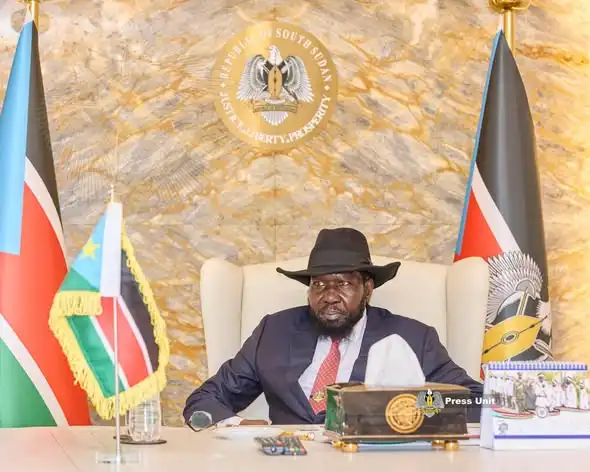
President Salva Kiir (Photo Credit: Pan African Visions / Press Unit / Facebook)
By Trevor Ng’ulia*
When South Sudan raised its flag on 9 July 2011, the atmosphere in Juba was one of jubilant defiance. After decades of civil war, the world’s youngest nation was born with immense hope, vast oil reserves, and international goodwill, poised for a prosperous future. Yet, fifteen years later, that promise has been tragically replaced by a staggering ledger of loss. While the tragedy of South Sudan is often framed by humanitarian statistics—millions displaced, millions hungrier—a more profound figure demands our attention: $158 billion. This is the estimated economic cost of two decades of conflict, a sum so vast it represents not merely lost GDP, but a catastrophic theft of a nation’s potential.
While 70 percent of the population subsists on the thin gruel of international aid, the country’s elite has presided over the systematic liquidation of its national wealth. The central question for the international community and the South Sudanese people is no longer how to merely manage the next cycle of crisis, but how to reclaim a peace dividend that has been so ruthlessly squandered.
The financial toll of South Sudan’s failure is a vortex of diverted revenues and external dependency. Since independence, the international community has poured an estimated $15 billion to $20 billion in humanitarian assistance into the country, with the United States alone contributing nearly $7.3 billion. However, this colossal investment has become a life-support system for a failed state rather than a catalyst for genuine development. In a perverse dynamic, humanitarian aid has inadvertently acted as a subsidy for the ruling class. By providing the basic services that the government has abdicated—healthcare, food, and education—international organisations have effectively freed up state resources for the elite’s true priorities: military expansion and self-enrichment.
These priorities are starkly reflected in a national budget that reads like a declaration of war against its own people. In 2023, South Sudan’s military spending skyrocketed by 106 percent to over $1.08 billion. This expenditure now consumes more than 6 percent of the nation’s GDP—more than double the regional average. This capital could have bridged the $879 million annual infrastructure gap identified by the World Bank over a decade ago, a deficit that has now ballooned into a cumulative $12 billion obstacle to any meaningful economic growth.
Compounding this tragedy is the “systematic looting” described by United Nations investigators. Since 2011, an estimated $8.6 billion has vanished into illicit financial flows and corruption. This is the nation’s peace dividend, stolen and funnelled into private offshore accounts and the maintenance of a sprawling security apparatus designed to protect the powerful from the powerless.
The concept of a “peace dividend” is often treated as an abstract hope, but for South Sudan, it is a quantifiable roadmap to recovery. If the government were to simply reduce its military spending to the regional average of 3 percent of GDP, it would unlock over $560 million annually. Over a decade, that reprioritisation alone would create a $5.6 billion development fund—a tangible investment in its future.
To put these numbers in perspective, the $1.08 billion spent on the military in 2023 could have fully funded the country’s entire annual national infrastructure plan, with nearly $200 million left over for schools and hospitals. Instead of trucking in food aid, the country could have invested in its immense agricultural potential to achieve food sovereignty. Instead of funding refugee camps, it could have built permanent homes and a national road network. Over the next decade, a stable and accountable South Sudan could unlock a dividend worth between $60 billion and $95 billion. This is the stark difference between a failed state and a rising African power.
Why, then, does this dividend remain unclaimed? The answer lies in a political system meticulously designed to profit from instability. The 2018 peace agreement (R-ARCSS) has largely failed to deliver meaningful change because it remains an elite bargain—a mechanism for managing competition over resources rather than a genuine blueprint for nation-building. Key provisions regarding financial transparency, security sector reform, and transitional justice are perpetually stalled, as the leadership exploits the “aid trap” to maintain the status quo.
Unlocking South Sudan’s future requires a radical shift in strategy from both within and without. The international community must move beyond the “humanitarian-only” mindset and embrace a policy of rigorous conditionality. All non-essential aid, debt relief, and diplomatic engagement must be explicitly tied to measurable progress on the peace agreement. This must include the transparent management of oil revenues and a verifiable downsizing of the military.
Furthermore, accountability for economic crimes must be moved to the absolute centre of the diplomatic agenda. The establishment of the Hybrid Court for South Sudan—a key component of the peace deal that has been deliberately ignored by the Juba elite—is non-negotiable. Prosecuting high-level corruption is not a distraction from the peace process; it is, in fact, a fundamental prerequisite for it. There can be no lasting peace without the end of impunity.
Finally, the focus must decisively shift from aid to investment. International partners should work to create a transparent framework for investing the peace dividend into the fundamental building blocks of a diversified economy: infrastructure, agriculture, and education.
South Sudan stands at a critical crossroads. One path leads further into the $158 billion abyss of state failure and human misery. The other leads toward a future where the nation’s wealth is used to serve its people rather than its generals. The peace dividend is not a gift to be granted by the international community; it is a profound choice to be made by South Sudan’s leaders. It is a choice that has been deferred for fifteen years, and it is a choice that the world can no longer afford to let them ignore.
*Trevor Ng’ulia is an international development worker and commentator on African affairs
Newer articles:
- In maps and charts: South Sudan’s 15 years of independence - 10/07/2026 21:18
- South Sudan civil society warns AU elections could fuel instability - 10/07/2026 21:11
- El-Obeid: Brave witness of the Sudanese Church in a city under siege - 10/07/2026 21:07
- WFP triggers historic anticipatory action plan to shield people from severe drought impact in South Sudan - 10/07/2026 21:06
- South Sudan: Fifteen years of independence marred by war - 08/07/2026 18:50
Older news items
- Kenya demands answers over citizen held under house arrest in South Sudan for 8 months - 08/07/2026 18:43
- South Sudan at 15: Political elite profiting from peace as well as war - 08/07/2026 18:40
- South Sudan eases oil dispute with BB Energy, awards 3 crude cargoes to restore access to crude financing - 08/07/2026 18:35
- New inter-communal violence in Warrap State: 19 killed and 14 injured - 08/07/2026 18:32
- Conflict pushes South Sudan's healthcare system to breaking point - 08/07/2026 18:28
Latest news items (all categories):
- China’s new Long March: Why its modernization is a demanding journey - 21/10/2026 12:31
- Drone attack in disputed Sudan-South Sudan border region kills at least 153 - 21/10/2026 12:17
- South Korea - 'Smart camp' system built at Hanbit Unit in South Sudan - 21/10/2026 12:09
- Sudanese refugees in Gorom camp, South Sudan, struggle for water, medicines, security - 21/10/2026 12:05
- South Sudan: A Testing Ground For Democracy While Citizens Struggle To Survive - 19/10/2026 14:31
See also (all categories):
Random articles (all categories):
- Sudan devalues currency by 30 percent amid dollar shortages - 11/11/2013 15:26
- South Sudan army battles rebels in key oil town - 13/03/2014 00:30
- South Sudan: Surgical services expanded in Jonglei state - 02/08/2013 05:36
- South Sudan rebels wary of truce - 27/12/2013 23:18
- South Sudan authorities holding 42 Ugandan farmers - 29/06/2021 07:00
Popular articles:
- Who is the darkest person in the world, according to Guinness World Record? - 25/10/2022 02:34 - Read 151140 times
- School exam results in South Sudan show decline - 01/04/2012 17:58 - Read 28320 times
- Top 10 weakest currency exchange rates in Africa in 2023 - 19/07/2023 00:24 - Read 25411 times
- No oil in troubled waters - 25/03/2014 15:02 - Read 24638 times
- NDSU student from South Sudan receives scholarship - In-Forum - 29/09/2012 01:44 - Read 22609 times
