
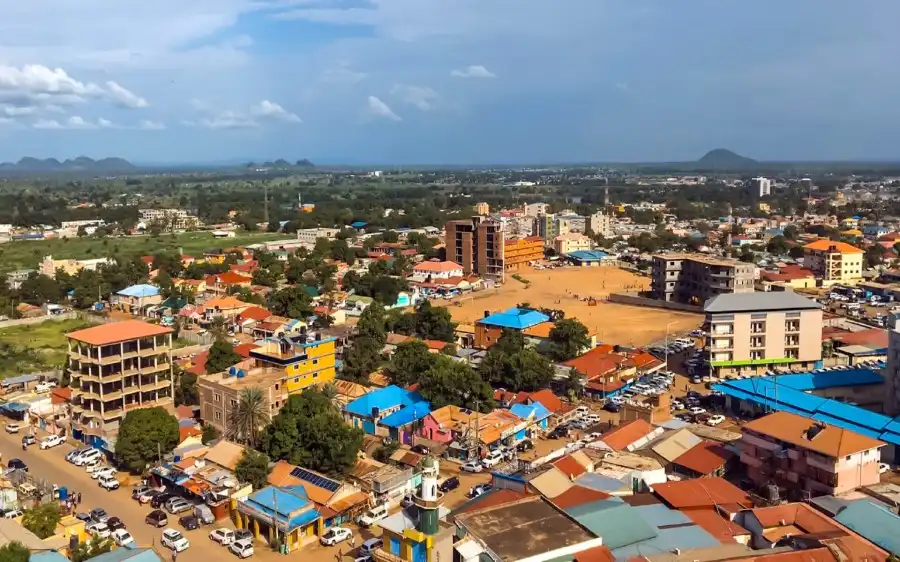
Juba City - South Sudan (File Image)
The World Bank Group and the Government of South Sudan have launched a new Urbanisation Review urging urgent and coordinated action to manage rapid urban growth and turn it into a driver of recovery, resilience and inclusive development.
The report highlights that while South Sudan remains one of the least urbanised countries globally, with only about one-fifth of its population living in urban areas, city populations are expanding quickly. Urban populations have grown from 1.7 million to 2.6 million since 2011, largely driven by displacement, climate pressures and economic factors. Much of this growth has been unplanned, placing pressure on already limited infrastructure, basic services and institutional capacity.
Officials say that, if properly managed, urbanisation could play a key role in stabilising the country and supporting economic transformation. Vice President and Chairperson of the Economic Cluster, Dr James Wani Igga said the government recognises the importance of cities in driving recovery and development. Igga said improving urban management and strengthening service delivery would be central to achieving more inclusive growth.
World Bank Group Country Manager Charles Undeland said South Sudan’s urban transition presents a major opportunity to create jobs, strengthen resilience and improve living conditions. Undeland said coordinated policies, stronger planning and targeted investments are needed to ensure cities can support economic growth and deliver tangible benefits for citizens.
The report outlines a series of priority reforms, including expanding access to essential services such as water, sanitation, drainage, roads and public lighting, particularly in underserved areas. It also emphasises the importance of using urban investments to generate jobs through markets, transport corridors and labour-intensive public works.
Improving land governance and urban planning is identified as another key area, with recommendations to address land disputes, improve transparency and support more structured urban expansion.
Strengthening data systems to guide planning and investment decisions is also highlighted as critical.
The report further stresses the need to build institutional capacity at both national and local levels to manage urban growth effectively.
The findings suggest that with the right policies and sustained investment, South Sudan’s cities could become central to recovery efforts, helping to create jobs, improve services and support long-term stability.
Newer articles:
- Two men convicted in UK of trying to send weapons to conflict zones, including South Sudan - 12/06/2026 12:36
- Vietnamese Field Hospital in South Sudan proactively enhances Ebola response capacity - 12/06/2026 12:31
- Conflict, hunger push South Sudan families to eat leaves to stay alive - 10/06/2026 12:41
- Somali referee returns home to hero’s welcome after World Cup heartbreak - 10/06/2026 12:38
- Belfast’s Sudanese community hunkers down after grisly attack - 10/06/2026 12:32
Older news items
- Sudan, South Sudan and Uganda should brace for heavy rains between June and August 2026 - 10/06/2026 12:27
- South Sudan: Humanitarian Snapshot (May 2026) - 10/06/2026 12:18
- Reformation meets growth with the Green Corrections Initiative in South Sudan - 08/06/2026 15:57
- How Sudan's war became East Africa's crisis – report - 08/06/2026 15:53
- South Africa's Ramaphosa vows crackdown on groups behind xenophobic attacks - 08/06/2026 15:48
Latest news items (all categories):
- Op-Ed - Breaking the Double-Standard Lens on China's Population Shifts - 23/10/2026 14:23
- South Sudan ceasefire monitors warn of rising violence ahead of December elections - 23/10/2026 13:39
- UNMISS SRSG visits Malakal, emphasizes that peace begins with collective action - 23/10/2026 13:36
- How Technology is Accelerating South Sudan’s Next Oil Discovery - 23/10/2026 13:34
- South Sudan’s Patriot make case in their opener against Urunani - 23/10/2026 13:12
See also (all categories):
Random articles (all categories):
- South Sudan extends search for illegal arms to all states - 13/09/2009 09:25
- South Sudanese fear leaving UN protected camps despite peace | Charlotte Observer - 26/01/2019 01:15
- S. Sudan pushing for elections as term expires - 30/09/2017 13:48
- UN peacekeeping chief urges South Sudan parties to respect ceasefire amid fresh clashes - 18/03/2014 20:00
- Exclusive: Sudan needs up to $5 billion in budget support to prevent collapse - 08/11/2019 16:11
Popular articles:
- Who is the darkest person in the world, according to Guinness World Record? - 25/10/2022 02:34 - Read 151202 times
- School exam results in South Sudan show decline - 01/04/2012 17:58 - Read 28342 times
- Top 10 weakest currency exchange rates in Africa in 2023 - 19/07/2023 00:24 - Read 25440 times
- No oil in troubled waters - 25/03/2014 15:02 - Read 24660 times
- NDSU student from South Sudan receives scholarship - In-Forum - 29/09/2012 01:44 - Read 22633 times
