
Download Infographic (PDF | 656.21 KB)
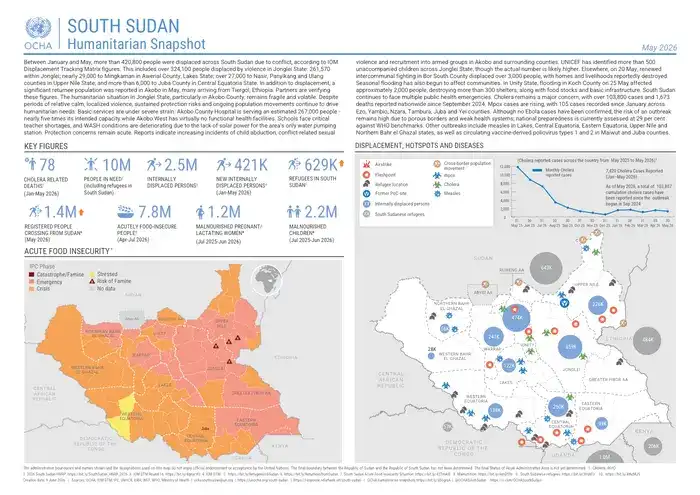
Between January and May, more than 420,800 people were displaced across South Sudan due to conflict, according to IOM Displacement Tracking Matrix figures. This includes over 324,100 people displaced by violence in Jonglei State: 261,570 within Jonglei; nearly 29,000 to Mingkaman in Awerial County, Lakes State; over 27,000 to Nasir, Panyikang and Ulang counties in Upper Nile State; and more than 6,000 to Juba County in Central Equatoria State. In addition to displacement, a significant returnee population was reported in Akobo in May, many arriving from Tiergol, Ethiopia.
Partners are verifying these figures. The humanitarian situation in Jonglei State, particularly in Akobo County, remains fragile and volatile. Despite periods of relative calm, localized violence, sustained protection risks and ongoing population movements continue to drive humanitarian needs. Basic services are under severe strain: Akobo County Hospital is serving an estimated 267,000 people - nearly five times its intended capacity while Akobo West has virtually no functional health facilities. Schools face critical teacher shortages, and WASH conditions are deteriorating due to the lack of solar power for the area’s only water pumping station.
Protection concerns remain acute. Reports indicate increasing incidents of child abduction, conflict-related sexual violence and recruitment into armed groups in Akobo and surrounding counties. UNICEF has identified more than 500 unaccompanied children across Jonglei State, though the actual number is likely higher. Elsewhere, on 20 May, renewed intercommunal fighting in Bor South County displaced over 3,000 people, with homes and livelihoods reportedly destroyed. Seasonal flooding has also begun to affect communities. In Unity State, flooding in Koch County on 25 May affected approximately 2,000 people, destroying more than 300 shelters, along with food stocks and basic infrastructure.
South Sudan continues to face multiple public health emergencies. Cholera remains a major concern, with over 103,800 cases and 1,673 deaths reported nationwide since September 2024. Mpox cases are rising, with 105 cases recorded since January across Ezo, Yambio, Nzara, Tambura, Juba and Yei counties. Although no Ebola cases have been confirmed, the risk of an outbreak remains high due to porous borders and weak health systems; national preparedness is currently assessed at 29 per cent against WHO benchmarks. Other outbreaks include measles in Lakes, Central Equatoria, Eastern Equatoria, Upper Nile and Northern Bahr el Ghazal states, as well as circulating vaccine-derived poliovirus types 1 and 2 in Maiwut and Juba counties.
UN Office for the Coordination of Humanitarian Affairs
To learn more about OCHA's activities, please visit https://www.unocha.org/.
Source: https://reliefweb.int/report/south-sudan/south-sudan-humanitarian-snapshot-may-2026
Newer articles:
- Conflict, hunger push South Sudan families to eat leaves to stay alive - 10/06/2026 12:41
- Somali referee returns home to hero’s welcome after World Cup heartbreak - 10/06/2026 12:38
- Belfast’s Sudanese community hunkers down after grisly attack - 10/06/2026 12:32
- World Bank calls for action as South Sudan’s cities rapidly expand - 10/06/2026 12:30
- Sudan, South Sudan and Uganda should brace for heavy rains between June and August 2026 - 10/06/2026 12:27
Older news items
- Reformation meets growth with the Green Corrections Initiative in South Sudan - 08/06/2026 15:57
- How Sudan's war became East Africa's crisis – report - 08/06/2026 15:53
- South Africa's Ramaphosa vows crackdown on groups behind xenophobic attacks - 08/06/2026 15:48
- Co-operative Bank of South Sudan hosts Co-operatives Forum in Northern Bahr el Ghazal State - 05/06/2026 18:10
- Aid rations replace currency in South Sudan - 05/06/2026 18:06
Latest news items (all categories):
- Op-Ed - Breaking the Double-Standard Lens on China's Population Shifts - 23/10/2026 14:23
- South Sudan ceasefire monitors warn of rising violence ahead of December elections - 23/10/2026 13:39
- UNMISS SRSG visits Malakal, emphasizes that peace begins with collective action - 23/10/2026 13:36
- How Technology is Accelerating South Sudan’s Next Oil Discovery - 23/10/2026 13:34
- South Sudan’s Patriot make case in their opener against Urunani - 23/10/2026 13:12
See also (all categories):
Random articles (all categories):
- South Sudan soldiers charged in hotel attack say not guilty - 20/06/2017 05:19
- Amid Tensions, Sudan-South Sudan Talks on Hold - Voice of America - 03/04/2012 14:00
- Sudan gets new government as PM keeps finance - 15/09/2018 15:19
- Video : Upper Nile South Sudan - 09/11/2012 17:40
- Officials rush to vaccinate 2,000 health workers in South Sudan amid fears killer Ebola outbreak in the Democratic Republic of Congo will spread - 29/01/2019 08:47
Popular articles:
- Who is the darkest person in the world, according to Guinness World Record? - 25/10/2022 02:34 - Read 151198 times
- School exam results in South Sudan show decline - 01/04/2012 17:58 - Read 28340 times
- Top 10 weakest currency exchange rates in Africa in 2023 - 19/07/2023 00:24 - Read 25438 times
- No oil in troubled waters - 25/03/2014 15:02 - Read 24658 times
- NDSU student from South Sudan receives scholarship - In-Forum - 29/09/2012 01:44 - Read 22632 times
