
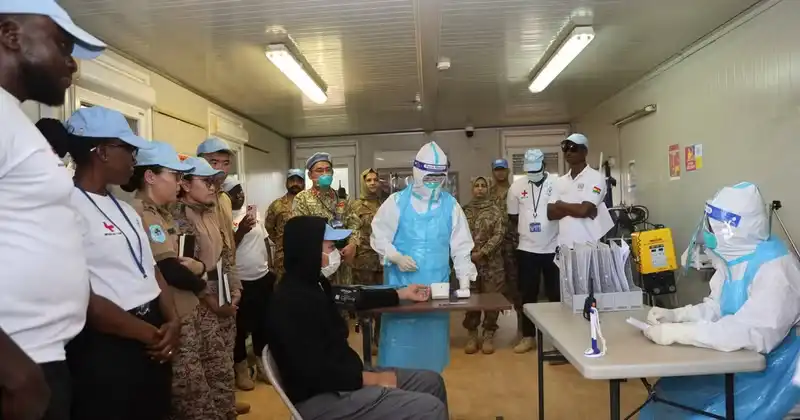
Vietnam’s Level 2 Field Hospital No. 7 at the United Nations Peacekeeping Mission in South Sudan organises a specialised workshop and a comprehensive Ebola response exercise (Photo: TIEN PHUC)
Held on June 10, the workshop and simulation exercise demonstrated the proactive spirit, sense of responsibility and readiness of Viet Nam’s military medical personnel in responding to public health threats that could affect the operations of the Mission.
According to the latest updates from the health system of the United Nations Peacekeeping Mission in South Sudan, although South Sudan has not recorded any cases of Ebola virus disease, the epidemiological situation in neighbouring countries continues to be closely monitored. A report dated May 31, 2026 recorded 1,100 suspected cases, 282 confirmed cases and 42 deaths in the Democratic Republic of the Congo, while Uganda reported nine confirmed cases and one death. By June 9, 2026, the number of confirmed cases in the Democratic Republic of the Congo had risen to 550, including 101 deaths, while Uganda had recorded 19 confirmed cases and two deaths.
These developments indicate that the risk of disease transmission within the region remains present, particularly given the frequent migration, population exchanges, humanitarian activities and international travel among East African countries. For United Nations peacekeeping units, where military personnel and civilian staff from many different countries are concentrated, preparedness and response capacity remain top priorities.
Recognising these requirements, Viet Nam’s Level 2 Field Hospital No. 7 has implemented a range of coordinated measures to enhance its ability to detect, isolate and safely manage suspected cases of dangerous infectious diseases at an early stage.
As soon as epidemiological alerts emerged in the region, the hospital’s Board of Directors instructed staff to maintain regular updates from the Mission’s Field Medical Office (FMO), the World Health Organization (WHO) and relevant United Nations agencies in order to promptly adjust response plans when necessary.
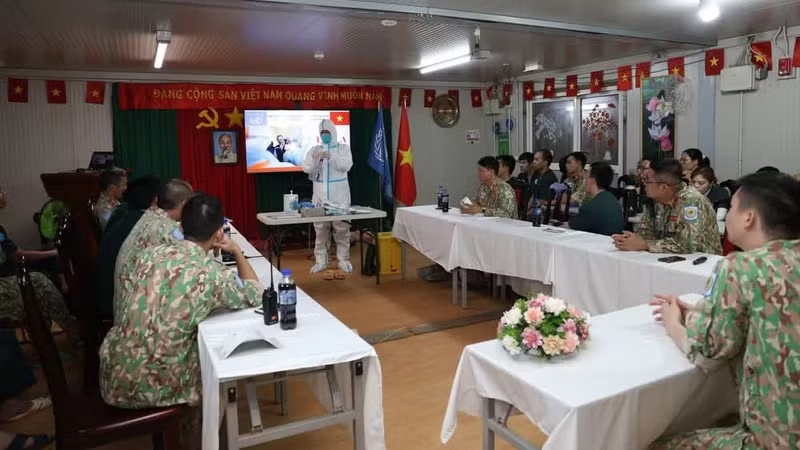
Training in the use of high-level Personal Protective Equipment (PPE) is one of the key components of the Ebola response capacity-building programme at Level 2 Field Hospital No. 7. (Photo: TIEN PHUC)
Alongside epidemiological surveillance, the unit has proactively reviewed its infrastructure, reinforced infectious disease isolation areas, refined patient screening and triage procedures, and conducted inventories and replenishment of personal protective equipment, disinfectants and infection-control supplies. All response plans have been developed according to principles of preparedness, strict implementation and maximum safety for both patients and healthcare workers.
Based on the latest professional guidelines, the Internal Medicine and Infectious Diseases Department of Level 2 Field Hospital No. 7 was tasked with developing training materials, standardising response procedures and conducting training for all personnel within the unit. The programme focused on the early identification of suspected symptoms, patient reception procedures, isolation protocols, infection prevention and control measures, and the proper use of personal protective equipment in accordance with biosafety standards.
Notably, the training programme was not limited to medical personnel but was extended to all staff members within the unit. This approach reflects the hospital’s view that disease prevention and control is a responsibility shared by the entire organisation, with every individual playing an important role in identifying risks and ensuring community safety.
In line with the directives of the hospital’s Board of Directors, training activities were conducted on the principle that every officer and staff member, regardless of position, must be capable of recognising risks, responding in accordance with established procedures and protecting themselves against dangerous infectious diseases.
This is regarded as a key factor in safeguarding patients, protecting colleagues and ensuring the safety of the force when confronted with serious disease outbreaks such as Ebola.
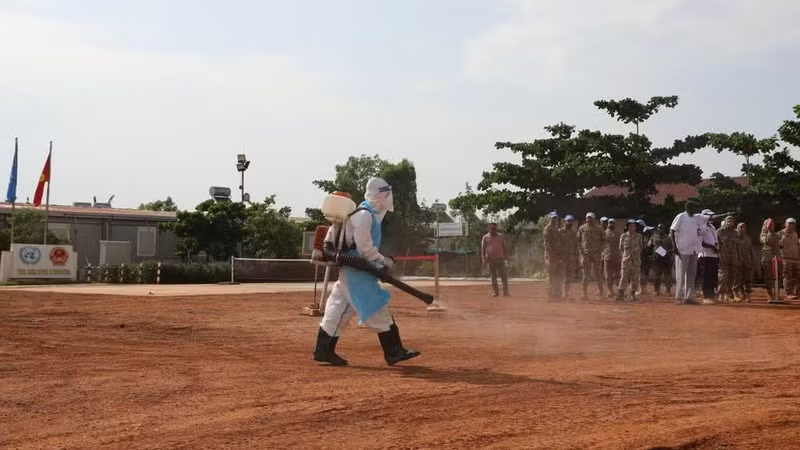
Medical personnel of Level 2 Field Hospital No. 7 practise disinfecting movement routes and areas associated with a suspected Ebola case during the simulation exercise. (Photo: TIEN PHUC)
Following the specialised workshop, the unit conducted practical drills based on a scenario involving a suspected Ebola patient within the base. The entire process, from reception, screening and emergency notification to isolation, transportation, treatment, disinfection and infection control, was tested and evaluated under conditions closely resembling real-life situations.
The highlight of the programme was the comprehensive simulation exercise held on June 10, which was observed and discussed by representatives from international field hospitals and medical units serving at the Mission, including contingents from Pakistan, Mongolia and Ghana, as well as the Level 1 Hospital of the Unity Sector.
Newer articles:
- Global Peace Index 2026: Horn of Africa wars now form one world’s dangerous conflict system - 15/06/2026 19:38
- Youth voices unite in UNMISS event to call for sustained peace - 15/06/2026 19:35
- Uganda, South Sudan triumph in CECAFA U-17 Women’s Championship - 15/06/2026 19:33
- South Sudanese whistleblower reported abducted in Kenya - 12/06/2026 12:38
- Two men convicted in UK of trying to send weapons to conflict zones, including South Sudan - 12/06/2026 12:36
Older news items
- Conflict, hunger push South Sudan families to eat leaves to stay alive - 10/06/2026 12:41
- Somali referee returns home to hero’s welcome after World Cup heartbreak - 10/06/2026 12:38
- Belfast’s Sudanese community hunkers down after grisly attack - 10/06/2026 12:32
- World Bank calls for action as South Sudan’s cities rapidly expand - 10/06/2026 12:30
- Sudan, South Sudan and Uganda should brace for heavy rains between June and August 2026 - 10/06/2026 12:27
Latest news items (all categories):
- Op-Ed - Breaking the Double-Standard Lens on China's Population Shifts - 23/10/2026 14:23
- South Sudan ceasefire monitors warn of rising violence ahead of December elections - 23/10/2026 13:39
- UNMISS SRSG visits Malakal, emphasizes that peace begins with collective action - 23/10/2026 13:36
- How Technology is Accelerating South Sudan’s Next Oil Discovery - 23/10/2026 13:34
- South Sudan’s Patriot make case in their opener against Urunani - 23/10/2026 13:12
See also (all categories):
Random articles (all categories):
- Trapped Americans Flown Out of Violence-Torn City in South Sudan - 22/12/2013 20:17
- South Sudan Crisis: 5 Fast Facts You Need to Know - 21/07/2016 12:52
- S. Sudan Government, Rebels Again Aim for Peace - 22/12/2015 20:56
- ICRC facilitates release of three including two foreigners in Central Equatoria - 14/10/2020 06:00
- US aid ship docks with food for Sudan war zones - 05/05/2016 06:16
Popular articles:
- Who is the darkest person in the world, according to Guinness World Record? - 25/10/2022 02:34 - Read 151201 times
- School exam results in South Sudan show decline - 01/04/2012 17:58 - Read 28341 times
- Top 10 weakest currency exchange rates in Africa in 2023 - 19/07/2023 00:24 - Read 25439 times
- No oil in troubled waters - 25/03/2014 15:02 - Read 24659 times
- NDSU student from South Sudan receives scholarship - In-Forum - 29/09/2012 01:44 - Read 22633 times
