
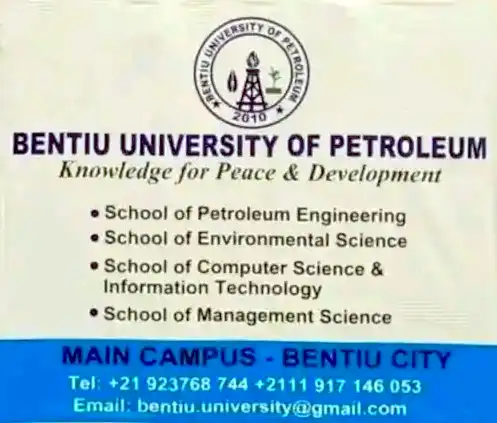
Bentiu University of Petroleum (Facebook)
In efforts to expand access to higher education across South Sudan, Bentiu University of Petroleum (BUP) in Bentiu, the capital of Unity State, has officially opened its doors for student admissions, marking the first public university in the oil-producing states.
Under the motto, ‘Knowledge for Peace and Development’, BUP accepted applications for the current academic year until 10 February, according to a public announcement by the BUP academic registrar.
BUP will offer courses leading to a Bachelor of Science in petroleum engineering, environmental studies and computer science, along with a Diploma in information technology.
Additional academic programmes in medicine, business, tourism, mining engineering and social sciences are under development.
Besides reducing the need for local students to travel to other states for higher education, the university is also facilitating students’ admissions to other public institutions, including the University of Juba, Upper Nile University and Bahr el-Ghazal University.
Vice-Chancellor Professor Melha Rout Biel was quoted as saying: “The university is mandated to produce experts in petroleum engineering, environmental sciences, business management and technology,” adding that it aims to become “a regional centre of excellence”.
South Sudan’s higher education system
South Sudan’s higher education system has grown rapidly, with five public and 13 private universities now operating, along with the emergence of a number of smaller private universities with commercial motivation and dubious levels of quality.
The South Sudanese education system faces numerous challenges, many of which are exacerbated by the country’s ongoing humanitarian crisis, along with outbreaks of conflict and civil war, economic stagnation and instability and natural disasters, which all have had a profound impact on education in South Sudan.
South Sudan was in last place at 167 in the 2023 Legatum Prosperity Index, which lists countries according to their traditional economic indicators and social well-being factors including education, where South Sudan ranks 164th.
South Sudan is often limited or not assigned a specific numerical rank in many annual developmental indexes and reports due to insufficient data, reflecting significant structural gaps in education, research and technical infrastructure.
Strategic idea, but with political and security concerns
South Sudanese researcher James Bilal told University World News: “The establishment of BUP is, in principle, a commendable and strategic idea.
“It reflects the need to develop national expertise in South Sudan’s petroleum sector, which remains central to the country’s economy,” said Bilal, who is the national coordinator of South Sudan Human Rights Defenders Network.
“However, under the current political and security conditions, the initiative is unlikely to be sustainable or to function effectively,” Bilal pointed out.
“South Sudan is facing its most severe period of instability since the signing of the Revitalised Agreement on the Resolution of Conflict in 2018, with renewed political and ethnic tensions pushing the country back to the precipice of conflict,” Bilal explained.
This is supported by a 3 February Global Conflict Tracker report entitled, Instability in South Sudan, which indicated that the country has returned to the “brink of war” following a sharp escalation of political and ethnic violence in early 2025 and 2026.
“In such an environment, higher education institutions, particularly specialised universities requiring high investment, security and continuity, face serious operational risks,” he said.
Challenges
“BUP will face several key challenges and concerns during its operation across teaching, research and community engagement that could hamper the day-to-day functioning of BUP and its ability to maximise its potential,” Bilal pointed out.
“These challenges include persistent insecurity in oil-producing areas, weak higher-education governance, limited financial capacity, lack of resources, shortages of qualified academic staff, and the absence of stable industry and research linkages.
“These factors collectively undermine the feasibility of establishing and maintaining a specialised petroleum university at this time,” Bilal said.
Bilal’s views are supported by a September 2024 policy brief entitled Data-Driven Decisions: Using Evidence to Improve South Sudan’s Higher Education System, which called for establishing “a well-resourced higher education system” in South Sudan.
The way forward
“A more viable policy option would be to strengthen existing universities, introduce petroleum-related programmes within current institutions, and invest in peace, stability, and higher education sector reform before establishing new specialised universities,” he said.
“While the concept of BUP is commendable, timing and context matter. A more viable approach would be to strengthen existing universities with petroleum-related departments, invest in peacebuilding, security, and higher education governance first, develop regional or international partnerships that allow South Sudanese students to be trained abroad until political and security conditions stabilise.
“Without durable peace, political stability, and sustained investment, the establishment of Bentiu University of Petroleum risks becoming symbolic rather than functional, an institution with ambition but no enabling environment to thrive,” Bilal concluded.
Source: https://www.universityworldnews.com/post.php?story=20260223070622716
Newer articles:
- Thousands flee Akobo after South Sudan army issues forced evacuation order - 09/03/2026 13:57
- “We are just as strong as men” – Mary Nyathiel, Sultan - 09/03/2026 13:54
- UNICEF Condemns Deadly Attack in South Sudan That Killed Children - 09/03/2026 13:51
- South Sudan Humanitarian Country Team Statement on the Situation in Akobo, Jonglei State - 09/03/2026 12:49
- South Sudan Soldiers To Face Court Martial Over Civilian Killings In Jonglei - 06/03/2026 19:50
Older news items
- D’Tigers Slide In World Rankings As South Sudan Rules Africa - 06/03/2026 19:34
- MSF concerned for unaccounted staff in Lankien and Pieri, South Sudan - 06/03/2026 19:30
- Sudanese bishops express distress after massacre - 06/03/2026 19:24
- Cholera Knockout in South Sudan (March 2026) - 06/03/2026 18:25
- UN Warns of Escalating Violence Following South Sudan Massacre - 04/03/2026 11:30
Latest news items (all categories):
- South Sudan Opens 14 Oil Blocks, Courts Investors Ahead of SSOP 2026 - 26/10/2026 15:08
- Jambojet Explores South Sudan Expansion After Talks with Juba Regulator - 26/10/2026 15:05
- Kiir swears in 5 officials ahead of South Sudan elections - 26/10/2026 14:53
- South Sudan cattle battles leaves 10 dead: official - 26/10/2026 14:49
- Churches urge world 'not to forget South Sudan' ahead of first elections - 26/10/2026 14:47
See also (all categories):
Random articles (all categories):
- South Sudan's hungry see little hope for peace - 25/03/2015 07:52
- UN Accuses South Sudan Rebels of Targeted Ethnic Killings - 21/04/2014 17:40
- من بينها السودان وغزة واليمن.. هذه قائمة أشد أزمات الجوع في العالم خلال عام 2025 - 27/04/2026 13:06
- South Sudan poised to realize Nile dam dream - 26/06/2021 08:38
- Refugees in South Sudan received in unfinished camp - Reuters AlertNet - 30/05/2012 14:03
Popular articles:
- Who is the darkest person in the world, according to Guinness World Record? - 25/10/2022 02:34 - Read 151283 times
- School exam results in South Sudan show decline - 01/04/2012 17:58 - Read 28381 times
- Top 10 weakest currency exchange rates in Africa in 2023 - 19/07/2023 00:24 - Read 25485 times
- No oil in troubled waters - 25/03/2014 15:02 - Read 24692 times
- NDSU student from South Sudan receives scholarship - In-Forum - 29/09/2012 01:44 - Read 22668 times
