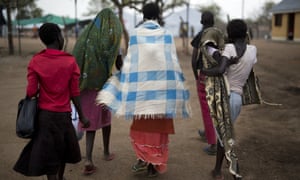
UN investigators say they have identified more than 40 South Sudanese military officers who may be responsible for war crimes and crimes against humanity.
Their findings are a sharp departure from previous UN reports that documented crimes but not perpetrators.
Oil-rich South Sudan[1] gained independence from neighbouring Sudan in 2011, but slid into civil war in December 2013. More than 4 million people, a third of the population, have been displaced by violence.
The investigators, from the UN Commission on Human Rights in South Sudan, say their findings are based on interviews with hundreds of witnesses, satellite imagery and nearly 60,000 documents dating back to the outbreak of the war.
Their report, released on Friday, makes the case for “individual command responsibility for widespread or systematic attacks on civilians” by senior military officers, including eight lieutenant generals, and by three state governors.
A spokesman for the government said it was willing to hold people to account for any crimes. “The government will prosecute anyone responsible for any crimes. This is a responsible government,” Mawien Makol, of the foreign affairs ministry, told Reuters.
So far, there have been very few prosecutions of South Sudanese military or government officials for crimes against civilians.
The UN report details what it calls “appalling instances of cruelty against civilians who have had their eyes gouged out, their throats slit, or been castrated”. It says such violence occurred during five major battles between government troops and rebels in 2016 and 2017.
The report contains testimony from a mother who witnessed her son being forced to rape his grandmother while his family was held hostage, and an 85-year-old woman who said she was gang-raped before watching the execution of her husband and son.
It also documents what the commission member Andrew Clapham called “a clear pattern of ethnic persecution, for the most part by government forces who should be pursued for crimes against humanity”.
The conflict has pitted the ethnic Dinka community – to which the South Sudanese president, Salva Kiir Mayardit, and most of his army commanders belong – against Nuer rebels led by Kiir’s former deputy, Riek Machar.
Whether the investigators’ evidence will result in prosecutions depends on the African Union. Under a 2015 peace deal that fell apart in 2016, the AU and South Sudan were supposed to set up a “hybrid court”, consisting of South Sudanese and other African judges, to try people accused of atrocities.
A year ago, the UN commission said the AU was making itself complicit in South Sudan’s bloodshed by failing to set up the court. It called again on Friday for the court to be established.
“The court could be set up straight away and the prosecutor could begin working on indictments,” said the commission’s chief, Yasmin Sooka. “Under the peace agreement, those indicted can no longer hold or stand for office.”
Elections are due in South Sudan this year, according to the 2015 peace pact. But other countries, including the US, are trying to get the warring sides to observe a ceasefire before any vote is held.
References
- ^ South Sudan (www.theguardian.com)
Newer articles:
- Insurance Agency withdraws UAP South Sudan’s rating - 24/02/2018 22:44
- BBC Hard Talk - Ezekiel Lol Gatkuoth - Minister of Petroleum, South Sudan - 24/02/2018 22:41
- South Sudan war: Men 'castrated' and children 'forced to watch rape' says UN - 24/02/2018 07:42
- U.N. South Sudan Mission Recalls Police Unit Over Sex Abuse Allegations - 24/02/2018 06:48
- Over 40 Should Face Trial for South Sudan Atrocities, U.N. Team Says - 23/02/2018 04:42
Older news items
- South Sudan sentences South African to death by hanging for conspiracy - 23/02/2018 02:14
- South Sudan religious leader urges President Kiir to step down - 22/02/2018 22:12
- South Sudan kills, beats, nabs journalists: UN - 22/02/2018 08:24
- Media, rights activists threatened in South Sudan - U.N. report - 22/02/2018 04:50
- South Sudan: President Salva Kiir Sends Warning To Police Against Power Abuse - 22/02/2018 01:53
Latest news items (all categories):
- IBAHRI - Journalists must be protected, not silenced: global impunity and attacks on media freedom threaten democracy and the rule of law - 02/11/2026 21:19
- South Sudan Civil Society Pushes For Peace And Development - 02/11/2026 20:21
- South Sudan’s first dedicated Media and Information Literacy Centre is creating opportunities for young people to navigate the digital space responsibly - 02/11/2026 20:17
- ‘We carried books into the bush’ – conflict-affected people of Lui plead for peace - 02/11/2026 20:06
- Strengthening food systems in South Sudan - 02/11/2026 20:01
Random articles (all categories):
- South Sudan encourages oil development despite waves of internal violence - 16/01/2012 15:05
- World Bank projects South Sudan economy to shrink in 2022 - 16/06/2022 09:38
- Ugandan Forces In South Sudan To Help Nationals There - 10/02/2014 06:51
- Sudan's military council warns against road blocks as protests continue - 22/04/2019 07:55
- South Sudan’s current violence ‘lot worse’ than during civil war - 19/02/2021 06:18
Popular articles:
- Who is the darkest person in the world, according to Guinness World Record? - 25/10/2022 02:34 - Read 151456 times
- School exam results in South Sudan show decline - 01/04/2012 17:58 - Read 28473 times
- Top 10 weakest currency exchange rates in Africa in 2023 - 19/07/2023 00:24 - Read 25573 times
- No oil in troubled waters - 25/03/2014 15:02 - Read 24776 times
- NDSU student from South Sudan receives scholarship - In-Forum - 29/09/2012 01:44 - Read 22753 times