
Debating Ideas reflects the values and editorial ethos of the African Arguments book series, publishing engaged, often radical, scholarship, original and activist writing from within the African continent and beyond. It offers debates and engagements, contexts and controversies, and reviews and responses flowing from the African Arguments books. It is edited and managed by the International African Institute, hosted at SOAS University of London, the owners of the book series of the same name.
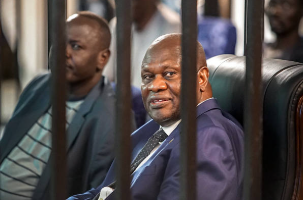
First Vice President Dr Riek Machar in court in Juba on October 8, 2025 (Credit: Radio Tamazuj)
South Sudan gained independence from Sudan in 2011, following 21 years of war. Two years later, the country was plunged into a civil war. The 2018 peace agreement, the Agreement for the Resolution of Conflict in South Sudan (ARCSS), between the Sudan People’s Liberation Movement in Government (SPLM-IG) and the Sudan People’s Liberation Movement in Opposition (SPLM-IO), led by Dr Riek Machar, ended the war. While the negotiations mediated by the Intergovernmental Authority on Development (IGAD) were difficult, the implementation would prove challenging.
Right from the beginning, the two peace partners found it difficult to implement the agreement. As a result, the unity government was extended four times (including in 2018, 2022 and 2024). On March 4, 2025, in a mishandled military affair motivated by the challenges in ARCSS implementation, the white army force, predominantly made up of Nuer youth, clashed with the government forces in the town of Nasir, killing hundreds of soldiers, including government military General David Majur Dak.
Instantly, the government accused the SPLM-IO leader and seven other political figures (all Nuer) of instigating and aiding the war and arraigned them in the court constituted by President Salva Kiir (a Dinka).
The prominent members of opposition (all Nuer) accused include the Minister of Petroleum, Puot Kang, MP, Gatwich Lam Pouch, and Gen.Gabriel Duop Lam Both, among others.
Following the formal publication of the charges against the accused, a decree read on state radio suspended First Vice President Machar along with other opposition leaders. The government, through the Minister of Justice and Constitutional Affairs, accused them of treason, murder, and crimes against humanity linked to the fierce clashes in Nasir earlier this year.
The trial
On Monday, 22 September 2025, South Sudan’s First Vice President, Dr Riek Machar, and the co-accused (all Nuer) appeared before a televised special court established by the government to answer to the levied charges.
While President Kiir has framed the trial of Riek Machar as a matter of legal accountability, some analysts and other South Sudanese find the trial to be, fundamentally, a political manoeuvre. It is, they argue, meant to exploit South Sudan’s deep-seated ethnic fault lines, consolidate power, and sideline opposition ahead of the peace agreement’s deadline, set for December 2026.
Despite the Nuer identity of the accused, the trial of Riek Machar is not primarily a tribal affair. Given the way President Kiir has tried to protect the longevity of his reign, it is reasonable to rationalize the trial as a calculated political act by President Kiir to dismantle the leadership of the SPLM-IO and remove a long-standing rival. This move jeopardizes R-ARCSS, and possibly could return the country to war.
The political dimension
The process of establishing a semblance of the rule of law is a step in the right direction. If the court rule against Dr Machar and his co-accused, it can facilitate accountability. However, the timing of the charges and the trial is rather suspiciously political. The trial of eight political figures from one tribe, the Nuer, is difficult not to rationalize as an ethnically selective sense of justice/injustice.
The trial is a political act because other former warlords in South Sudan have committed atrocities similar in magnitude to the Nasir incident. Yet not a single case has been investigated and tried in any competent court of law. For instance, the Cobra (Murle militia) of David Yau Yau, now Deputy Minister of Information, Telecommunication and Postal Services, killed hundreds of forces in the then Jonglei state after losing a constituent seat in the 2010 election. Agweleng (Shilluk militia) of Johnson Olony committed similar atrocities in Upper State. None of those military leaders has appeared before the law to account for their crimes against South Sudanese civilians and the military.
The Cobra forces and Agweleek militias, affiliated with the government, fought alongside government forces during the 2013–18 conflict.
The tribal dimension
The news report shows that the Nasir incident was triggered by the government’s decision to send Agweleek (Shilluk) and ABushook (Dinka) tribal militias, mixed with some elements of the national army, the South Sudanese People’s Defense Forces (SSPDF), to the town of Nasir, Upper Nile State to quell the tension between the white army and government forces stationed in Nasir.
President Salva Kiir and First Vice President Dr Riek Machar, despite being peace partners and liberation colleagues, have had a sour political relationship in the past. For instance, President Kiir constantly uses the 1991 coup initiated by Dr Machar against late John Garang of the SPLA, to blackmail him politically. The two leaders’ disagreement on the modes and mechanisms of primary election to the party’s National Liberation Council (NLC), the most consequential one, resulted in the 2013 war, and now the possibility of renewed war is brewing. The arrest of Dr Machar and the trial outcome of the ongoing court proceedings risk the collapse of the peace agreement. There are already voices calling for the independence of the Upper Region from South Sudan to form their own country. President’s Kiir argument is that the white army (mainly Nuer youth) has a history of siding with Dr Machar in most wars he waged against the government. The white army fought alongside Machar in the attempted coup in 1991 against John Garang, then leader of the SPLM/A, and again in the December 2013 war, advancing to Juba. The trial of Dr Machar, who many (especially Nuer groups) regard as their leader, may strain the unity government established under the 2018 peace agreement.
The court that is now trying the case of Dr Machar and other Nuer men is presided over by a Shilluk judge. This trial sent a specific message to Dr Machar’s supporters that only Nuer tribesmen are being set as an example of accountability for the country.
In response, the Nuer community in the town of Bentiu, the capital of Unity State where Dr Machar comes from, took to the streets to protest the trial. The September 25, 2025 Bentiu protest highlights the enduring nature of ethnicized political grievances in South Sudan. The protest in Bentiu was not just about Dr Machar’s arrest; it reflects frustrations over the delayed implementation of peace and mistrust in the justice process.
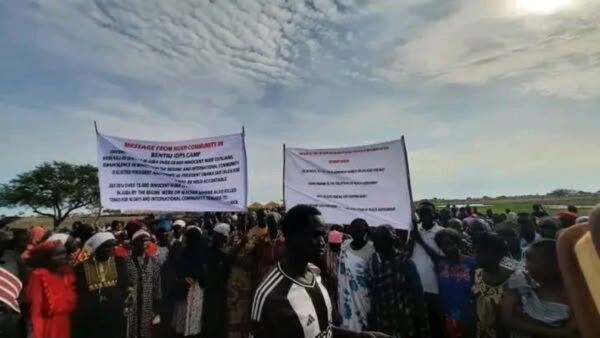
Bentiu protests October 2025, (Credit: Eye Radio)
Media coverage and the trial
At the beginning of the trial, all private media were barred from covering it. Only government media were permitted to broadcast the proceedings live. This is the first time a high-profile trial is being broadcast live on national television. The former detainees in the aftermath of the 2013 conflict were tried in a closed-door session in the old Judiciary premises in Juba. Machar’s trial attracted a diverse range of populations, both within and outside the country, including global, regional, and local audiences.
The government’s decision to broadcast the trial live on the state-owned South Sudan Broadcasting Corporation (SSBC), while simultaneously barring private media, reveals a calculated strategy. The live broadcast aims to project an image of transparency and due process to the public and international community. However, the exclusion of independent journalists ensures the state controls the narrative, preventing critical questioning and presenting a sanitized version of events that reinforces the government’s official charges.
Conclusion
The equity principle stated that “whoever seeks justice must come with clean hands”. Are Kiir’s hands clean? This suggests that the trial is a selective application of the law, making it appear more politically motivated than impartial. Whatever the outcome of the constituted Special Court, the peace agreement would be violated and may create more instability in the country.
Nhial Bol Aken, former editor of The Citizen Daily Newspaper, in his famous editorial piece after 2013 conflict, wrote “When they (SPLM) divide, they kill us and when they reunite, they loot our resources”.
Source: https://africanarguments.org/2025/11/riek-machar-on-trial-in-south-sudan-is-it-tribal-or-political/
Newer articles:
- UN urges restraint as violence erupts in Eastern Equatoria state - 25/11/2025 16:42
- UNMISS calls for an immediate end to fighting in Eastern Equatoria - 25/11/2025 16:34
- UK court blocks South Sudan oil sale over unpaid loan - 21/11/2025 21:23
- South Sudan authorities suspend Hot in Juba news outlet - 21/11/2025 21:19
- South Sudan: Children living with diabetes in remote villages - 21/11/2025 21:15
Older news items
- Kiir Returns Wani Igga as VP; Garang’s Son Joins Cabinet - 18/11/2025 19:06
- South Sudan Engages in Global Dialogue on Rural Broadband and Digital Skills - 18/11/2025 18:51
- Conflict and funding cuts fuel soaring hunger in South Sudan - 18/11/2025 18:43
- Ethiopian Airlines to Order 11 More 737 MAXs - 18/11/2025 18:36
- Kiir Appoints New Executive Secretary - 14/11/2025 13:24
Latest news items (all categories):
- South Sudan Opens 14 Oil Blocks, Courts Investors Ahead of SSOP 2026 - 26/10/2026 15:08
- Jambojet Explores South Sudan Expansion After Talks with Juba Regulator - 26/10/2026 15:05
- Kiir swears in 5 officials ahead of South Sudan elections - 26/10/2026 14:53
- South Sudan cattle battles leaves 10 dead: official - 26/10/2026 14:49
- Churches urge world 'not to forget South Sudan' ahead of first elections - 26/10/2026 14:47
See also (all categories):
Random articles (all categories):
- South Sudan Energy Summit to Host African Petroleum Producers Association (APPO) Secretary General as Keynote Speaker - 24/02/2023 01:00
- South Sudan opened 'new page' with transitional govt - UN peacekeeping chief - 14/06/2016 03:53
- South Sudan: UN Claims 'Ethnic Killings' - 22/04/2014 09:59
- UNMISS hands over new police post in Kuajena - 24/10/2022 06:56
- UK MPs and others call for UK government action to protect Sudanese protesters - 01/02/2019 08:48
Popular articles:
- Who is the darkest person in the world, according to Guinness World Record? - 25/10/2022 02:34 - Read 151298 times
- School exam results in South Sudan show decline - 01/04/2012 17:58 - Read 28390 times
- Top 10 weakest currency exchange rates in Africa in 2023 - 19/07/2023 00:24 - Read 25496 times
- No oil in troubled waters - 25/03/2014 15:02 - Read 24701 times
- NDSU student from South Sudan receives scholarship - In-Forum - 29/09/2012 01:44 - Read 22676 times
