

The road to Ariath, in Aweil North cuts through endless stretches of scorched plains in Northern Bahr el Ghazal state, South Sudan. When it rains, the road turns to mud and when it dries, the heat burns through the ground of the cracked earth. It takes one and a half hours by car to reach the small village. Inside a mud-walled home, 11-year-old Aher sits beside a clay pot filled with water, the family’s improvised refrigerator. Inside lies the medicine that keeps him alive: insulin. Without it, his blood sugar levels spiral out of control and his body convulses with seizures.
Aher’s parents, farmers struggling to feed their five children, have lived through countless nights of fear. When Aher was barely two, he fell gravely ill, vomiting, losing weight and slipping into unconsciousness. They went from one clinic to another, selling what little they had to pay the medical bills and transport costs, but his condition only worsened. Eventually, a desperate trip to Aweil state hospital changed everything. There, the doctors diagnosed Aher with type 1 diabetes, an autoimmune condition requiring daily insulin to survive.
“Since he started using the pen, he has not been in the ICU again. He plays now. He smiles. We eat once or twice a day. The doctors say he needs a special diet, but how can we buy it?”
Lual, Aher’s father
Globally, around 20 million people live with type 1 diabetes, including 1.1 million children and young adults under 20. In high income countries, it can be managed at home with insulin pens and glucose monitors. But in low-income countries, it is a different story. Across Africa, only one in seven people who need insulin can get it. Without insulin, the body shuts down, leading to diabetic ketoacidosis (DKA), a medical emergency that can be deadly without hospital treatment.
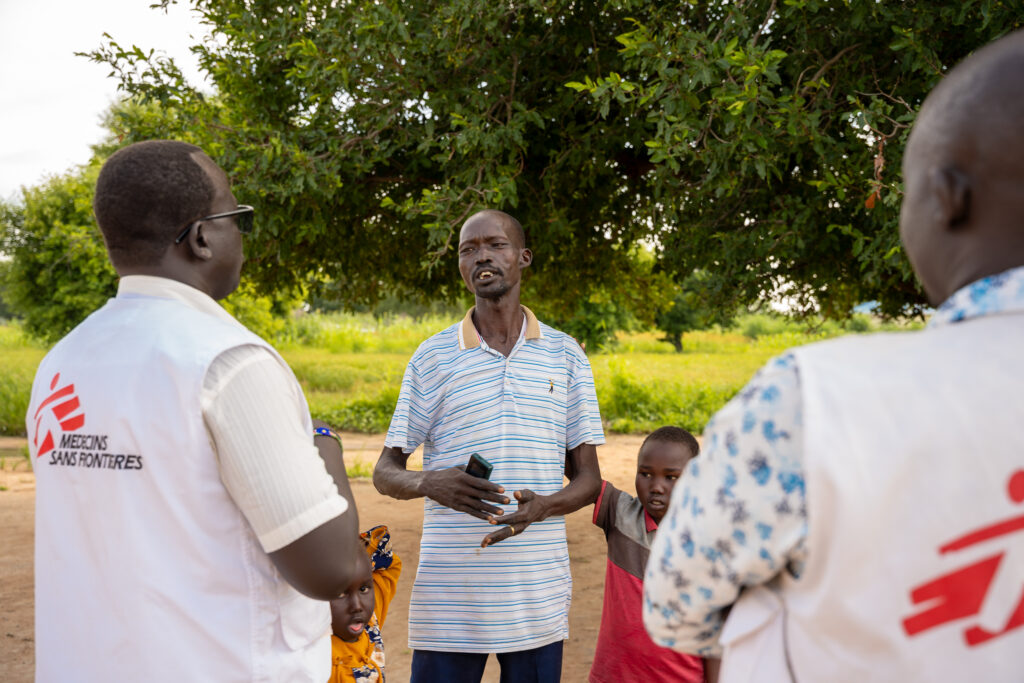 MSF staff speak to Lual, Aher’s father, at his home in Ariath, Aweil North. South Sudan, 2025. © Isaac Buay/MSF
Obstacles to access insulin in South Sudan
In Aweil, Doctors Without Borders/Médecins Sans Frontières (MSF) supports the pediatric unit in the state hospital and treats around 30 children with DKA in the intensive care unit (ICU) every month. It is a critical situation: DKA is the second leading cause of death after malnutrition. Patients and their families travel for hours, often by motorbike or on foot, to reach the only specialized diabetes clinic in the region. Some don’t make it in time.
At first, Aher received insulin through vials and syringes. “He hated them,” says Lual, Aher’s father. “The injections were painful, but it was the only way to keep him alive.”
Earlier this year, Aher was enrolled in an MSF trial to determine whether using insulin pens and glucometers could make a difference in children’s lives. The changes were immediate.
“Since he started using the pen, he has not been in the ICU again,” says Lual. “He plays now. He smiles.” But transport still costs more than most families can afford and hunger complicates his care. “We eat once or twice a day. The doctors say he needs a special diet, but how can we buy it?”
Just 90 kilometres away in Marial Bai, 12-year-old Ajou lives with the same disease but has no access to insulin pens. “When the medicine runs out and I cannot find transport to Aweil, he gets worse,” says Rebecca, his mother. “Sometimes I think he survives only by God’s mercy.”
Rebecca gathers firewood to sell so she can buy flour to feed her son. However, during the rainy season, the forest floods, cutting her off from both income and the hospital. A single trip costs about 40,000 South Sudanese pounds (just over $430 Canadian), more than she can earn for regular hospital visits. “If you had not come today, we would not have been able to go to the hospital”, she says to a visiting MSF outreach team. “But I desperately want my son to get treatment.”
Ajou’s arms bear the marks of countless injections. He grows weary of the pain, sometimes refusing the shots. “He wants to give up,” says Rebecca quietly. “But I keep reminding him that the medicine is his only life source.
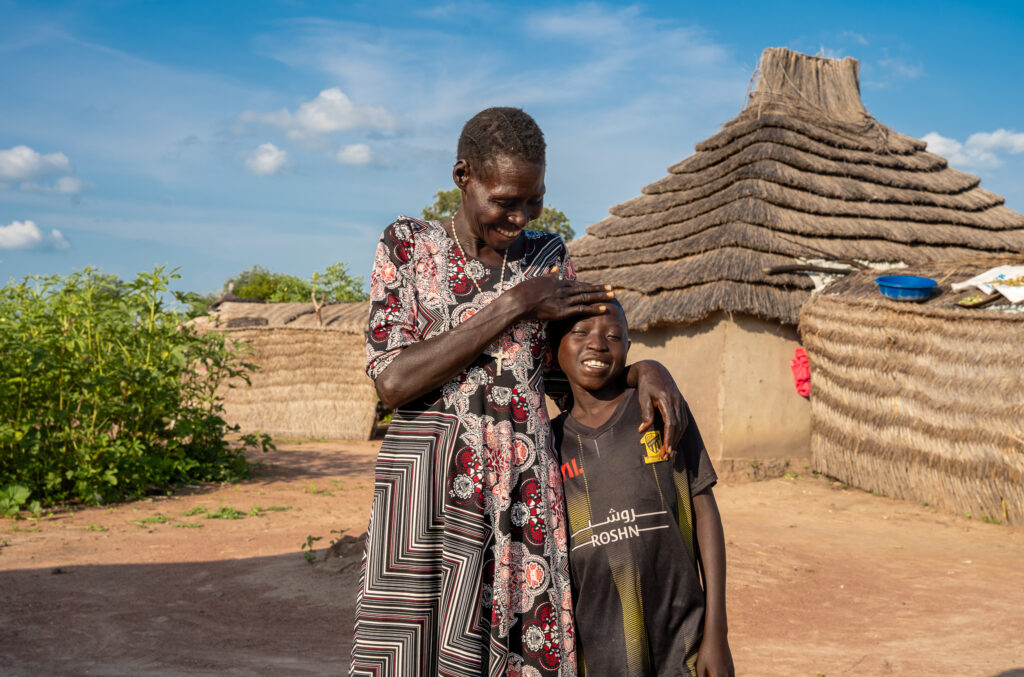 Rebecca and her son Ajou, who has type 1 diabetes and frequently goes into diabetic ketoacidosis, often requiring intensive care unit admission during hospital visits. South Sudan, 2025. © Isaac Buay/MSF
The global struggle for affordable insulin and vital tools
In 2021, the World Health Organization launched the Global Diabetes Compact, pledging that by 2030 everyone with type 1 diabetes should have access to affordable insulin and glucose self-monitoring. With only five years left, that goal still feels far away in places like Aweil where the cycle between home and the ICU is endless for many children.
However, early results from the MSF trial show access to insulin pens is changing lives. Lual knows that better than anyone. Every month, he worries the pen might break or that one day they will not get another. “I do not want to go back to the days when he was always in the ICU,” he says. “I just want him to grow strong.”
Insulin pens and glucose monitors would be game changers for children across South Sudan, but they remain out of reach due to pricing. As the world moves quickly toward 2030, the question is not whether these tools work, but whether the global community will make them affordable for every child who needs them. Until then, children like Ajou and Aher will continue to end up in the ICU – and some, sadly, will continue to have no access to life-saving treatment at all.
Source: https://www.doctorswithoutborders.ca/south-sudan-children-living-with-diabetes-in-remote-villages/
Newer articles:
- South Sudan.. How does a 14 year old nation fight for its first major tournament? - 25/11/2025 16:46
- UN urges restraint as violence erupts in Eastern Equatoria state - 25/11/2025 16:42
- UNMISS calls for an immediate end to fighting in Eastern Equatoria - 25/11/2025 16:34
- UK court blocks South Sudan oil sale over unpaid loan - 21/11/2025 21:23
- South Sudan authorities suspend Hot in Juba news outlet - 21/11/2025 21:19
Older news items
- Riek Machar on Trial in South Sudan: Is it Tribal or Political? - 18/11/2025 19:14
- Kiir Returns Wani Igga as VP; Garang’s Son Joins Cabinet - 18/11/2025 19:06
- South Sudan Engages in Global Dialogue on Rural Broadband and Digital Skills - 18/11/2025 18:51
- Conflict and funding cuts fuel soaring hunger in South Sudan - 18/11/2025 18:43
- Ethiopian Airlines to Order 11 More 737 MAXs - 18/11/2025 18:36
Latest news items (all categories):
- IGAD and South Sudan Strengthen National Coordination for the Implementation of the Building Women’s Economic Resilience for Sustainable Peace Project - 03/08/2026 18:53
- South Sudan plans interoperable birth registration, digital ID systems - 03/08/2026 18:50
- South Sudan Oil & Power Returns as South Sudan’s Premier Investment Platform - 03/08/2026 18:04
- Kenya: Mudavadi meets South Sudan foreign minister as Juba gears up for landmark elections - 03/08/2026 16:52
- A Long Road Home: Jal’s Journey Through Conflict and Separation - 03/08/2026 16:41
See also (all categories):
Random articles (all categories):
- Friday Zico: The refugee from South Sudan that nearly joined Man Utd - 01/11/2021 02:28
- South Sudan runner bids for independent place - Reuters - 18/07/2012 12:01
- Sudan rebels 'shoot down' air force bomber - AFP - 08/11/2012 10:00
- Can South Sudan Afford A Total Lockdown? - 02/06/2020 12:20
- South Sudan's Nuer tribe seeks community center in Austin - Post-Bulletin - 03/07/2012 20:56
Popular articles:
- Who is the darkest person in the world, according to Guinness World Record? - 25/10/2022 02:34 - Read 148298 times
- School exam results in South Sudan show decline - 01/04/2012 17:58 - Read 27916 times
- Top 10 weakest currency exchange rates in Africa in 2023 - 19/07/2023 00:24 - Read 25002 times
- No oil in troubled waters - 25/03/2014 15:02 - Read 24325 times
- NDSU student from South Sudan receives scholarship - In-Forum - 29/09/2012 01:44 - Read 22281 times
