
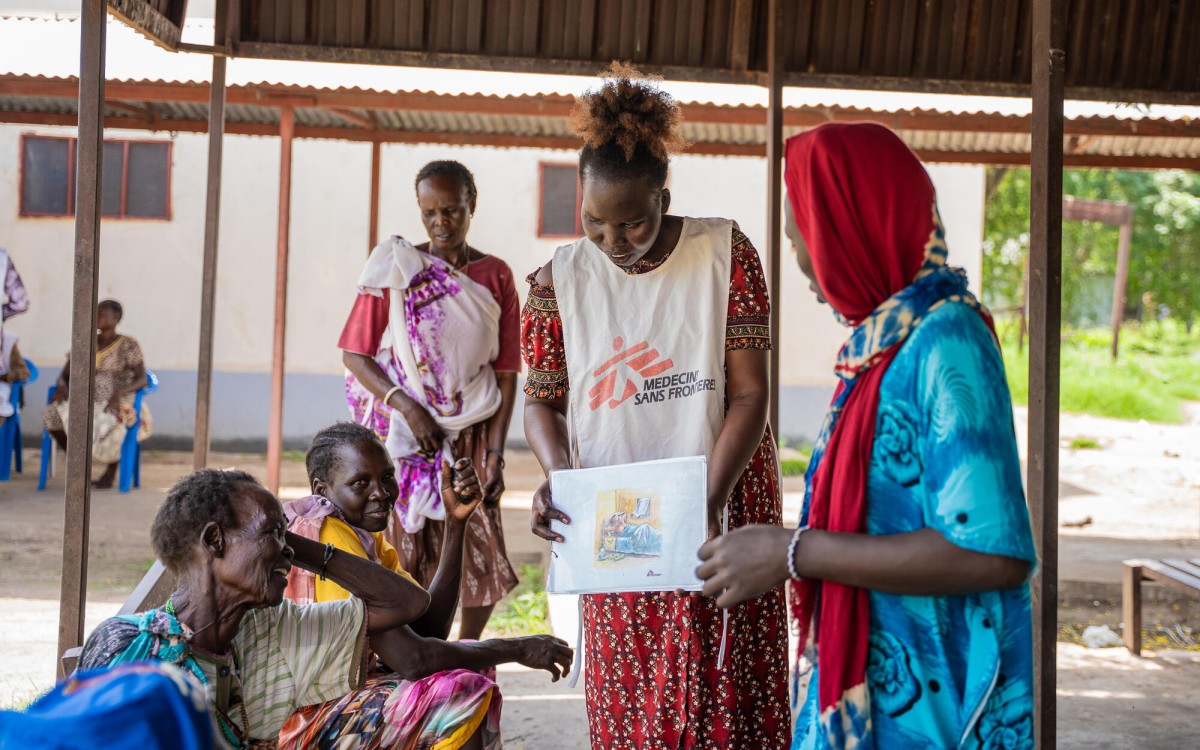
“I knew I was unwell, but not a criminal,” says Samat Nyuk, a patient recovering from a mental health condition in Malakal, South Sudan. “I needed support, not punishment. What hurt the most was that my own family chose prison for me instead of treatment.”
Samat was sent to prison by his family when traditional herbs and remedies failed to calm the turmoil in his mind. At the onset of his illness, he experienced vivid and terrifying visions.
“I felt like I was crossing a river where the water reached my neck, and I saw fingers pointing at me while voices urged me to drown,” he shares.
A friend, noticing Samat’s distress, sought traditional remedies. A local elder gave him an herbal root that brought a momentary reprieve. Concerned for both his son’s safety and their family’s well-being, Samat’s father, Nyuk, asked the local authorities to detain his son or find him help. Samat was restrained in June 2025 and taken to Malakal Central Prison, where he was placed in a small cell in the prison’s isolated section for those suffering from mental illness.
In Malakal, where no psychiatric care is available, families are often left with no alternative — sending their loved ones to jail becomes a desperate last resort. Life in prison was brutal for Samat. Initially, he was confined to a dark cell with nothing but a thin mat. He endured nights of cold, swarms of mosquitoes, and relentless voices in his head.
A growing but overlooked crisis
South Sudan is grappling with a profound but often invisible mental health crisis. Decades of conflict, displacement, poverty, and food insecurity have inflicted lasting wounds. Ongoing insecurity and recurrent displacement continue to disrupt essential services, forcing communities to remain on the move and putting health staff and facilities at constant risk. This situation not only deepens the need for mental health support but also severely undermines the ability to deliver sustained care.
Many people live with anxiety, depression, trauma, and post-traumatic stress; however, services remain woefully inadequate. Access to trained professionals, effective treatments, and community awareness is limited. The outcome is grim: individuals with mental health conditions often face stigma, neglect, or are treated as criminals, leading to their incarceration.
Survivors of sexual and gender-based violence face additional layers of trauma, underscoring the need for integrated mental health and legal support services. These comprehensive responses are resource-intensive and often unavailable in many parts of the country.
On the other hand, mental health and psychosocial support programmes remain chronically underfunded and vulnerable to sudden budget cuts, threatening the continuity of services, staff retention, and the steady supply of essential medicines.
“In many cases, detention centres become the only places where those with severe symptoms can receive care or be kept safe,” says Laura Ximena, MSF’s mental health activity manager in Malakal. “While this is far from ideal, it reflects the urgent need for enhanced mental health infrastructure in the region.”
MSF’s response in Malakal
In Malakal, we provide mental health services at the Malakal Teaching hospital. Since 2023, we have been providing mental health care and psychiatric medications at the Malakal Central Prison. MSF staff members and one staff from the Ministry of Health provide follow-up care through counselling and psychopharmacological treatment. In the detention centre, we try to ensure that patients are doing well and take their medication every day.
Between January and August 2025, MSF provided mental health consultations to 1,130 individuals in Malakal, which included 761 women (67%) and 369 men (33%). For patients requiring specialised care and pharmacological care, the most common diagnoses include psychosis, bipolar disorder, depression, and mental health comorbidities involving psychoactive substance use.
Samat’s experience mirrors the plight of many patients in need of mental health care in South Sudan—faced with limited options, individuals often resort to desperate measures. Some have even had suicidal thoughts.
Between January and September this year, 12 patients seen by MSF admitted to contemplating suicide, primarily due to prolonged trauma, instability, inadequate psychosocial support, food insecurity, and exposure to violence. April 2025 saw the highest number of cases, with four patients having attempted suicide and one having thoughts of suicide.
MSF also conducts awareness sessions in various settings targeting healthcare staff and patients in hospitals. These include brief talks in waiting areas and community focus group discussions with local leaders to promote mutual support and reduce stigma. MSF also holds participatory awareness sessions in secondary schools and runs radio programmes in local languages.
Our work in Malakal continues to show that with appropriate medication, counselling, and consistent follow-up, as well as family and community support, recovery is possible. However, progress remains fragile without food security, social support, and an effective health system.
“Mental health must be integrated into healthcare services across South Sudan, ensuring trained professionals are available at all care levels,” says Ximena. “This also requires securing essential psychotropic medicines, maintaining buffer stocks, and integrating them into existing supply chains.”
Above all, individuals with mental health conditions deserve to be treated as persons with dignity...
Laura Ximena, MSF’s mental health activity manager in Malakal
“Community awareness and family involvement are equally vital,” she says. “Above all, individuals with mental health conditions deserve to be treated as persons with dignity, and not resort to detention centres where they can be associated with criminals.”
MSF continues to follow up with Samat and other patients who have been sent home, providing them with medication and counselling. Today, Samat is regaining his strength and searching for a job.
“What gives me hope now is freedom,” he says. “Prisons are not suitable for individuals with mental health conditions. We need hospitals—places offering treatment, food, and hope for recovery.”
Source: https://www.msf.org/comprehensive-treatment-serious-mental-health-conditions-south-sudan
Newer articles:
- Liam Neeson tells of fear for children in South Sudan as aid slashed - 27/10/2025 14:58
- South Sudan’s first homegrown ride-hailing startup finds ways to survive its tough market - 27/10/2025 14:54
- South Sudan’s Army Chief Orders Immediate Closure of Illegal Checkpoints Following Security Clash - 27/10/2025 14:46
- South Sudan: Flooding Situation Flash Update No. 8 (As of 24 October 2025) - 27/10/2025 14:40
- South Sudan: The Internal Turmoil - 21/10/2025 16:47
Older news items
- The football academy giving South Sudan's youth an alternative to gang life - 21/10/2025 16:33
- The Cost of Faith in Sudan - 21/10/2025 16:29
- Prosecution of South Sudan’s vice-president raises fears of return to full-scale civil war - 14/10/2025 13:22
- Political crisis and corruption fuelling violence in South Sudan, UN rights body says - 14/10/2025 13:16
- UN commission calls upon international bodies to address deepening crisis in South Sudan - 14/10/2025 13:08
Latest news items (all categories):
- South Sudan Opens 14 Oil Blocks, Courts Investors Ahead of SSOP 2026 - 26/10/2026 15:08
- Jambojet Explores South Sudan Expansion After Talks with Juba Regulator - 26/10/2026 15:05
- Kiir swears in 5 officials ahead of South Sudan elections - 26/10/2026 14:53
- South Sudan cattle battles leaves 10 dead: official - 26/10/2026 14:49
- Churches urge world 'not to forget South Sudan' ahead of first elections - 26/10/2026 14:47
See also (all categories):
Random articles (all categories):
- UN reports surge in conflict-related sexual violence in South Sudan - 11/05/2022 01:00
- South Sudan pushes back licence round - 24/03/2020 05:43
- Abyei residents vote on Sudan-Sudan choice - 27/10/2013 12:01
- Kenya and Uganda complicit in targeting of South Sudan human rights defenders - 26/03/2021 10:09
- South Sudan's Kiir pardons politicians, rebels - 09/10/2013 03:15
Popular articles:
- Who is the darkest person in the world, according to Guinness World Record? - 25/10/2022 02:34 - Read 151294 times
- School exam results in South Sudan show decline - 01/04/2012 17:58 - Read 28388 times
- Top 10 weakest currency exchange rates in Africa in 2023 - 19/07/2023 00:24 - Read 25493 times
- No oil in troubled waters - 25/03/2014 15:02 - Read 24697 times
- NDSU student from South Sudan receives scholarship - In-Forum - 29/09/2012 01:44 - Read 22673 times
