

When Dut Majak attended an IT conference abroad in 2017, repeated questions about South Sudan’s tech scene—culminating in a sarcastic comment about how people lived without modern amenities—ignited a resolve that would birth the country’s first homegrown ride-hailing app.
Two years later, Shilu-ANA launched into one of Africa’s most challenging markets, where over 95% youth unemployment meets 15.7% internet penetration, and only 2% of roads are paved.
In a country where six other ride-hailing companies have launched and failed since 2019, Shilu-ANA has carved out a niche by adapting to the harsh realities in Juba, South Sudan’s capital.
The app transitioned from directly employing drivers to an independent contractor model due to economic pressures, while proactively reducing its commission from the standard rate to 15% to 10% in September 2025.
 A Shilu-ANA taxi is parked prominently along a street in Juba. The ride-hailing app has become integrated into the city’s daily life since it launched in 2019 (Image Credit: Reath Bol)
“Our main issues have always been centred around the poor roads. I always worry whenever I get an order to one of the suburban areas of the city,” says Tongun Noah, a 28-year-old Shilu-ANA driver navigating Juba’s unpaved streets daily.
Beyond infrastructure challenges, drivers face numerous security checkpoints that interrupt their most profitable hours, especially so if their passengers are foreigners. “Most of our good income is generated during weekend night movements, but this regular interruption can be difficult,” Noah explains. Still, Noah is very optimistic about the future of Shilu-ANA as he witnesses the growing demand and goodwill surrounding their services.
For passengers like Al-Hamim Mohamed, a 26-year-old Sudanese refugee, the app provides crucial safety and convenience in a city where traditional taxi negotiations can be unpredictable.
“Before Shilu-ANA, it was always a worry, especially at night or when I needed to go somewhere unfamiliar,” Al-Hamim explains, recounting his early days in Juba. “With Shilu-ANA, I just open the app, book, and I know who is coming. It’s much safer, and the peace of mind is worth the cost.”
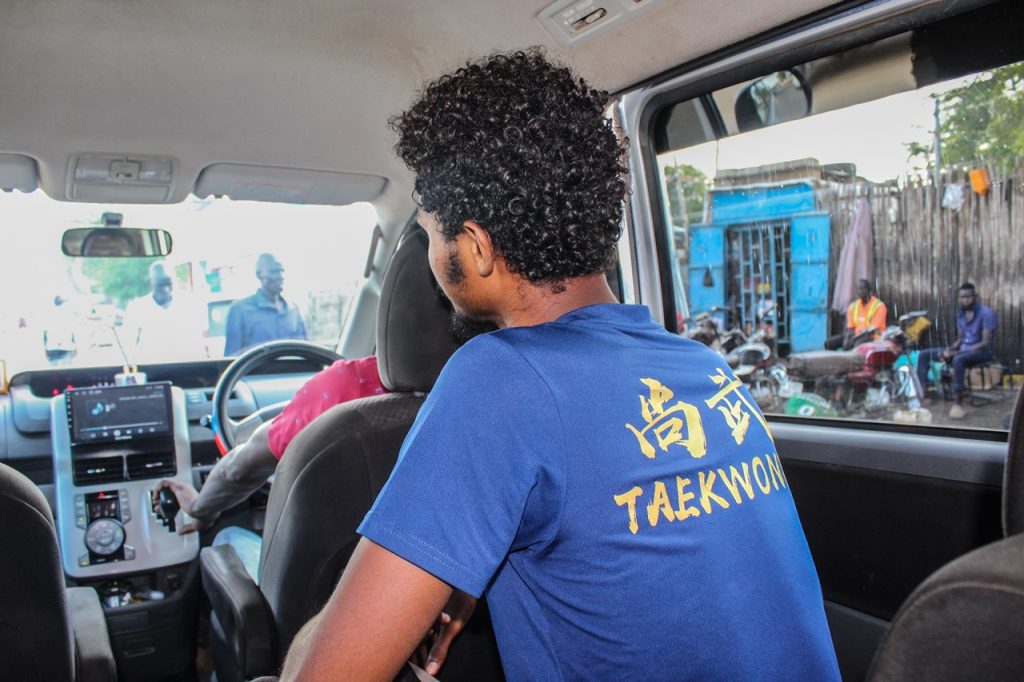 Al-Hamim Mohamed, 26-year-old Sudanese refugee, greets driver, Tongun Noah, in the car as he starts his trip to the hospital (Image Credit: Reath Bol)
The digital divide challenge
Operating in a market where only 1.90 million people use the internet presents unique challenges. While Shilu-ANA focuses on smartphone users in urban Juba, competitor RABA Taxi addresses connectivity issues by offering services via SMS and phone calls, highlighting different approaches to the same fundamental problem.
“Not everyone is using Shilu-ANA in Juba compared to other services,” notes a critical voice from the ICT community, who asked not to be named to speak freely. The company’s smartphone-only approach in a low-connectivity environment, though commendable, raises questions about digital equity and market reach.
Dennaya Denis, Founder and CEO of Koneta Hub, South Sudan’s tech advocacy organisation, acknowledges these systemic challenges: “If you look into Juba, the roads, the infrastructure is very poor.” He emphasises that robust infrastructure development requires government collaboration with mobile network operators to expand coverage beyond the three primary capitals of Juba, Wau, and Malakal.
Regional ambitions
Despite domestic challenges, Shilu-ANA expanded to Tanzania in 2024 after navigating a year-long regulatory process, with plans to re-enter Rwanda in 2026. The company is also developing additional platforms including Caribou (food and goods delivery) and Juba Market (online marketplace) for future launch in Tanzania, demonstrating a diversification strategy beyond ride-hailing.
“I do believe that it is a locally owned startup and the solution will definitely grow into bigger companies like Uber in the region,” Denis says, expressing optimism about Shilu-ANA’s regional potential.
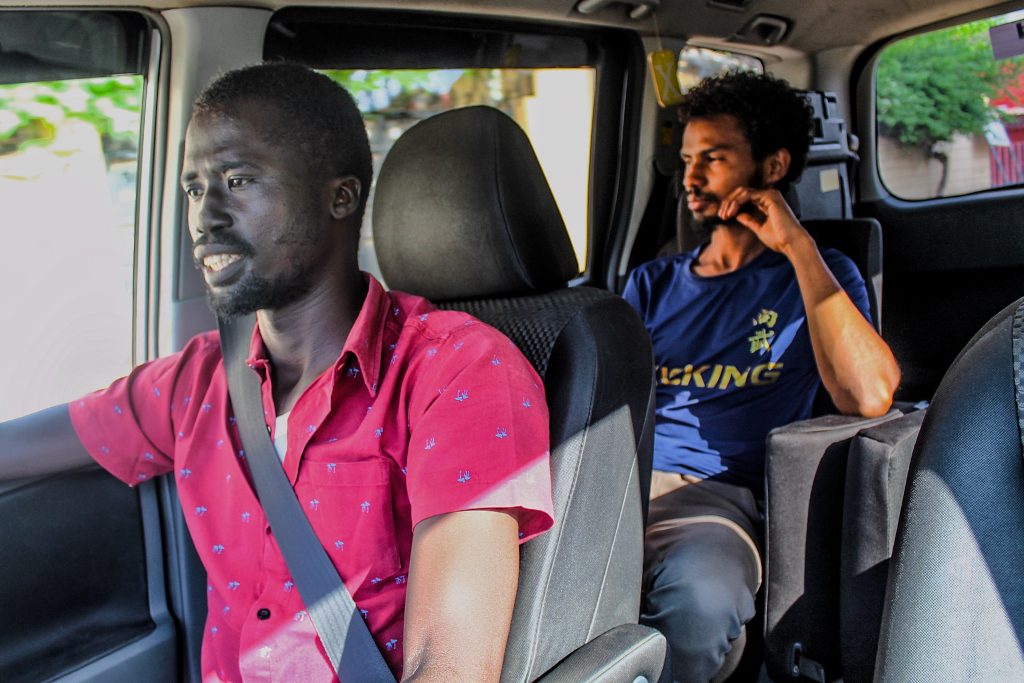 Al-Hamim Mohamed and Tongun Noah ride to Mohamed’s destination, a hospital in Juba, South Sudan’s capital (Image Credit: Reath Bol)
Founder Majak hopes to collaborate with government agencies to shape supportive tech policies, recognising that infrastructure development and regulatory frameworks are crucial for the broader tech ecosystem’s growth.
The company’s journey illustrates both the potential of local innovation and the reality of operating in post-conflict environments where basic infrastructure remains limited.
As Noah reflect: “The only challenge is the general financial collapse the country is undergoing, which is affecting us also. Otherwise, we would have provided better.” His optimism, despite challenges, mirrors the broader resilience driving South Sudan’s emerging tech sector.
In a nation often defined by struggle, Shilu-ANA represents more than transportation—it’s a symbol of local ingenuity, creating economic opportunities and technological pride in one of Africa’s newest countries.
Newer articles:
- South Sudan’s blind footballers chase Paralympic dream - 30/10/2025 12:30
- ‘They killed civilians in their beds’: chaos and brutality reign after fall of El Fasher - 30/10/2025 12:20
- Sudan army withdraws from Darfur’s el-Fasher, UN warns of RSF atrocities - 28/10/2025 11:27
- Why Riek Machar’s trial brings ‘existentially high’ stakes for South Sudan - 27/10/2025 15:06
- Liam Neeson tells of fear for children in South Sudan as aid slashed - 27/10/2025 14:58
Older news items
- South Sudan’s Army Chief Orders Immediate Closure of Illegal Checkpoints Following Security Clash - 27/10/2025 14:46
- South Sudan: Flooding Situation Flash Update No. 8 (As of 24 October 2025) - 27/10/2025 14:40
- South Sudan: The Internal Turmoil - 21/10/2025 16:47
- Comprehensive treatment for serious mental health conditions is possible in South Sudan - 21/10/2025 16:40
- The football academy giving South Sudan's youth an alternative to gang life - 21/10/2025 16:33
Latest news items (all categories):
- South Sudan Opens 14 Oil Blocks, Courts Investors Ahead of SSOP 2026 - 26/10/2026 15:08
- Jambojet Explores South Sudan Expansion After Talks with Juba Regulator - 26/10/2026 15:05
- Kiir swears in 5 officials ahead of South Sudan elections - 26/10/2026 14:53
- South Sudan cattle battles leaves 10 dead: official - 26/10/2026 14:49
- Churches urge world 'not to forget South Sudan' ahead of first elections - 26/10/2026 14:47
See also (all categories):
Random articles (all categories):
- لجنة نزح السلاح بولاية اعالى النيل تواصل اجتماعها الدورى الثانى لمناقشة كيفية نزح السلاح - 06/09/2011 01:00
- South Sudan: Pres. Obama Appoints Ambassador Booth As Special Envoy for Sudan, South Sudan - 02/09/2013 23:28
- East Africa’s persistent counterfeits threaten Kenya-South Sudan trade - 10/12/2019 09:51
- Sudan and S. Sudan claim control of oil town - Albany Times Union - 20/04/2012 18:05
- Putin wants to attend an August summit. Host country South Africa doesn’t want to have to arrest him - 17/07/2023 00:25
Popular articles:
- Who is the darkest person in the world, according to Guinness World Record? - 25/10/2022 02:34 - Read 151291 times
- School exam results in South Sudan show decline - 01/04/2012 17:58 - Read 28387 times
- Top 10 weakest currency exchange rates in Africa in 2023 - 19/07/2023 00:24 - Read 25492 times
- No oil in troubled waters - 25/03/2014 15:02 - Read 24696 times
- NDSU student from South Sudan receives scholarship - In-Forum - 29/09/2012 01:44 - Read 22672 times
