
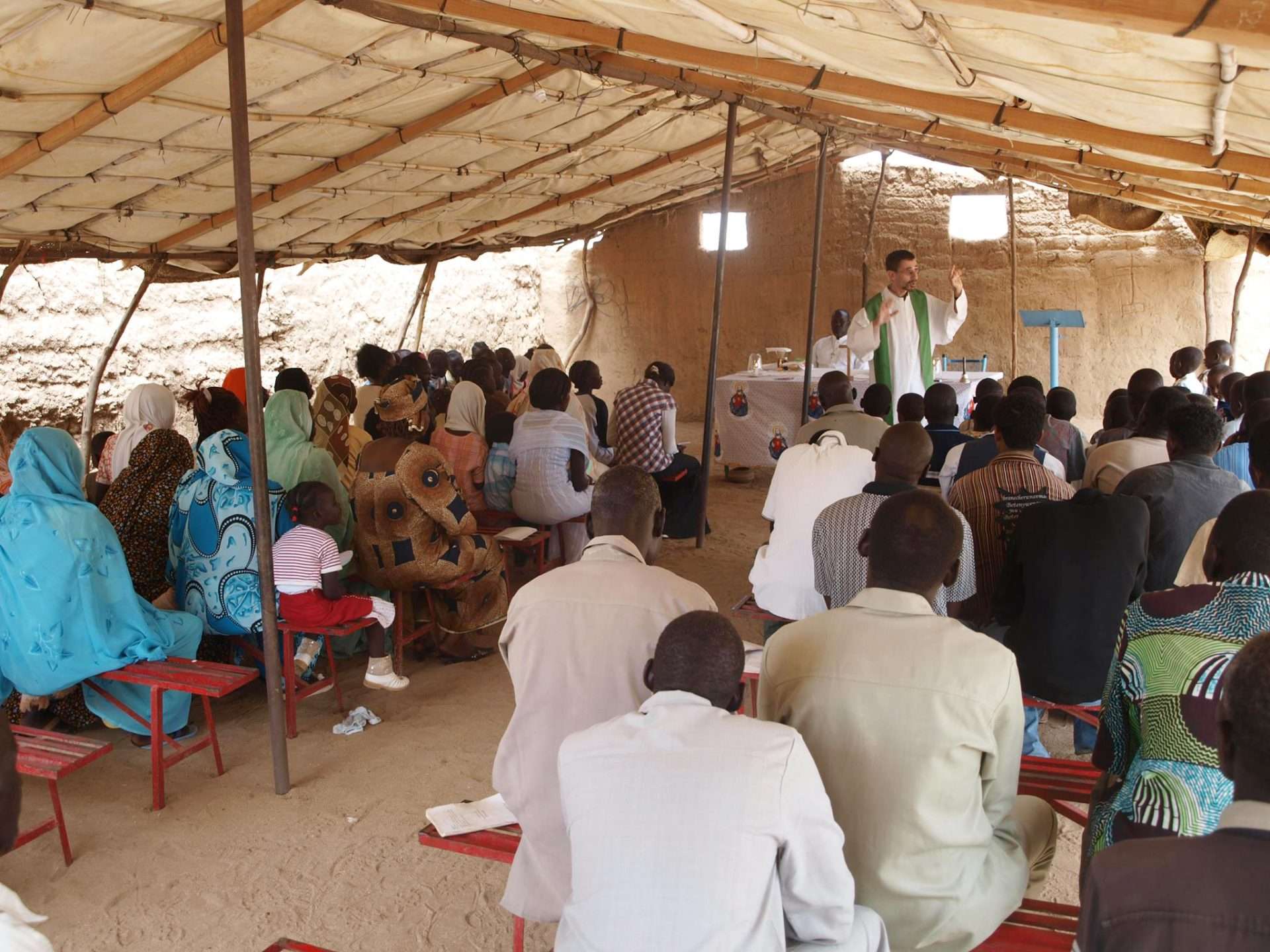
The apostolic nuncio to South Sudan visited Sudan in September ‘to bring a word of closeness and of encouragement from the Pope to this much tried local church in Sudan’.
The last Christian minister in the besieged city of El Fasher fled his church in September after militia forces attacked it.
The Rev’d Daramali Abudigin had remained in the capital of Sudan’s North Darfur state since the paramilitary Rapid Support Forces (RSF) began fighting government troops in April 2023, keeping the St Matthew Episcopal Church open even after the RSF surrounded and blockaded the city in May 2024.
Repeated assaults and bombardments in the months since have caused an unknown number of deaths. The last Catholic priest in the city, Fr Luka Jomo, was shot dead in June. The United Nations declared a famine in the El Fasher area last year.
RSF gunmen attacked Abudigin’s church on 16 September, killing two people and injuring others. Three days later, an RSF drone strike on a mosque in El Fasher killed 85 people.
Abudigin told the Religion News Service last week that he was sheltering on the outskirts of the city with more than 40 other people seeking a way to escape. The Anglican Diocese of Leeds, which supports the Episcopal Church in Sudan, sent funds to pay to airlift him and others to safety.
An estimated 260,000 civilians remain in El Fasher, their routes out of the city restricted by the besiegers’ lines to a single 60km passage to Tawila. Militia have attacked people travelling along this route, or demanded large sums of money to pass checkpoints.
Such travel restrictions were blamed for delaying the humanitarian response after a landslide in the mountains of Central Darfur state on 31 August.
The apostolic nuncio to South Sudan visited Sudan in September “to bring a word of closeness and of encouragement from the Pope to this much tried local church in Sudan, and especially in these last two years, when a terrible civil war has raged”.
Archbishop Séamus Patrick Horgan, a native of Ennis, Co. Clare, told Vatican News that his visit on 11-21 September showed “that the wider Church was expressing its concern and assuring its prayers” for the Catholic community of Sudan, which “has been very, very hard pressed from every side”. He praised local clergy and missionaries for “their fidelity in very, very trying circumstances”.
The nuncio visited the capital Khartoum, Atbara, Omdurman and Port Sudan, where he met officials from the transitional government, whose forces are fighting the RSF. He said they were “very receptive” to his visit and that he emphasised the importance of “freedom of religion and freedom of culture” in Sudan’s political future.
“This war has shown that Christians and Muslims suffer the same fate,” Archbishop Horgan said. “When there’s a war, everyone suffers together. And to overcome this war, we must work together to rebuild Sudan.”
Fr Jorge Naranjo, a Spanish Comboni missionary in Port Sudan, said the nuncio’s visit brought “a word of encouragement from the Pope to the Sudanese people and gave hope to the community”. He told Aid to the Church in Need that fighting in Khartoum had driven most priests from the capital, leaving a “pastoral vacuum” making the work of lay catechists essential for the survival of the Church there.
The civil war has worsened instability across the region, with refugees driven back and forth across Sudan’s border with South Sudan and into other neighbouring countries in the world’s worst displacement crisis.
Speaking last month after a visit to Ethiopia’s Tigray region, Bishop Paul Swarbrick of Lancaster told The Tablet that “the effects of Sudan’s tragedy is spreading across international borders in the region and further afield”.
”The conflict in Sudan is not showing evidence of moving towards a resolution, said Swarbrick, the lead bishop for Africa for the bishops’ conference of England and Wales. “From a global perspective it remains almost a side show to other conflicts, and yet, the loss of life, the widespread suffering and the number of displaced people far outnumber those affected in other conflicts.”
In South Sudan, Church leaders warned that the 14-year-old nation was “at a perilous crossroads” that could undermine years of peace efforts.
The Archbishop of Juba Cardinal Stephen Ameyu Martin Mulla joined an appeal on 13 September, two days after the government of President Salva Kiir charged the suspended first Vice President Riek Machar Teny with murder, treason and crimes against humanity.
Machar was has been under house arrest since March this year, and on 22 September appeared behind bars in a courtroom as his trial began in Juba, alongside 20 other leaders of the Sudan People’s Liberation Movement-in-Opposition (SPLM-IO).
The party ordered its supporters to assemble for regime change. The SPLM-IO is associated with the powerful White Army militia and Machar’s Nuer ethnic community. It agreed to the 2018 Revitalised Agreement on the Resolution of the Conflict in the Republic of South Sudan (R-ARCSS) that averted a return to civil war.
Though the Church leaders did not comment on the charges against Machar, their statement warned that “stagnation of the [R-ARCSS] risked undoing sustained efforts towards peace”.
They said South Sudan continued to struggle with profound political and humanitarian crises, worsened by the lack of political will to implement the agreement. During a summit at the Vatican in 2019, Pope Francis kissed the feet of Kiir, Machar and others as he urged them to follow it, repeating the appeal during his ecumenical peace pilgrimage in February 2023.
Newer articles:
- South Sudan opposition leader Machar claims immunity in treason trial - 04/10/2025 14:39
- Death of a rainmaker: When drought means murder in South Sudan - 04/10/2025 14:33
- Great Hunger: South Sudan is at Tipping Point - 04/10/2025 14:27
- Bishop tells victims of violence in South Sudan that the Lord loves the brokenhearted - 04/10/2025 14:23
- Sudanese city under siege: 'My son's whole body is full of shrapnel' - 04/10/2025 14:19
Older news items
- Four strategies South Sudan's elite use to cling to power - 28/09/2025 21:57
- Suspension of South Sudanese vice-president very likely to renew NSAG and SSPDF clashes - 28/09/2025 21:36
- Is Riek Machar's trial threatening stability? - 26/09/2025 22:43
- South Sudan is unstable: how a weak state benefits the ruling elite - 26/09/2025 22:37
- UN: More Than 1,800 Civilians Killed in South Sudan Since Beginning of Year - 26/09/2025 22:28
Latest news items (all categories):
- Advancing Women’s Land Rights through building capacity of customary institutions in Magwi County, South Sudan - 02/10/2026 13:18
- AU calls for release of political detainees ahead of South Sudan elections - 02/10/2026 13:15
- Atrocity Alert No. 496: Ethiopia, South Sudan and Central African Republic - 02/10/2026 13:13
- Ethiopia and Eritrea cut diplomatic ties as northern conflict escalates - 02/10/2026 13:09
- انفصال جنوب السودان ودروس لم تتعلمها النخب السودانية - 02/10/2026 13:06
See also (all categories):
Random articles (all categories):
- South Sudanese ask Sudhir to open Victoria University branch in Juba - 30/11/2020 20:26
- What al-Bashir’s removal means for South Sudan’s fragile peace - 30/04/2019 04:33
- South Sudan launches action plan for health care system - 10/12/2020 23:37
- Hybrid War Crimes Court Promises Justice But Political Rivalry May Impede Pursuit - 07/03/2021 20:15
- UN ready to move on South Sudan sanctions - 05/11/2014 01:54
Popular articles:
- Who is the darkest person in the world, according to Guinness World Record? - 25/10/2022 02:34 - Read 150510 times
- School exam results in South Sudan show decline - 01/04/2012 17:58 - Read 28178 times
- Top 10 weakest currency exchange rates in Africa in 2023 - 19/07/2023 00:24 - Read 25293 times
- No oil in troubled waters - 25/03/2014 15:02 - Read 24520 times
- NDSU student from South Sudan receives scholarship - In-Forum - 29/09/2012 01:44 - Read 22477 times
