
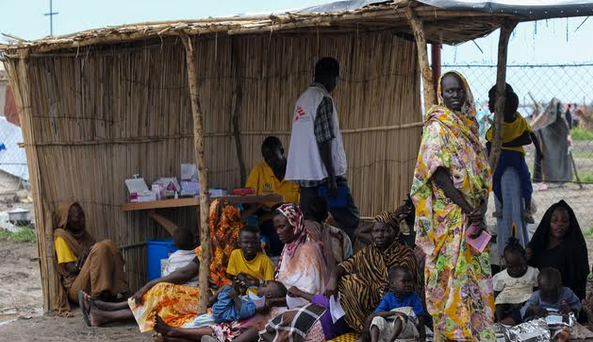
A view of the malaria testing and waiting area of the MSF mobile clinic at Zero Transit Centre in Renk, Upper Nile state. (Photo: MSF/Evani Debone)
International medical organization Médecins Sans Frontières (MSF) is urgently calling for an improved medical and humanitarian response for people fleeing conflict in Sudan and entering South Sudan through Renk in Upper Nile State.
According to MSF, since the fighting erupted in Sudan, around 290,000 individuals have entered South Sudan—80 percent of them through the Joda border in Upper Nile state. Although the formal and informal transit centers in Renk are ideally a temporary stopover for them to move further into the country, the returnees can spend weeks or even months there. This stay is often exhausting and painful, as they have limited access to food, shelter, water, sanitation and healthcare.
According to a Wednesday statement, MSF is supporting Renk Civil Hospital in the measles isolation ward, an inpatient therapeutic feeding center and a pediatric ward. In the wake of an influx of patients, the teams have expanded the capacity of the wards from 22 to 45 beds. Since July, MSF has admitted 232 patients for malnutrition and treated 282 cases of measles requiring hospital care.
“Aid is woefully inadequate in Renk as compared to the needs that are growing every day. We are calling on the humanitarian and medical groups to do more by strengthening medical and humanitarian activities at the entry point and transit centers,” said MSF head of mission in South Sudan, Jocelyn Yapi. “Basic healthcare services should be made available at all times on the border for those coming with medical conditions. A systematic vaccination catch-up should be also available 24/7 on the border given the current low vaccination coverage in Sudan and ongoing outbreak of measles in both countries.”
Limited food supply and deplorable living conditions
Many people, especially children, are arriving at the border in alarming health conditions suffering from deadly diseases like measles or malnutrition requiring immediate medical care. Amidst the rainy season, MSF medical facilities in the area are recording a 70 percent positivity rate of malaria, a disease that already kills more people than any other in South Sudan.
“Malnourished children in particular must be given urgent nutritional support on the border and at once transferred to the medical facilities,” Yapi stated. “Relief items such as mosquito nets, plastic sheets, and other essential non-food items should be provided at the border so nobody who is in need is missed out.”
Although people there receive a one-off cash distribution of 12 US dollars (USD) per person, considering the high prices—a normal meal on average is sold for two USD in Renk —this assistance is hardly enough to afford one meal a day for a week. People are staying weeks and at times months without further cash assistance and there is no regular food distribution by the humanitarian organizations or the authorities in the area.
Marta Manher, a mother of six, living at Zero, one of the unofficial settlements for returnees in Renk, lamentingly stated she has been selling off her clothes to buy food.
“I am selling my clothes for 2,000 South Sudanese pounds ($2) per piece to buy food,” she said. “I have sold six of them and left with the remaining two to wear.”
Limited food and deplorable living conditions are taking a toll on people’s health status.
“In two of mobile clinic sites run by MSF at Zero and Abukadra, the teams are recording 300 medical consultations a day and seven out of 10 are malaria patients,” the MSF statement read. “Most people there live under the open sky or in temporary shelters made of clothing. In this area, patches of stagnant rainwater provide ideal breeding places for mosquitos, and people have no mosquito nets or other means of protection available to them.”
An urgent humanitarian response is needed
According to MSF, in the Renk civil hospital where they support measles isolation ward, 90 percent of the patients are returnees and unvaccinated.
“On top of that, some severely sick patients are being transferred without provision of medical care to Malakal, a 48 to 72 hours journey on boats without medical care, water or food,” the statement said. “Deaths have been recorded on boats and MSF teams are receiving severely sick patients at Bulukat transit center, resulting in a higher mortality rate in the facilities in Malakal.”
For his part, Abraham Anhieny, an MSF Medical Doctor in Renk, said the community of returnees is too vulnerable.
“Not only insufficient food and drinking water, they do not have shelters as they use pieces of cloth to protect themselves from the sun and rain,” he stated. “As we treat malnourished children in the hospital, we see that many mothers are also malnourished.”
Years of conflict have already caused one of the world’s largest humanitarian crises in South Sudan. As the country already suffers from regular disease outbreaks, flooding, displacements, and high rates of malnutrition, the arrival of returnees is another burden, and the current response is incapable of absorbing additional needs.
The country requires more attention and support to deal with the ongoing humanitarian crisis, and another emergency caused by the conflict in Sudan,” MSF sternly warned.
Newer articles:
- WFP: ‘Looming emergency hunger crisis’ along Sudan-South Sudan border - 05/10/2023 04:39
- UN struggling to reach 18 million people in need in war-torn Sudan - 05/10/2023 03:50
- Naira among worst performing currencies in Sub-Saharan Africa - World Bank - 05/10/2023 01:34
- SA, Nigeria and Angola drag down sub-Saharan Africa growth, says World Bank - 05/10/2023 01:31
- UN Food Agency Says That 1 In 5 Children In South Sudan 'malnourished' - 04/10/2023 09:28
Older news items
- Catholic Bishop in South Sudan Emphasizes Link Between “sacrifice” and Doing God’s Will - 04/10/2023 06:07
- Sudan army, RSF blame each other of bombing Ethiopia embassy - 04/10/2023 04:30
- Switzerland provides further funding to support people in Sudan and neighbouring countries - 04/10/2023 03:41
- South Sudan president fires another central bank governor - 03/10/2023 09:19
- PNP sends 25 cops for peacekeeping mission in South Sudan - 03/10/2023 07:19
Latest news items (all categories):
- Western Equatoria prepares for voter registration - 14/09/2026 15:11
- South Sudanese Women Reclaim Their Lives after Fistula Surgery - 14/09/2026 15:10
- Digitel Launches Voice and Social Media Bundles in South Sudan - 14/09/2026 15:07
- Nearly 100,000 displaced in Sudan’s Blue Nile state since January amid fighting: UN agency - 14/09/2026 15:03
- جنوب السودان يرفض طلبًا لـ”حميدتي” بمنحه الحصة الأكبر من عائدات النفط - 14/09/2026 14:51
Random articles (all categories):
- Hopes high Pope’s African visit will clear path to peace - 28/01/2023 02:11
- Enough’s Omer Ismail to Testify in Congress on Sudan Sanctions - 03/04/2017 18:50
- South Sudan leaders discuss ties, peace implementation with Ethiopian PM - 14/03/2023 08:40
- Today marks 1 million South Sudanese fleeing to Uganda - 17/08/2017 00:24
- South Sudan Sanctions: Vote on Draft Resolution - 30/05/2023 11:49
Popular articles:
- Who is the darkest person in the world, according to Guinness World Record? - 25/10/2022 02:34 - Read 149574 times
- School exam results in South Sudan show decline - 01/04/2012 17:58 - Read 28113 times
- Top 10 weakest currency exchange rates in Africa in 2023 - 19/07/2023 00:24 - Read 25193 times
- No oil in troubled waters - 25/03/2014 15:02 - Read 24463 times
- NDSU student from South Sudan receives scholarship - In-Forum - 29/09/2012 01:44 - Read 22414 times
