
(Photo: BBC)
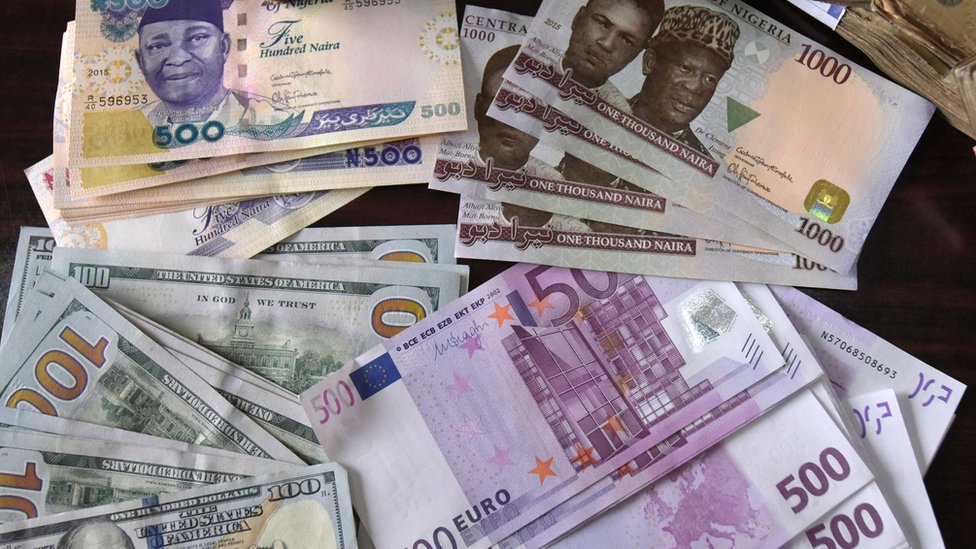
The World Bank’s latest Africa’s Pulse report has revealed that the Nigerian Naira has experienced nearly a 40 percent depreciation in 2023, making it one of the worst-performing currencies in Sub-Saharan Africa.
This year, other currencies in the region with significant losses include the Angolan Kwanza, South Sudanese Pound, Burundian Franc, Congolese Franc, Kenyan Shilling, Zambian Kwacha, Ghanaian Cedi, and Rwandan Franc.
“So far this year, the Nigerian naira and the Angolan kwanza are among the worst-performing currencies in the region: these currencies have posted a year-to-date depreciation of nearly 40 percent.
Other currencies with significant losses so far in 2023 are those of South Sudan (33 percent), Burundi (27 percent), the Democratic Republic of Congo (18 percent), Kenya (16 percent), Zambia (12 percent), Ghana (12 percent), and Rwanda (11 percent),” the report said.
These losses are attributed to various factors, including uncoordinated policy interventions and foreign exchange controls, which have also contributed to inflation in some Sub-Saharan African countries, such as Ethiopia, Nigeria, and Zimbabwe.
The report noted that Inflation in most Sub-Saharan African countries has been increasing since 2022, it said “However, controlling inflation is still difficult for central banks in the region, especially in countries with underdeveloped financial systems, large informal sectors, and poor fiscal-monetary policy coordination.”
For countries where inflation is close to or within the central bank’s target range (such as South Africa, Kenya, and Uganda), it is important to fine-tune monetary policy to control inflation without causing hardship or job losses.
The bank advised that countries with high double-digit inflation rates or inflation that has not yet peaked such as Ethiopia, Ghana, and Nigeria, should avoid unorthodox interventions that could make their monetary policies ineffective, such as monetizing the budget deficit, direct lending interventions, untargeted subsidy programs, or foreign exchange controls.
“If monetary and fiscal policies are not coordinated to bring down inflation, there is a risk that inflation expectations will become unanchored, leading to further inflation, higher interest rates, and a slowdown in economic activity.”
For these countries, an independent central bank with a clear mandate, transparent decision-making, and accountable authorities are essential to curbing inflation. Fiscal policies should be coordinated with monetary measures to achieve inflation targets and ensure the sustainability of public finances.
Regarding current account deficits, the report projects a narrowing of the median regional current account deficit in Sub-Saharan Africa, with oil-exporting countries expected to maintain a surplus despite softer energy prices.Nigeria’s current account is expected to improve in 2023 due to reduced imports and increased domestic refining capacity, despite lower oil earnings.
“The current account surplus of these countries is set to narrow even further to one percent in 2025, reflecting a likely drop in forecast energy prices,” it said.
“Oil-exporting countries are expected to have a current account surplus of 2.2 in 2023. This is because energy prices are still above pre-pandemic levels, and oil output is expected to be lower due to capacity issues and lower investments in some countries such as Angola, Equatorial Guinea, and Nigeria, among others,” the report said.
The report said that in Nigeria, the current account is expected to improve slightly from 0.2 percent of GDP in 2022 to 0.6 percent of GDP in 2023, even though Nigeria will earn less money from selling oil.
This is because Nigeria is expected to import fewer goods and services due to the devaluation of the naira (which makes imports more expensive) and a boost in domestic refining capacity (which means Nigeria will need to import less oil.
It mentioned that oil production is projected to recover in 2024–25, but it will continue to be below the OPEC+ quota. Imports of fuel products are expected to decline as the new refinery ramps up production.
The financial institution said growth in the Sub-Saharan region excluding large countries, such as Angola, Nigeria, and South Africa, is projected at 3.1 percent in 2023, and set to expand to 4.7 and 5.2 percent in 2024 and 2025, respectively.
The economic performance of the AFW(Western and Central Africa Subregion) will be held back by the underperformance of Nigeria in 2024–25 (at growth rates lower than the subregional average).
The Nigerian economy is expected to grow from 2.9 percent in 2023 to an average rate of 3.7 percent in 2024–25. This translates into growth per capita of 1.3 percent in 2024–25, which is insufficient to reduce extreme poverty in the country. Growth will continue to be driven by services, trade, construction, manufacturing, and agriculture.
Newer articles:
- New UN report cites media censorship, restriction on civic activities in South Sudan - 05/10/2023 06:52
- UNMISS Force Commander visits Yambio, Tambura to evaluate the mission’s ongoing protection efforts - 05/10/2023 06:51
- Nearly 8 Million People Are Starving in South Sudan as War Intensifies - 05/10/2023 05:27
- WFP: ‘Looming emergency hunger crisis’ along Sudan-South Sudan border - 05/10/2023 04:39
- UN struggling to reach 18 million people in need in war-torn Sudan - 05/10/2023 03:50
Older news items
- SA, Nigeria and Angola drag down sub-Saharan Africa growth, says World Bank - 05/10/2023 01:31
- UN Food Agency Says That 1 In 5 Children In South Sudan 'malnourished' - 04/10/2023 09:28
- MSF: Malaria, malnutrition rise among South Sudanese returnees in Renk requires stronger medical response - 04/10/2023 06:24
- Catholic Bishop in South Sudan Emphasizes Link Between “sacrifice” and Doing God’s Will - 04/10/2023 06:07
- Sudan army, RSF blame each other of bombing Ethiopia embassy - 04/10/2023 04:30
Latest news items (all categories):
- Juba commissioner denies chasing foreigners - 07/10/2026 14:36
- Australia: 19-year-old from South Sudan arrested over a wild joy ride - 07/10/2026 14:33
- South Sudan’s aid crisis deepens as food stocks run low - 07/10/2026 14:29
- South Sudan’s Juba warns foreigners against running small-scale businesses - 07/10/2026 14:25
- Peace Dialogues foster social cohesion in Nyirol County after persisting tensions - 07/10/2026 14:23
Random articles (all categories):
- Vietnam calls on UNSC to review sanctions against South Sudan - 04/03/2020 21:41
- IFOR International Conference in South Sudan - 11/11/2022 04:28
- Feeling the Pinch: Golden Wing Airline Shuts Operations across South Sudan - 25/05/2016 07:22
- Luol Deng combines president role with head coaching duties at South Sudan - 24/11/2020 21:51
- B.C. inventor tackles poverty in South Sudan with bike-powered grain mill - 27/06/2013 15:02
Popular articles:
- Who is the darkest person in the world, according to Guinness World Record? - 25/10/2022 02:34 - Read 150679 times
- School exam results in South Sudan show decline - 01/04/2012 17:58 - Read 28189 times
- Top 10 weakest currency exchange rates in Africa in 2023 - 19/07/2023 00:24 - Read 25301 times
- No oil in troubled waters - 25/03/2014 15:02 - Read 24531 times
- NDSU student from South Sudan receives scholarship - In-Forum - 29/09/2012 01:44 - Read 22491 times
