
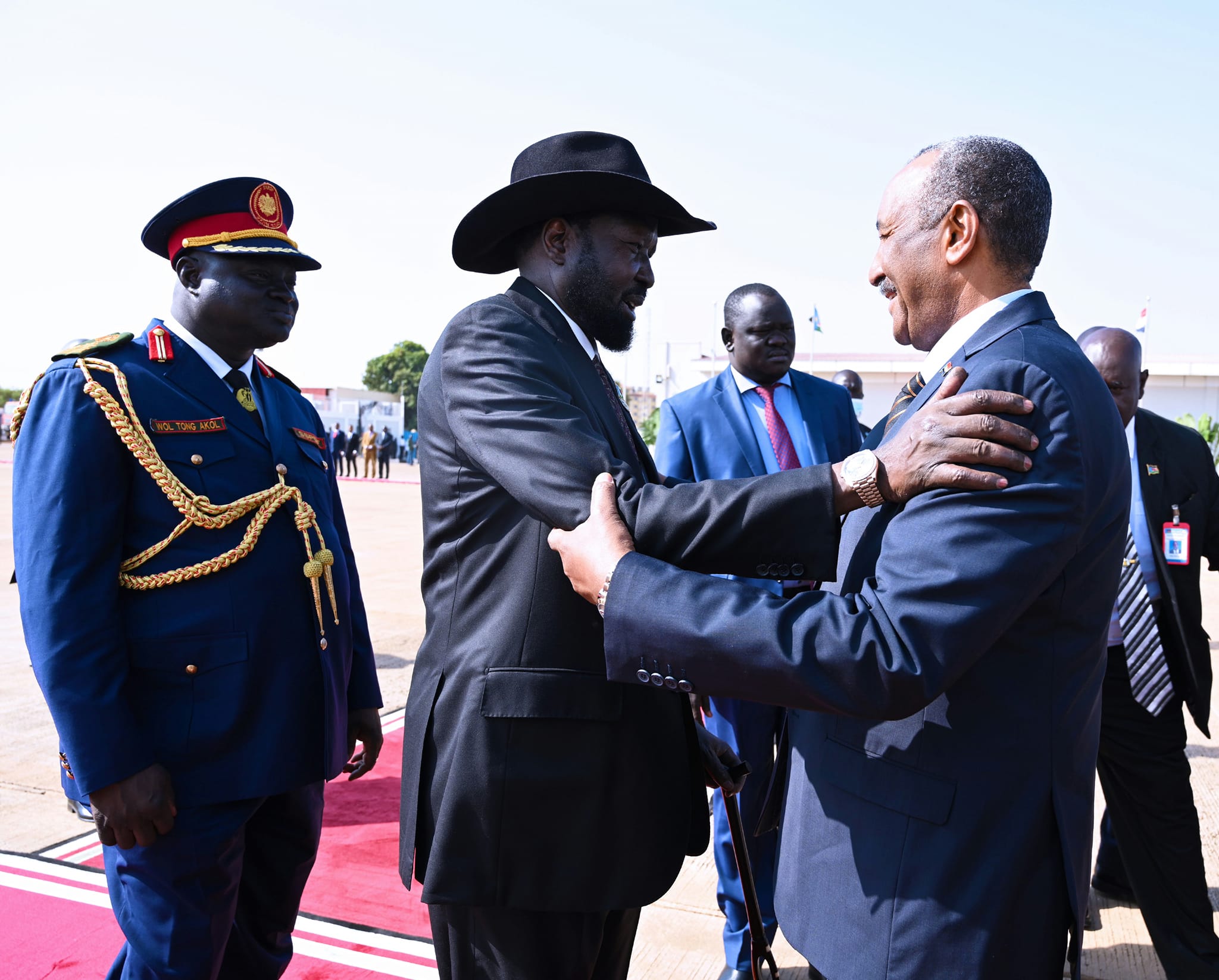
President Salva Kiir Mayardit meets Sudanese military leader, Gen. Abdel Fattah Al-Burhan in Juba, 19 February 2023. (Photo courtesy: Office of the President, Republic of South Sudan).
Given their strong historical bonds, and Juba's track record, what is the argument for Juba to mediate the conflict in Sudan?
With over 500 indigenous African ethnicities, Sudan is necessarily founded on its ethnic diversity. Despite its wealth of human and natural resources, however, it is at a crossroads. War, a constant feature for many of these groups that occupy the periphery, has, after 67 years, arrived in Khartoum. Ironically, this is where it has always stemmed from.
The root cause of Sudan's crisis is the country's conflicted identity, which produced the system of privilege and exclusion concentrated in Khartoum, the nation's capital. The imbalance of power, favouring the country's three self-proclaimed Arab riparian ethnic groups over many others, has created a rift between privileged and marginalised groups, triggering a cascade of conflicts.
The power dynamics in Sudan led to the war in the South, but the Khartoum power structure refused to address the root causes. Instead of addressing the fundamental issue, the partition of the country was viewed as a solution, leading to the secession of the South. It's not surprising, therefore, that the war has extended into the North, with the Army using paramilitary forces to suppress ethno-regional discord in Darfur, the Nuba Mountains, the Blue Nile, and other regions.
This approach, driven by the persistent failure to tackle the core problem, now risks fragmenting the country in a manner reminiscent of the Balkans; those same paramilitary forces, armed, organised, and deployed by the government, have now turned on their paymasters stating that they have understood and now champion the cause of the marginalised ethnic communities.
So what is the alternative to Sudan's balkanisation? A genuine commitment to resolving the fundamental issue. Yet, the inability of international actors to facilitate a resolution, driven primarily by their narrow interests, remains a significant obstacle. It is in the interest of Sudan, the region, and the world to assess honestly the current state of play by the international actors claiming to help Sudan in its time of greatest need.
The undeniable fact remains that South Sudan, steeped in a shared history, culture, and context with Sudan, is uniquely placed to contribute to a viable resolution to the crisis. South Sudan's successful brokerage of the Juba Peace Agreement[1] demonstrates this position. Nevertheless, it is lamentable that South Sudan's potential has been overlooked, not least by Washington, whose role both overtly and surreptitiously in brokering peace deals in the Sudans cannot be exaggerated.
The Jeddah Peace Process, brokered by the US-Saudi alliance, exemplifies the global attention directed toward the ongoing Sudanese conflict. Despite its good intentions, the initiative reveals a fundamental lack of understanding of Sudan's core issue, creating deficiencies that could potentially undermine its success.
International interests and the exclusion of immediate neighbours like South Sudan, who have a deeper understanding of the Sudanese context, compound these challenges. Case in point: six proclamations for a humanitarian cessation of hostilities have been made since the outbreak of fighting between the Sudanese Armed Forces (SAF) and the Rapid Support Forces (RSF), none of which have been respected or implemented.
Notwithstanding their geopolitical interests, regional blocs like IGAD may encounter similar roadblocks due to their limited understanding of Sudan's fundamental problem. Dependence on foreign resources further impairs their independence, engagement, and relevance to Sudan's reconstruction.
In this context, the Republic of South Sudan, led by the Sudan People's Liberation Movement (SPLM) under the leadership of His Excellency Salva Kiir Mayardit, President of the Republic, emerges as a credible mediator. Our understanding of each other, the absence of ideological, territorial, or resource ambitions, and mutual strategic interest in regional security and economic cooperation position us uniquely to help navigate this crisis.
The "New Sudan" vision, created by the SPLM, fosters inclusivity, accommodating both centre and periphery, a crucial requirement for Sudan's democratic reconstruction. It is worth noting that the Government of South Sudan promptly stepped in following the ousting of President Omer Hassan El-Bashir in 2019. Unfortunately, Western allies favored the African Union's involvement over ours, creating the Sovereign Council and the Constitutional Charter. The latter, lacking clear power-sharing safeguards, indirectly led to the October 2021 coup.
The Juba peace initiative, launched by the South Sudan Government, aimed to foster dialogue between the Transitional Government of Sudan and the Sudanese Revolutionary Front (SRF), a conglomerate of various armed and unarmed movements. This innovative political process established the Juba Peace Agreement. This groundbreaking document addressed the heart of Sudan's ongoing discord, offering a blueprint for democratic reconstruction across all conflict regions.
Our initiative led to a meaningful step towards stability; yet, on 25 October, 2021, the military staged a coup, dissolving a promising civilian government. The aftermath saw the reappointment of a civilian Prime Minister, reduced to little more than a figurehead under the watchful eye of the military junta. However, the junta, under Al-Burhan, recognised the objectivity of the Juba peace agreement. This agreement, rather than emphasising a power-sharing deal, established a robust framework for the post-conflict democratic reconstruction of the country.
Before the onset of the war, attempts to restore civilian rule faltered. Western allies seemed to favour some Western-leaning parties in the civilian coalition more than others, fostering division rather than cohesion amongst the parties. This inequity was due to a peace process spearheaded by inexperienced mediators unfamiliar with Sudanese political intricacies.
Despite being pushed out of direct mediation, South Sudan's persistence in resolving the Sudanese conflict was manifested in the Juba Peace Agreement, showcasing the strategic position and the potential we possess in helping to address Sudan's root problem.
The tale of Sudan is thus one of struggle and turmoil but also one of hope. A new chapter awaits, and it requires recognising and addressing the fundamental issues that have led to its present condition. We believe in the capacity of South Sudan to play a unique role in achieving this end, guided by our shared history, deep contextual understanding, and mutual respect for all parties involved.
I have recounted the story of Sudan as seen from the eyes of someone at the heart of its political and diplomatic engagements. This narrative, I believe, is a guide along the path toward a peaceful resolution to finally address the fundamental problem of Sudan once and for all.
Mayiik Ayii Deng, MP is a former Minister of Foreign Affairs and International Cooperation in the Republic of South Sudan as well as former Minister of Presidential Affairs
Provided by SyndiGate Media Inc. (Syndigate.info[2]).References
- ^ Juba Peace Agreement (en.wikipedia.org)
- ^ Syndigate.info (syndigate.info)
Newer articles:
- Khartoum islanders 'under siege' as Sudan fighting rages - 07/06/2023 01:01
- Data | Most soldiers killed in action during UN missions were Indians - 07/06/2023 00:36
- Egypt: Institute Of Diplomatic Studies Holds Training Course For Diplomats From South Sudan - 06/06/2023 10:13
- Project targets 261,000 women in South Sudan for empowerment - 06/06/2023 08:50
- AfDB provides South Sudan with food security funding - 06/06/2023 08:16
Older news items
- Aweil West: Host community welcomes new camp for Sudanese refugees - 06/06/2023 03:14
- East Africa: Air Bonanza Express targets African oversize market with IL-76 - 06/06/2023 02:24
- Shelling, looting in Sudan’s capital as military factions battle for 8th week - 06/06/2023 02:03
- South Sudan moves to protect bank deposits with insurance scheme - 05/06/2023 11:11
- Canada: London's Sudanese community gathers for fundraiser to support relief efforts - 05/06/2023 01:19
Latest news items (all categories):
- The SPLM ruling party is facing a dilemma and Thucydides trap at a pivotal moment - 24/08/2026 14:06
- Shanghai Cooperation Organization (SCO) countries are making green development an engine of growth - 24/08/2026 13:36
- President Salva Kiir in Pretoria Seeking Support Ahead of South Sudan’s December Elections - 24/08/2026 12:48
- Tambura’s fragile path from conflict to recovery - 24/08/2026 12:45
- South Sudan’s Yei Joint Stars advance to semi final stage of Zonal qualifiers - 24/08/2026 12:43
Random articles (all categories):
- S Sudan turns down proposal to take more UN troops - 10/08/2016 12:02
- South Sudan minister says rebel leader can't make ceasefire hold - 17/01/2014 17:34
- Sudan orders stoppage of South Sudan oil exports - 09/06/2013 10:54
- Illegal poaching by foreigners ongoing in South Sudan, a case of Dr. Anour Ahmed Mohamed (President of SNP group) - 11/08/2022 10:16
- Sudan-S.Sudan rivals still far apart in oil talks: minister - 14/02/2012 17:50
Popular articles:
- Who is the darkest person in the world, according to Guinness World Record? - 25/10/2022 02:34 - Read 148862 times
- School exam results in South Sudan show decline - 01/04/2012 17:58 - Read 27996 times
- Top 10 weakest currency exchange rates in Africa in 2023 - 19/07/2023 00:24 - Read 25081 times
- No oil in troubled waters - 25/03/2014 15:02 - Read 24390 times
- NDSU student from South Sudan receives scholarship - In-Forum - 29/09/2012 01:44 - Read 22335 times
