
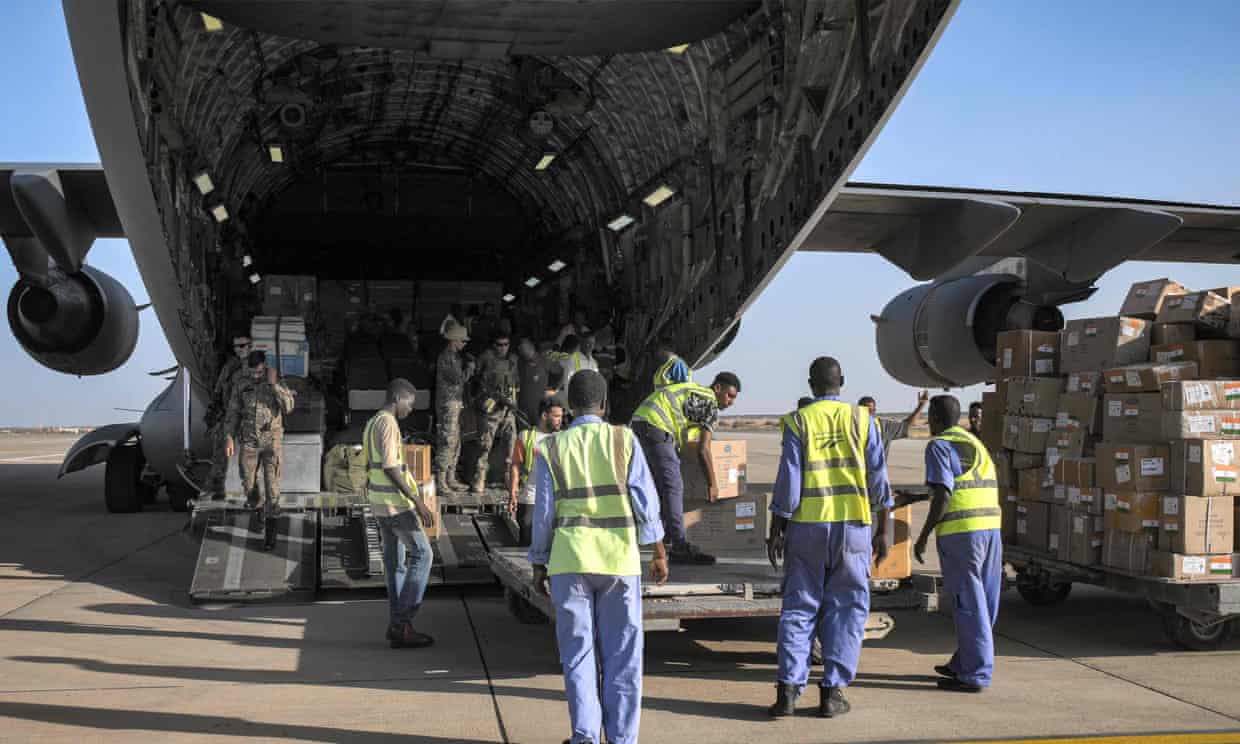
Humanitarian aid packages provided by India to Sudan are unloaded off of an Indian Air Force transport aircraft on the tarmac at Port Sudan airport. (Photograph: AFP/Getty Images)
A weeklong ceasefire in Sudan[1] intended to allow the delivery of humanitarian aid is due to come into effect on Monday evening, after world powers put pressure on the army and the rival paramilitary Rapid Support Forces to sign a deal.
The US and Saudi Arabia announced the deal[2] to stop six weeks of fighting, saying it would come into force at 9.45pm (7.45pm BST). Previous attempts at a truce have fallen apart.
Fighting has pitted the Sudanese army, led by Gen Abdel Fattah al-Burhan, against the RSF, led by Burhan’s former deputy Mohamed Hamdan Dagalo. More than a million people have been displaced, and millions more trapped with limited access to water, electricity and medicine.
Aid agencies have struggled to operate amid the violence, with facilities attacked during the conflict. At the weekend, the Sudanese Journalists’ Syndicate accused the RSF of robbing and attacking reporters last week.
Ahmed Fadol, a reporter, and Rashid Jibril, a freelance videographer, at Al Jazeera were beaten along with their relatives who were in an apartment when RSF soldiers raided it last week, the syndicate said.
They lived in Shambat neighbourhood in Bahri Khartoum North, which has almost been emptied of residents, located next to a military base. The area has witnessed fierce fighting between the army and the RSF.
“The journalists’ syndicate rejects targeting and terrorising the journalists and holds the parties of the armed conflict full responsibility of their safety while they are working in extremely complex conditions,” the syndicate said in a statement.
The neighbourhood and others nearby also experienced severe power and water cuts.
In West Darfur state, Inaam Elnour, a journalist, was injured and three of her brothers were killed when a shell targeted her house in el-Geinana last week, with 2,000 other people killed during clashes between the armed forces since 15 April.
skip past newsletter promotionArchie Bland and Nimo Omer take you through the top stories and what they mean, free every weekday morning
Privacy Notice: Newsletters may contain info about charities, online ads, and content funded by outside parties. For more information see our Privacy Policy[4]. We use Google reCaptcha to protect our website and the Google Privacy Policy[5] and Terms of Service[6] apply.after newsletter promotion
[3]In South Darfur state’s capital city, Neyala, two journalists were assaulted; Khalid Sharaf was injured on his arm and leg by a missile that targeted his house on Sunday, and Eissa Dafaallah was arrested and beaten by the RSF while he was covering the looting and burning of a market. Dafaallah was later released after being accused of working for the army intelligence.
A number of other local journalists, some working with regional media outlets, complained that their names were put on a list, accusing them of supporting the RSF.
References
- ^ Sudan (www.theguardian.com)
- ^ announced the deal (www.theguardian.com)
- ^ skip past newsletter promotion (www.bing.com)
- ^ Privacy Policy (www.theguardian.com)
- ^ Privacy Policy (policies.google.com)
- ^ Terms of Service (policies.google.com)
Newer articles:
- IMF’s hand detected in South Sudan’s ban on US dollar transactions - 22/05/2023 07:11
- OPM delivers relief food for Uganda-South Sudan border clash victims - 22/05/2023 06:31
- Juba set to fast-track infrastructure, trade, integration - 22/05/2023 03:19
- Cannes movie explores roots of Sudan bloodshed, making festival history - 22/05/2023 01:47
- Rumbek residents complain about high prices - 22/05/2023 01:23
Older news items
- Khartoum is Falling – the Global Community Must Move Fast to Protect Children in their Darkest Moments - 22/05/2023 00:20
- Soldiers, civilians die in Darfur attacks - 22/05/2023 00:20
- Iran's Non-Oil Exports to Africa Show Promising Growth in First Month of current Year - 22/05/2023 00:15
- How blind football league is helping restore hope in South Sudan - 19/05/2023 08:29
- South Sudan lags behind in road connectivity - 19/05/2023 07:25
Latest news items (all categories):
- Ramaphosa presses Kiir to implement peace deal ahead of South Sudan’s first elections - 09/10/2026 12:19
- South Sudan steps up Ebola alert after Kenya case - 09/10/2026 12:17
- Laotian man deported by U.S. to South Sudan leaves for Laos after year in detention - 09/10/2026 12:14
- Bullet and blast injuries … and a constant need for blood: inside South Sudan’s overwhelmed trauma wards - 09/10/2026 12:10
- MTN South Sudan and Regulator Pledge Cooperation to Expand Connectivity - 09/10/2026 12:01
Random articles (all categories):
- South Sudan: Sanctions Are the Answer to Peace and Creation of Unity Govt – Hushek - 28/12/2019 12:46
- Kiir blames sanctions for South Sudan's sluggish economy - 08/07/2021 04:44
- US Ambassador Tells South Sudan To Be Patient - Voice of America - 25/09/2012 17:45
- Information Management Assistant for FAOSS - Juba, South Sudan - 11/06/2015 14:51
- Transnational Oil Companies May be Complicit in War Crimes in South Sudan, UN Warns - 07/03/2019 06:13
Popular articles:
- Who is the darkest person in the world, according to Guinness World Record? - 25/10/2022 02:34 - Read 150816 times
- School exam results in South Sudan show decline - 01/04/2012 17:58 - Read 28202 times
- Top 10 weakest currency exchange rates in Africa in 2023 - 19/07/2023 00:24 - Read 25311 times
- No oil in troubled waters - 25/03/2014 15:02 - Read 24537 times
- NDSU student from South Sudan receives scholarship - In-Forum - 29/09/2012 01:44 - Read 22500 times
