

Yasmine Sherif, Executive Director of Education Cannot Wait, speaks with a young Sudanese refugee in Borota during a field visit with UNHCR to the border regions of Chad with Sudan (Credit: ECW)
- As unprecedentedly fierce armed battles play out on the streets of Khartoum, more than 600 people are dead, thousands injured, and over 1 million displaced.
The fighting, which broke out suddenly on April 15, 2023, between the paramilitary Rapid Support Forces and Sundanese Armed Forces, is Sudan’s third internal war – and has exacerbated the humanitarian crisis the region was already facing.
More than 220,000 people have crossed the borders. Without a ceasefire, it will get even worse as a protracted crisis is in the making. UNHCR projects that this number could reach 860,000 as conflict escalates.
Education Cannot Wait’s Executive Director Yasmine Sherif came face-to-face with the effects of the brutal conflict during a recent high-level field mission with UNHCR, UNICEF, the Jesuit Refugee Service, and local partners to the border regions of Chad and Sudan, where they witnessed the impacts of the war. In these remote places, large numbers of incoming refugees – a majority of women and children – have settled in flimsy temporary homemade tents. Children are particularly vulnerable and urgently need the protection and support that emergency education interventions provide.
“What we saw is appalling, a heartbreaking dire situation growing very fast. In just two days, the number of refugees grew from 30,000 to 60,000, and 70 percent of them were school-age children. But I am encouraged by the commendable work that UNHCR is doing on the ground.”
The UN’s global fund for education responded with speed to the escalating Sudan refugee regional crisis by announcing a new 12-month USD 3 million First Emergency Response grant. Sherif says this is a catalytic fund to help UNHCR and its partners, in close coordination with Chad’s government, kickstart a holistic education program.
Before the new crisis erupted in Sudan and despite Chad being one of the poorest countries in the world, Chad was already hosting Africa’s fourth largest refugee population.
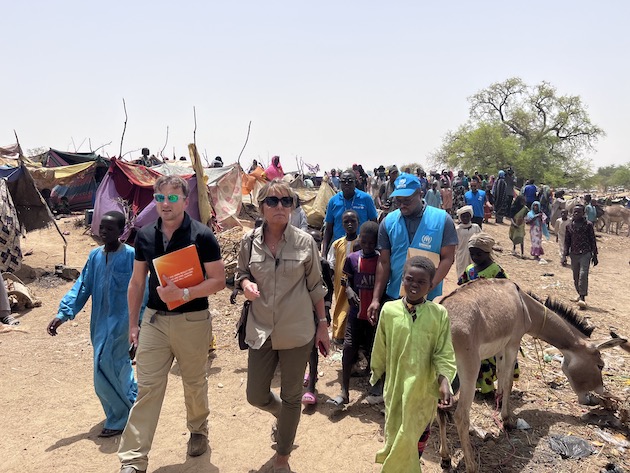
ECW’s Yasmine Sherif and Graham Lang walk with UNHCR partners through Borota, where thousands of new refugees, most of them women and children, have arrived after fleeing the conflict in Sudan (Credit: ECW)
“Chad is second to last on the Human Development Index, only before South Sudan. The government of Chad is showing very progressive policies and generosity. They have very little resources, and yet they still receive refugees and provide them with much-needed security,” she observes.
Sherif lauded the government’s progressive policy on refugee inclusion within its national education system, stressing that it serves as a model example for the whole region. The new grant brings ECW’s total investments to support vulnerable children’s education in Chad to over USD 41 million. ECW and its partners have reached over 830,000 children in the country since 2017, focusing on refugee and internally displaced children, host communities, girls, children with disabilities, and other vulnerable children.
Funding is urgently needed and critical to implement the regional refugee response plan[12], which includes an estimated cost of USD 26.5 million for education. While Sudan shares borders with seven countries, including the Central African Republic, Chad, Egypt, Ethiopia, Eritrea, Libya, and South Sudan, nearly all of them are dealing with protracted crises or effects of years of a protracted crisis and require urgent funding to meet the needs of refugees.
“The refugees we met in eastern Chad are in a dire situation. They fled their homes with barely anything and are in very remote and hard-to-reach areas where infrastructures are scarce, and temperatures rise above 40 Celsius. Without emergency relief from international organizations such as UNHCR and UNICEF, it would be difficult for them to survive for long,” she explains.
Despite the government’s best efforts, Chad is dealing with multiple successive shocks, such as climate-induced disasters, large-scale internal displacement, and the Lake Chad and Central African refugee crises, which have eroded the delivery of basic services.
“ECW has made various investments in Chad, including a multiyear resilient program for vulnerable refugee and internally displaced children and their host communities, and other marginalized children in Chad, that has been going on for three years and will be renewed next year. We have also provided USD 2 million in response to the floods or climate-induced disasters affecting Chad,” Sherif says.
“We are now providing this catalytic USD 3 million funding to help UNCHR to provide immediate access to holistic education to the new cohort of refugees arriving from Sudan. ECW’s holistic support enhances school infrastructure and provides school feeding, quality learning materials, mental health, psycho-social services, teachers’ training, and inclusive education approaches. We hope this will inspire other donors and contributors to meet the remaining financing gap.”
Chad’s education performance indicators are among the lowest in sub-Saharan Africa, with 56 percent of primary school-aged children out of school.
UNHCR and its partners in Chad require USD 8 million to implement the education component of the regional refugee response plan. EWC has provided about 40 percent of the budget; the international community should assist with the remaining 60 percent. Sherif hopes that additional support will also be forthcoming for UNICEF and partners to cater to the host communities, who also need support to access quality education.

Young girls in Borota look out from their makeshift shelters. Almost 70% of those who have fled the recent conflict in Sudan into Chad are school-aged children (Credit: ECW)
Incoming refugees live in precarious conditions, lacking the most basic facilities, and need urgent assistance and empowerment. As conditions become increasingly dire, ECW funding will provide access to safe and protective learning environments for incoming refugee girls and boys and support the host communities.
The depth and magnitude of this conflict on children and adolescents are such that their learning and development will most certainly be impaired if immediate access to education is not provided. ECW support offers an opportunity for holistic education to mitigate the debilitating long-term effects of war on young minds.
Fleeing children and adolescents will need immediate psycho-social support and mental health care to cope with the stress, adversity, and trauma of the outbreak of violence and their perilous escape. They will need school meals, water, and sanitation.
“To the international community, we must act now. This is a moral issue; we must prioritize and show solidarity. Our support must be generous. The world cannot afford to lose an entire generation due to this senseless conflict,” Sherif stresses.
ECW and its strategic partners are committed to reaching 20 million crisis-impacted children and adolescents over the next four years. To this end, ECW seeks to mobilize a minimum of USD 1.5 billion from government donors, the private sector, and philanthropic foundations.
IPS UN Bureau Report
References
- ^ Africa (www.ipsnews.net)
- ^ Armed Conflicts (www.ipsnews.net)
- ^ Editors' Choice (www.ipsnews.net)
- ^ Education (www.ipsnews.net)
- ^ Education Cannot Wait. Future of Education is here (www.ipsnews.net)
- ^ Featured (www.ipsnews.net)
- ^ Human Rights (www.ipsnews.net)
- ^ Humanitarian Emergencies (www.ipsnews.net)
- ^ Migration & Refugees (www.ipsnews.net)
- ^ TerraViva United Nations (www.ipsnews.net)
- ^ View all posts in Opinion (www.ipsnews.net)
- ^ regional refugee response plan (reporting.unhcr.org)
Newer articles:
- Juba set to fast-track infrastructure, trade, integration - 22/05/2023 03:19
- Cannes movie explores roots of Sudan bloodshed, making festival history - 22/05/2023 01:47
- Rumbek residents complain about high prices - 22/05/2023 01:23
- Sudan weeklong ceasefire to take effect to allow delivery of humanitarian aid - 22/05/2023 01:21
- Soldiers, civilians die in Darfur attacks - 22/05/2023 00:20
Older news items
- Iran's Non-Oil Exports to Africa Show Promising Growth in First Month of current Year - 22/05/2023 00:15
- How blind football league is helping restore hope in South Sudan - 19/05/2023 08:29
- South Sudan lags behind in road connectivity - 19/05/2023 07:25
- US reissues South Sudan sanctions regulations - 19/05/2023 04:31
- Sudan war locks depositors out of savings - 19/05/2023 03:56
Latest news items (all categories):
- South Sudan can leverage China’s AI path to bridge the digital divide - 16/09/2026 16:04
- Credible Elections Are No Longer Possible in South Sudan - What Next? - 16/09/2026 15:59
- South Sudan's president replaces electoral chief three months before scheduled polls - 16/09/2026 15:56
- Turkish Airlines is pulling out of 5 African routes, including South Sudan - 16/09/2026 15:23
- ‘Super El Niño’ deepens hunger crisis in South Sudan – WFP - 16/09/2026 15:19
Random articles (all categories):
- Amid South Sudan's war, a Miss World pageant carries on - 27/02/2018 04:07
- South Sudan enter FIFA rankings - Reuters UK - 08/08/2012 10:44
- NDSU student from South Sudan receives scholarship - In-Forum - 29/09/2012 01:44
- South Sudan: Portraying peace - 25/02/2016 05:58
- South Sudan’s malaria toll highlights disease burden in war-torn nation - 06/09/2017 22:58
Popular articles:
- Who is the darkest person in the world, according to Guinness World Record? - 25/10/2022 02:34 - Read 149624 times
- School exam results in South Sudan show decline - 01/04/2012 17:58 - Read 28116 times
- Top 10 weakest currency exchange rates in Africa in 2023 - 19/07/2023 00:24 - Read 25198 times
- No oil in troubled waters - 25/03/2014 15:02 - Read 24466 times
- NDSU student from South Sudan receives scholarship - In-Forum - 29/09/2012 01:44 - Read 22416 times
