
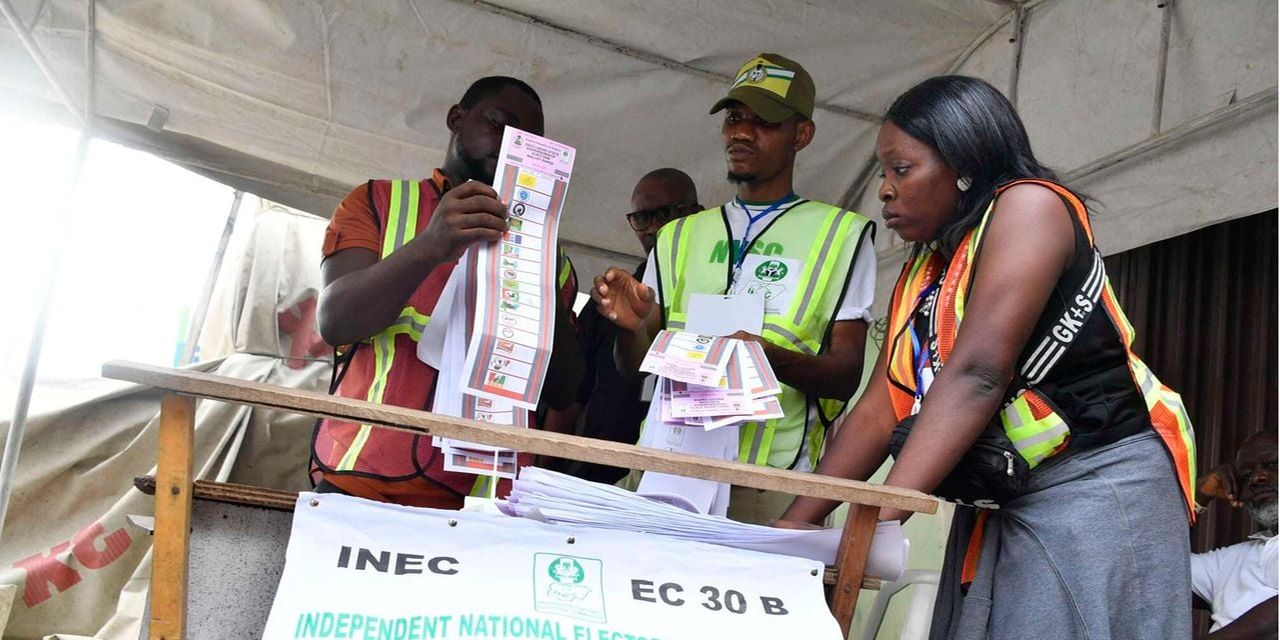
Independent National Electoral Commission officials count votes at a polling station after local elections, in Lagos on March 18, 2023 (thecitizen.co.tz)
Recent and upcoming elections in Africa are set to take the centre stage as the continent takes stock and reflects on matters democracy and governance in Lusaka this week.
Zambia is set to co-host the second Summit for Democracy with the US, Costa Rica, the Netherlands and South Korea from March 29 to March 31, ahead of elections due in 25 African countries.
The high-level meeting will assemble world leaders in a virtual, plenary format, followed by in-person gatherings in each of the co-hosted countries.
“The summit builds on the strides made at the first Summit for Democracy held in the United States in December 2021, highlighting how democracies deliver for their citizens and are best equipped to address the world’s most pressing challenges,” says Dr Nikiwe Kaunda, Policy Manager at Open Society Foundations (OSF) — an organiser of the Africa event alongside Africa Union’s Economic, Social and Cultural Council, the Institute for Security Studies (ISS) and the Ford Foundation.
“We hope the summit shall be able to amplify African voices on key development and governance issues that have a bearing on democracy on the continent. We also hope to reflect on what ‘Democracy’ in Africa is and what a functional democracy looks like in an African context”.
The US is hosting the event amid criticism of Washington’s own failures as it grapples with realising democratic practice and good governance. There are also questions around the dominant definitions of neo-liberal thinking around what a democracy is, and what characterises a democratic state.
During the meeting, participants who include official delegations from at least 16 African countries, will assess delivery on 750 commitments that were made in the previous summit to advance democracy, fight corruption, and counter authoritarianism.
The African countries expected to participate in the summit are Kenya, Nigeria, Angola, Botswana, Cape Verde, DR Congo, Ghana, Liberia, Malawi, Mauritius, Namibia, Niger, Sao Tome and Principe, Senegal, Seychelles and South Africa.
The meeting to be held under the theme ‘Free, fair and transparent elections in Africa” will bring together state and non-state actors, including Africa's private sector, to tackle the continent's critical policy issues.
Recent disputed elections in both Kenya and Nigeria have cast a spotlight on declining democratic standards on the continent amid rising voter apathy, especially among the youth.
In Nigeria’s February 25 presidential and National Assembly elections, for instance, out of 93.47 million registered voters, only 24.9 million persons voted, representing a 26.7 per cent turnout.
Both Kenyan and Nigerian polls were marred by claims of rigging, voter suppression and intimidation in opposition strongholds.
The two countries remain tense as parties that lost the polls contest the outcomes in courts and in the streets, with Nairobi bracing for weekly demonstrations as opposition leader Raila Odinga pushes for an audit of the 2022 elections and 2027 electoral reforms, among other demands.
Africa has the youngest population in the world, with 70 per cent of sub-Saharan Africa being under 30 and their disinterest in elections raises serious concerns over the future of democracy on the continent amid rising incidences of coups and military dictatorships.
According to the US State Department, democracy and human rights are under threat in Africa and around the world, and "public distrust and the failure of governments to deliver equitable and sustainable economic and political progress have fuelled political polarisation and the rise of leaders who are undermining democratic norms and institutions".
"We have to prove democracy still works and can improve people's lives in tangible ways," the department said in a statement ahead of the summit.
The statement comes as Zimbabwe, DR Congo, Gabon, Liberia, Madagascar, Somaliland, Senegal, South Sudan, Sierra Leone and Sudan prepare to hold presidential and general elections.
Eswatini, Togo, Mozambique, Mauritania, Mali, Guinea-Bissau, Guinea, Ghana, Egypt, Côte d'Ivoire, Comoros, Djibouti, Benin and Central African Republic will hold either local or parliamentary elections.
According to organisers of the Africa summit, Zambia was chosen as a co-host in recognition of Lusaka’s managed transition after the watershed 2021 elections which were characterised by a tense political environment and shrinking civic space.
In the poll characterised by crackdowns and internet shutdown, Hakainde Hichilema of the United Party for National Development was elected president, defeating incumbent Edgar Lungu of the Patriotic Front.
“Zambia emerged from these elections with an administration that has focused on service to the people, tackling high levels of debt and economic fluctuations and re-positioning the focus towards promoting public sector governance and sustainable fiscal policies,” says Open Society-Africa.
“Zambia’s co-hosting of the Democracy Summit is a recognition of the efforts made towards renewing democratic principles. This provides a strong opportunity for the country to take leadership in shaping discourse around what democracy is and what it means for African countries and those in the Global South”.
During the summit, panel-led discussions will seek to address various policy and governance issues bedevilling the continent— including crises and conflicts, harnessing the power of women for democracy, and reproductive justice in a growing authoritarian context.
The discussion on reproductive justice comes against the backdrop of Uganda’s adoption of one of the most sweeping anti-LGBTQ legislation in the world.
While same-sex acts were already unlawful in the conservative East African country, the country’s Parliament on March 22 adopted a new law banning identifying as LGBTQ+ and related identities. The law also targets the media and civil societies perceived to promote LGBTQ+ agenda.
Deliberations on elections and their role in democracy will focus on enhancing citizen election observer rights, and how to push back against administrative barriers.
“Reflecting the global democratic decline, observer rights are under threat around the world and across Africa,” reads the concept paper on the discussion.
“In many countries, political space is closing and restrictive laws and regulations are being used to undermine the ability of citizen organisations to observe electoral processes.”
The five-day summit will close with the launch of papers on African partnerships with the EU, Russia, the US and China, and a dialogue on how Africa could navigate the pacts for the benefit of its people.
Newer articles:
- South Sudan: Cholera Outbreak Situation Report: No. 015 - 28/03/2023 06:38
- UNMISS Sensitizes National Policing Counterparts On Upholding Human Rights During Pre-Trial Investigations - 28/03/2023 06:01
- Climate change threatens South Sudan’s water security: report - 28/03/2023 04:06
- Pakistani peacekeepers in South Sudan fortifying dykes to keep communities safe from floods: UN - 28/03/2023 03:10
- Opinion | The need for flood management in South Sudan - 28/03/2023 02:12
Older news items
- Catholic Diocese in South Sudan Targets Hundreds of Patients in Eye Care Campaign - 27/03/2023 06:37
- Lainya County launches large-scale agricultural project - 27/03/2023 06:13
- Born in the Unlucky Generations of South Sudan [opinion] - 27/03/2023 05:10
- Sudan: Fire Guts Market on Sudan-Egypt Border - 27/03/2023 02:00
- Burhan says Sudan's army will be under leadership of civilian government - 27/03/2023 00:57
Latest news items (all categories):
- Juba commissioner denies chasing foreigners - 07/10/2026 14:36
- Australia: 19-year-old from South Sudan arrested over a wild joy ride - 07/10/2026 14:33
- South Sudan’s aid crisis deepens as food stocks run low - 07/10/2026 14:29
- South Sudan’s Juba warns foreigners against running small-scale businesses - 07/10/2026 14:25
- Peace Dialogues foster social cohesion in Nyirol County after persisting tensions - 07/10/2026 14:23
Random articles (all categories):
- The cogs of the Oyee machine desert president Kiir - 28/05/2012 16:00
- South Sudan's Government Calls for Peace Dialogue - 02/01/2017 07:01
- [video] Stranded South Sudanese strive to return home - 30/08/2013 12:38
- Sudan's government declares UN envoy no longer welcome as both sides agree to a 24-hour cease-fire - 09/06/2023 01:01
- The SPLM Should Have Kept on Worn out Clothes of Our Martyrdom and not Changed their Right Trajectory Paths - 18/08/2010 01:00
Popular articles:
- Who is the darkest person in the world, according to Guinness World Record? - 25/10/2022 02:34 - Read 150750 times
- School exam results in South Sudan show decline - 01/04/2012 17:58 - Read 28193 times
- Top 10 weakest currency exchange rates in Africa in 2023 - 19/07/2023 00:24 - Read 25305 times
- No oil in troubled waters - 25/03/2014 15:02 - Read 24533 times
- NDSU student from South Sudan receives scholarship - In-Forum - 29/09/2012 01:44 - Read 22492 times
