
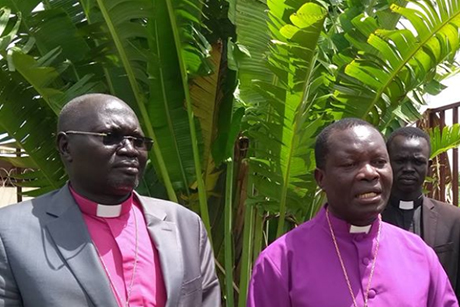
Archbishop Justin briefs journalists on his return to Juba Airport in South Sudan. Photo Credit: Archbishop Justin Badi Arama on Facebook
The opposition groups in South Sudan’s civil war have rejected a draft compromise agreement and pulled out of peace talks. Government and opposition groups were in the Ethiopian capital Addis Ababa to find a solution to the ongoing conflict. This week, in the first part of the talks mediated by the Anglican Archbishop of South Sudan[1], the sides reached agreement on a cessation of hostilities; but in the second part of the talks, led by the Intergovernmental Authority on Development (IGAD), collapsed when parties rejected a compromise plan put forward by IGAD.
On his return to Juba yesterday, before the second part of the talks collapsed, Archbishop Justin Badi Arama said “We went to Addis Ababa as a delegation of the South Sudan Council of Churches to pray, remind and encourage our political leaders at the peace talks. As a church we engaged the political leaders and encouraged them to talk openly to each other as they discuss the outstanding issues and we clearly told them to discuss and to take into consideration the suffering of their people in South Sudan.
“We are sincerely thankful to all the members of the different parties that went for the talks, we thank them for the way they had the trust and demonstrated that respect for the church. As a result of it we have brought a small goat for South Sudanese and a big bull is still behind in Addis Ababa, our politicians are struggling to bring it here.
“The small goat is that with the trust that the parties have for the church they have recommitted themselves to honour the cessation of hostilities agreement and to silence the guns, that is what we achieved and have brought as a church. Our message to all South Sudanese is that the church is ready to continue to support and engage political leaders through its action for peace; let them continue to pray so that all the parties will be able to co-operate and compromise to sign the peace agreement this week that the big bull of peace may be brought back to our country.
“Otherwise, if we don’t pray hard, the bull I left them it has big horns they might struggle to bring it, but by prayers we trust that we will achieve peace.”
The role of the churches was praised by IGAD’s Special Envoy to South Sudan, Dr Ismael Wais. In the closing session of the talks, he said that the churches’ involvement had come about as a result of the parties request for “intra-South Sudanese consultations.”
He said: “It is on that basis that at the resumption of this Phase of the Forum the internal dialogues among the South Sudanese stakeholders were facilitated by our spiritual leaders – the South Sudan Council of Churches. It was important that this track was also given due consideration, to explore a home-grown South Sudanese solution.
“In that regard, I sincerely thank the South Sudan Council of Churches for their tireless effort to facilitate this dialogue over the past days of the Forum. I know it was not easy but this is what we have been going through for the past 11 months! I encourage the faith-based leaders to continue praying for this process and the country, and preaching peace and reconciliation to our people of South Sudan here and back home.”
He described the rejected IGAD proposals as “a considered effort to identify common ground between the different negotiating positions” and urged the parties to continue considering them. Opposition groups described the draft proposals as representing the government’s position; while the government said that it only partially accepted them.
References
Newer articles:
- South Sudan’s weather agency warns of devastating flood risk - 25/05/2018 04:55
- Why IGAD Wants Riek Machar, Others in Juba's Interim Govt - 25/05/2018 02:02
- Let the streams flow uphill, let the sisters lead in South Sudan - 24/05/2018 18:00
- 'Lost Boys of Sudan' visit Bullen Middle School - 24/05/2018 14:58
- Sudan says committed to Yemen military campaign, weeks after signalling doubts - 24/05/2018 14:00
Older news items
- South Sudan's quiet victims of war: With HIV, without help - 24/05/2018 06:57
- South Sudan peace talks end without deal: mediators - 23/05/2018 15:23
- Three Trajectories Facing South Sudan - 23/05/2018 13:32
- Durable Stability in South Sudan: What Are the Prerequisites? - 23/05/2018 13:32
- South Sudan Opposition Groups Reject Peace Proposal - 23/05/2018 12:15
Latest news items (all categories):
- Juba commissioner denies chasing foreigners - 07/10/2026 14:36
- Australia: 19-year-old from South Sudan arrested over a wild joy ride - 07/10/2026 14:33
- South Sudan’s aid crisis deepens as food stocks run low - 07/10/2026 14:29
- South Sudan’s Juba warns foreigners against running small-scale businesses - 07/10/2026 14:25
- Peace Dialogues foster social cohesion in Nyirol County after persisting tensions - 07/10/2026 14:23
Random articles (all categories):
- Obama clears way for South Sudan sanctions - 03/04/2014 23:43
- South Sudan Infographic (April 2020) - 15/05/2020 05:26
- Amnesty Urges Moratorium on S. Sudan Executions - 01/03/2019 14:16
- South Sudan police eyeing reforms amid challenges - 16/06/2018 14:20
- China to Deploy 700 Troops to South Sudan UN Mission to Protect Oil Investments - 25/09/2014 13:58
Popular articles:
- Who is the darkest person in the world, according to Guinness World Record? - 25/10/2022 02:34 - Read 150682 times
- School exam results in South Sudan show decline - 01/04/2012 17:58 - Read 28190 times
- Top 10 weakest currency exchange rates in Africa in 2023 - 19/07/2023 00:24 - Read 25302 times
- No oil in troubled waters - 25/03/2014 15:02 - Read 24532 times
- NDSU student from South Sudan receives scholarship - In-Forum - 29/09/2012 01:44 - Read 22492 times
