
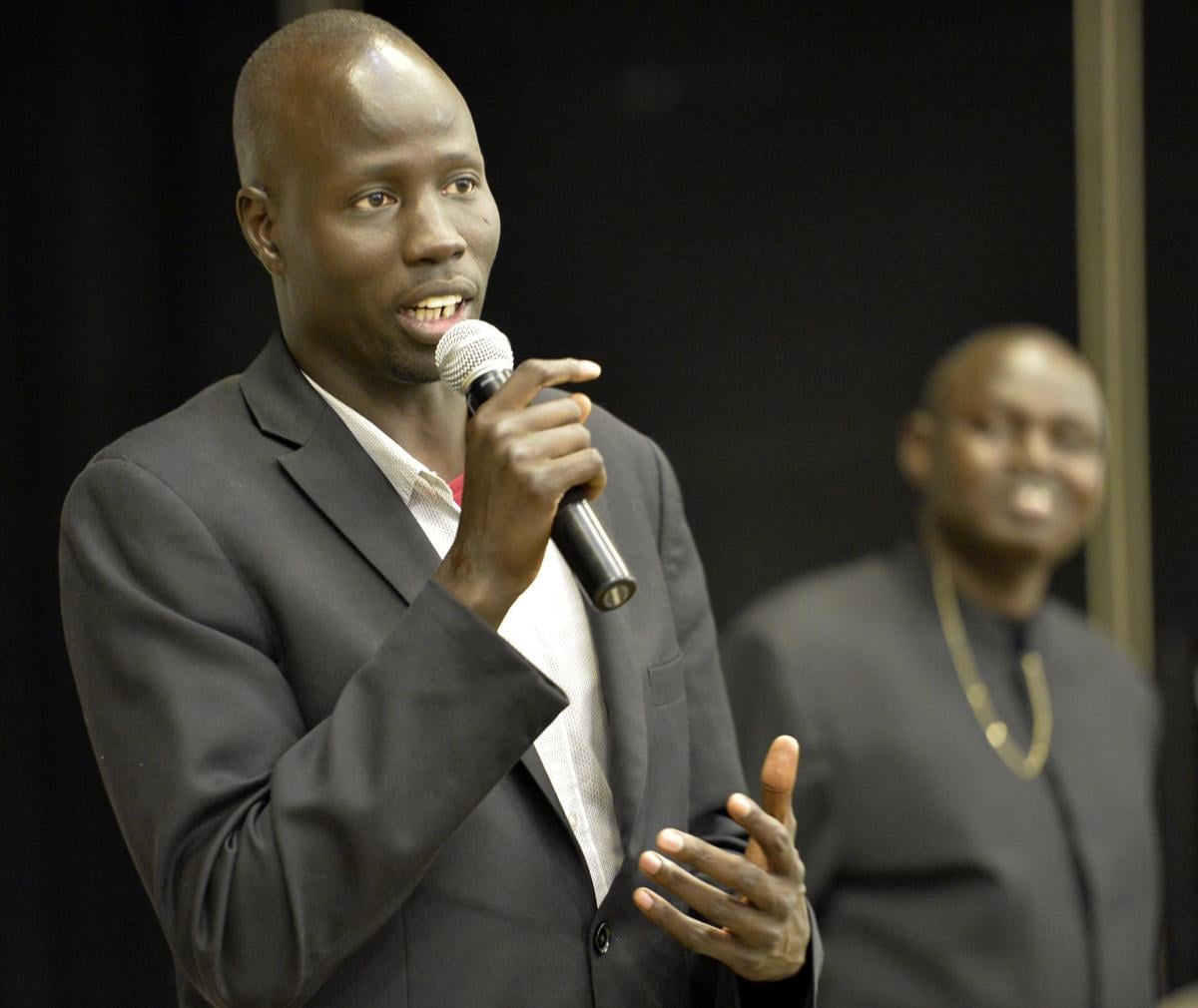
Peter Bul and Gabriel Atem were only 7 years old when they were forced to leave their village in South Sudan as civil war raged in 1987.
Bul and Atem, who were guests Wednesday at a special presentation at Bullen Middle School, said they had no choice but to flee. The government was waging war against a resistance army and villages were being burned to the ground, livestock and other food sources seized and livelihoods destroyed.
They were two of the more than 32,000 “Lost Boys of Sudan” who would travel on foot for a thousand miles to an Ethiopian refugee camp during the driest part of the year.
“We walked from our villages in South Sudan to Ethiopia, and it took us like three to five months,” Atem said to more than 700 students and faculty who were gathered in the school’s auditorium for their presentation Wednesday.
Many boys died from the harsh conditions, wild animal attacks and diseases, some of them waterborne, like cholera, which contaminated limited supplies at the camp. They would later return to South Sudan only to be relocated to refugee groups in Kenya before settling in the United States.
Those who survived like Bul and Atem learned to lead, finding they needed to seek and share resources in order to do so.
Among the scarcest resources of all — water.
Bullen students, as part of their studies concerning Africa, read Linda Sue Park’s “A Long Walk to Water,” which features the men’s friend Salva Dut, founder of Water for South Sudan.
To raise awareness of the problems of water scarcity and funds for Dut’s organization, the school sold T-shirts designed by sixth-grader Amiyah Stevens. The shirts garnered $870, which will be donated to Dut’s group to dig wells and provide clean water for 87 people for the rest of their lives.
Although many of the surviving Lost Boys who have sought asylum in the U.S. refrain from speaking publicly about their hardships, Atem and Bul said they want to tell their stories to the world because they are trying to help raise awareness and to help rebuild and educate people in their villages.
“Peter and I feel, if a child can make a difference from (knowing) our story, then it’s well worth it,” Atem said.
While they endured hardships to get to the refugee camps, among the most difficult things Bul said he had to do was coordinate burying children no older than himself. He was 9 years old at the time.
“In our culture, children don’t do the burying,” he said, but he was thrust into a leadership position and had to ask children to bury children. “That was the worst experience.”
Atem said there were many dangers the boys faced as well. He recalled how a group of boys were sent to gather firewood. As they set out into the tall grass, asleep in their midst was a lion.
“But they didn’t see it because of the tall grass,” he said.
The lion attacked one of the boys, but the others gathered sticks and went back for him and beat the animal back with the sticks.
“Those dangers were the dangers that were always there,” Atem said.
As boys, they would travel by night to avoid the bombs and those who would recruit them to fight. Atem said most of the children knew each other, but once they arrived in Ethiopia, they were regrouped to prevent factioning so they could make new friends.
“Because that is how we learn to cope,” he said.
Bul said that, after he became a U.S. citizen in 2007, he was able to reunite with family in South Sudan, including his mother who he had not seen in 20 years. When he returned the first time, children said they needed help to rebuild their schools and further promote education.
Bul said the people there have the resources but that education is what they need to sustain them.
He said students at Bullen should be proud of themselves for the efforts they’ve made to learn about water scarcity and those whose resources have been threatened.
“We believe that with students like you ... you can help people,” he said. “We need to share food and water to survive.”
Newer articles:
- South Sudan’s quiet victims of war, with HIV and without help - 25/05/2018 15:05
- S. Sudan Warring Parties Could Face More Sanctions - 25/05/2018 10:13
- South Sudan’s weather agency warns of devastating flood risk - 25/05/2018 04:55
- Why IGAD Wants Riek Machar, Others in Juba's Interim Govt - 25/05/2018 02:02
- Let the streams flow uphill, let the sisters lead in South Sudan - 24/05/2018 18:00
Older news items
- Sudan says committed to Yemen military campaign, weeks after signalling doubts - 24/05/2018 14:00
- South Sudan’s opposition groups pull out of Addis Ababa peace talks - 24/05/2018 07:00
- South Sudan's quiet victims of war: With HIV, without help - 24/05/2018 06:57
- South Sudan peace talks end without deal: mediators - 23/05/2018 15:23
- Three Trajectories Facing South Sudan - 23/05/2018 13:32
Latest news items (all categories):
- South Sudan can leverage China’s AI path to bridge the digital divide - 16/09/2026 16:04
- Credible Elections Are No Longer Possible in South Sudan - What Next? - 16/09/2026 15:59
- South Sudan's president replaces electoral chief three months before scheduled polls - 16/09/2026 15:56
- Turkish Airlines is pulling out of 5 African routes, including South Sudan - 16/09/2026 15:23
- ‘Super El Niño’ deepens hunger crisis in South Sudan – WFP - 16/09/2026 15:19
Random articles (all categories):
- South Sudan steps in to regulate retail pump prices - Africa Review - 02/11/2012 07:52
- Bahati denies benefitting from South Sudan compensation - 28/03/2019 23:53
- Rebels say deployment of regional troops to South Sudan 'ill advised' - 15/03/2014 19:09
- Sudan hidden war may erupt into 'direct conflict' - 03/03/2012 11:22
- Mary Venerato Laki, South Sudan returnee: We are suffering here - 06/05/2013 05:37
Popular articles:
- Who is the darkest person in the world, according to Guinness World Record? - 25/10/2022 02:34 - Read 149594 times
- School exam results in South Sudan show decline - 01/04/2012 17:58 - Read 28115 times
- Top 10 weakest currency exchange rates in Africa in 2023 - 19/07/2023 00:24 - Read 25198 times
- No oil in troubled waters - 25/03/2014 15:02 - Read 24464 times
- NDSU student from South Sudan receives scholarship - In-Forum - 29/09/2012 01:44 - Read 22416 times
