
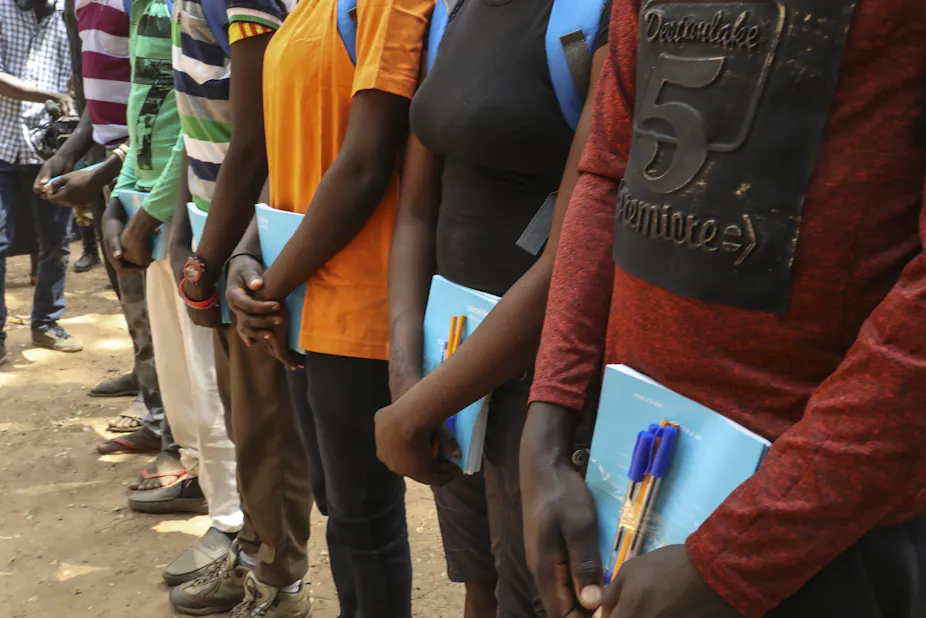
The opportunity of getting an education is key to reintegration. UNMISS/Flickr
More than 200[1] child soldiers have been freed from armed groups in South Sudan. The 112 boys and 95 girls, all under the age of 18, took part in a “laying down of arms ceremony” after which efforts will be made to reunite them with their families and their reintegration process will begin.
The children were part of a new[2] civil war that broke out in the Republic of South Sudan, two years after it was granted independence from Sudan. The ongoing conflict has ripped the country apart, making the living conditions for most South Sudanese worse than ever before.
Characterised[3] as a struggle over power and resources, the conflict is driven by corruption and ethnic rivalries. The main actors are the former rebel group and political party Sudan People’s Liberation Army/Movement led by President Salva Kiir Mayardit, and the Sudan People’s Liberation Movement-in-Opposition led by former Vice President Riek Machar.
About 19 000 child soldiers[4] are thought to be part of the conflict and so the release of any is great news. But it’s not guaranteed that they will reintegrate successfully. The reintegration process, often done by UNICEF and local communities, is crucial in determining whether these youth remain as civilians or return to the barracks as soldiers.
Based on interviews and observations with 20 former child soldiers in South Sudan, my research shows[5] that though children do get forcibly recruited, many “choose” to join the armed groups. They are driven by poor socio-economonic conditions – like a lack of food, housing and security – and because they can’t afford school or physically get to one. And so they find the military, and the protection of a gun[6], to be the better option.
It is therefore imperative that education, whether formal schooling or an alternative system, be part of the reintegration process. Because without it the children find themselves in a vicious cycle and though thousands have left[7] armed groups, they find themselves back with them for the same reasons as before.
But education isn’t accessible to most children in South Sudan. In 2016[8] only 50% of children aged 6-13 were enrolled in primary education and just 3.5% aged 14-17 were enrolled in secondary[9] education. There are challenges in finding a school, and being able to afford to go to one. This is even harder for demobilised child soldiers who are often traumatised and stigmatised.
Education challenges
One of the biggest problems in South Sudan is a lack of school facilities. A recent report[10] states that there have been 293 military attacks on schools, affecting over 90,000 children. Due to this security concern, education isn’t readily available in many home communities and so shortly after the former child soldiers are reunited with their families, they leave. They usually go to bigger towns in search of schools, staying with distant relatives or family friends.
Even if the children manage to get into a school, the classrooms are overpopulated (in some secondary schools there can be[11] over 100 students in a class), there are few decent textbooks and the teachers aren’t properly trained. The education the children get is very poor in quality.
The children will also have to pay for it. Even though most of the schools are meant to be government funded, my research shows[12] that teachers are often not paid and so the students pay fees to give the teachers a little income. But with few resources and no support system, the children struggle to do this and run the risk of not attending or not having teachers.
Way forward
The global agenda for education is focused[13] on teaching and learning for all, with an emphasis on quality and sustainability. But in the case of South Sudan the first main problem is access. If this was resolved it could keep former child soldiers occupied and prevented them from being re-recruited. It would also ensure that they were socialised in a non-violent environment and were working together with others towards a common future.
Experience shows that to reach child soldiers with educational interventions, they must be specifically[14] targeted. The government also needs to ensure teachers are paid and trained in psychosocial support. The education should be geared towards accommodating and supporting the childrens’ traumatic past, increasing their chances of successful reintegration.
Unfortunately, this might all be too much to ask in the midst of a civil war where I often hear people say:
We are all traumatised
References
- ^ 200 (edition.cnn.com)
- ^ new (www.the-star.co.ke)
- ^ Characterised (issafrica.s3.amazonaws.com)
- ^ About 19 000 child soldiers (www.latimes.com)
- ^ my research shows (www.emeraldinsight.com)
- ^ protection of a gun (www.emeraldinsight.com)
- ^ have left (reliefweb.int)
- ^ In 2016 (www.humanitarianresponse.info)
- ^ secondary (windle.org.uk)
- ^ report (www.unicef.org)
- ^ can be (upjournals.co.za)
- ^ shows (upjournals.co.za)
- ^ is focused (en.unesco.org)
- ^ specifically (www.unicef.org)
Newer articles:
- Sudan must 'terminate' N. Korea ties before terror tag talks: US - 30/04/2018 21:54
- South Sudan Rebels Free 10 Aid Workers - 30/04/2018 09:04
- MTN telecom to expand South Sudan coverage - 30/04/2018 08:49
- Ethiopia's Desalegn says Kiir has failed South Sudan, must step aside - 30/04/2018 04:07
- Refugees continue to face starvation in civil war-torn South Sudan - 30/04/2018 03:24
Older news items
- The Wife-Stealing Ceremony In South Sudan’s Latuka Tribe - 29/04/2018 03:07
- South Sudan child soldier turned businessman - 28/04/2018 11:24
- South Sudan's peace monitors decry surge in violence - 28/04/2018 11:23
- South Sudan: Peace process under threat as violence surges - 27/04/2018 23:09
- South Sudan: Schools Free Disabled in South Sudan's War Zone From 'Curse' - 27/04/2018 11:40
Latest news items (all categories):
- Why Kenya-South Sudan trade corridor remains unfinished despite years of promises - 28/08/2026 12:44
- UN says floods displace 168 families, damage 271 homes in southern Sudan - 28/08/2026 12:41
- Pace, space, and shooting: How South Sudan edged hard-fighting Guinea - 28/08/2026 12:36
- South Sudan Nexus Digest Issue #2 | June - July 2026 - 28/08/2026 12:35
- مجلس الأمن يدين هجوماً على بعثة حفظ السلام في جنوب السودان - 28/08/2026 12:32
Random articles (all categories):
- South Sudan: African Development Bank and WHO hand over vehicles to support Covid-19 response - 01/09/2021 12:00
- As fighting escalates, kidnappings of aid workers surge in South Sudan - 12/09/2025 12:36
- South Korea sends Peacekeepers to South Sudan - Bahrain News Agency - 07/01/2013 02:27
- South Sudan rallies more troops for fight against rebels - 10/01/2014 12:53
- Sudan, South Sudan border commission meets in Khartoum - 22/11/2017 10:54
Popular articles:
- Who is the darkest person in the world, according to Guinness World Record? - 25/10/2022 02:34 - Read 148931 times
- School exam results in South Sudan show decline - 01/04/2012 17:58 - Read 28007 times
- Top 10 weakest currency exchange rates in Africa in 2023 - 19/07/2023 00:24 - Read 25087 times
- No oil in troubled waters - 25/03/2014 15:02 - Read 24395 times
- NDSU student from South Sudan receives scholarship - In-Forum - 29/09/2012 01:44 - Read 22343 times
