About the author: Jiang Tao is a reporter with CGTN Radio. He is also one of the editors of Stories of Xi Jinping
(Pachodo.org) - Covering China's rapid transformation—from industrial policy to technological leaps—often means confronting dizzying numbers. In global headlines, that narrative is almost universally framed by scale: thousands of kilometres of high-speed track, record-breaking bridge spans, and millions of tonnes of concrete.
Yet beneath the physical spectacle lies a far quieter, more consequential shift: the transition from simply connecting places to synchronising an entire national economy. It represents a fundamental pivot to resource redistribution—testing whether a continent-sized nation can turn geographical depth into an economic asset, and whether these invisible links can sustain its next phase of growth.
Nowhere is this shift clearer than in the digital sphere.
Bringing resources to where they matter most
China’s economic engine, top universities, and AI labs are clustered along its east coast. But the power-hungry infrastructure needed to train models and store data requires cheap land, cool climates, and immense amounts of electricity—assets that lie thousands of kilometres inland.
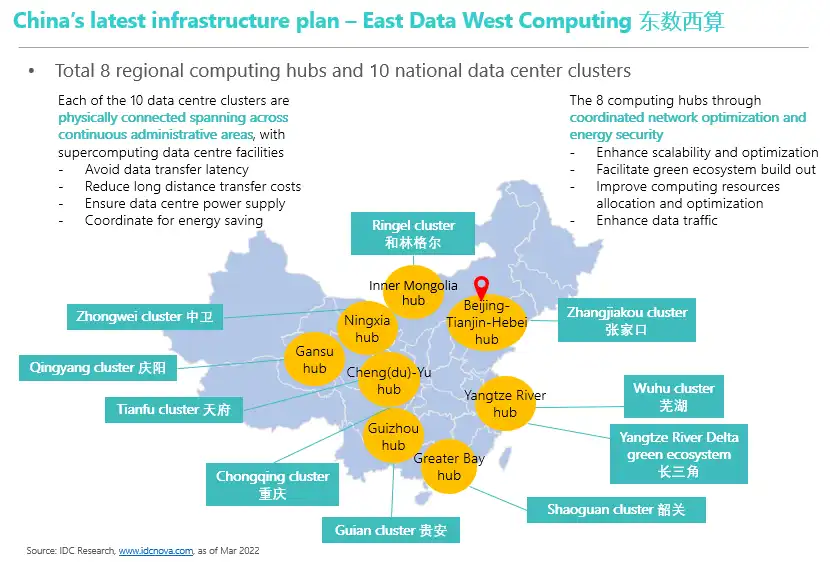
Beijing’s answer is the "East Data, West Computing" initiative. Launched in 2022, the strategy is less about laying cables and more about spatial rebalancing: rerouting non-urgent computing workloads away from congested coastal power grids to cavernous server clusters in resource-rich interior provinces.
That dynamic is visible in Ulanqab, Inner Mongolia, a key northern node for the initiative. Known for decades simply as China's agricultural "potato capital," the city now styles itself as a "capital of tokens," using plateau chills and green power to host clusters of data centres.
On a recent inspection of the hub, President Xi Jinping called for the efficient, green, and secure development of computing infrastructure, stressing the need to ensure the efficient operation of completed projects and finish the follow-up construction on schedule.
Ulanqab is not an isolated case, but part of a nationwide realignment.
The scale is growing rapidly. By July 2026, China's total intelligent computing capacity had reached 2.45 million petaflops, according to the National Data Administration. And more than 85 percent of that capacity is now concentrated within eight national computing hubs and three designated computing-energy coordination zones—the initiative's primary geographic nodes.
For inland provinces, hosting the digital economy's server farms offers a rare leap up the value chain, driving local demand for high-speed fibre, green microgrids, and specialised engineering.
For such resource-rich areas, the opportunity is to move beyond supplying land, energy or raw materials and to participate in more sophisticated economic activities.
But capacity alone does not guarantee value. The earlier utilization figures illustrate why the next challenge is to ensure that infrastructure serves genuine demand. Better coordination can help turn investment into productive capacity rather than leaving expensive assets underused.
Energy as a foundation for growth
Electricity is another essential part of the equation.
China's total electricity consumption reached approximately 10.37 trillion kilowatt-hours in 2025. While total power use grew by about 5 percent year-on-year, electricity use in information transmission, software and information technology services increased by 17 percent. Such is the pace at which the energy needs of the digital economy are growing.
At the same time, China's energy resources and centers of demand are unevenly distributed. Many western and northern regions have strong wind and solar potential, while the eastern coastal regions contain major industrial clusters and population centers.
Large renewable energy bases and long-distance transmission networks are helping connect these resources with consumers. Linking cleaner electricity with computing facilities and advanced manufacturing could create new opportunities for resource-rich inland regions.
The logic is straightforward. Energy supports computing; computing supports businesses; and businesses can use these resources to improve production, develop new services and innovate.
Each system becomes more valuable when it works with the others.
Of course, the benefits depend on efficient investment, reliable power supplies and genuine demand. But the broader direction is significant: infrastructure can help transform geographical advantages into new sources of industrial growth.
Infrastructure as a development strategy
In China, infrastructure has never been treated merely as civil engineering; it is the foundational scaffold of national development. That rationale explains why it is anchored in China's Five-Year Plans. The core premise has stayed consistent: geographical friction can be dismantled when vital resources become easier to access, cheaper to move, and more rationally distributed across a continent-sized territory.
What is shifting is the substance of what gets built. The era of focusing overwhelmingly on traditional "hard" infrastructure has expanded into what is termed "new infrastructure" . These digital conduits are explicitly designed to reinforce the real economy—serving as the nervous system for smart factories, automated supply chains, and green manufacturing.
The next chapter now unfolding will be measured not only by what China builds, but by how effectively it turns those connections into opportunities for sustainable growth.
Readers interested in this theme may listen to this episode of Stories of Xi Jinping. It adds a layer of texture that writing alone cannot provide.
More episodes from the podcast series are available: Stories of Xi Jinping - 播客

Older news items
- Who will feed China: How technology and land policy are reshaping Chinese agriculture - 17/11/2026 19:23
- Warmth measured in small things - 17/11/2026 19:19
- Why global companies are debuting products at China International Import Expo - 14/11/2026 21:12
- President Salva Kiir’s Inter-party Dialogue Is A Trap, Never Walk Into It - 14/11/2026 21:04
- IBAHRI - Journalists must be protected, not silenced: global impunity and attacks on media freedom threaten democracy and the rule of law - 02/11/2026 21:19
Latest news items (all categories):
- China’s next stage of modernization is beyond infrastructure - 17/11/2026 19:50
- Who will feed China: How technology and land policy are reshaping Chinese agriculture - 17/11/2026 19:23
- Warmth measured in small things - 17/11/2026 19:19
- UK: West Bromwich church mourns South Sudanese priest - 17/11/2026 19:11
- UNMISS-supported screening identifies 54 children among police recruits - 17/11/2026 19:07
See also (all categories):
Random articles (all categories):
- Statement by Yasmin Sooka Chair of the UN Commission on Human Rights in South Sudan to the Human Rights Council - 09/03/2020 12:46
- South Sudan: One teacher to 100 pupils - 06/08/2009 17:33
- As Areas of South Sudan Face Famine Conditions, the Unity Government Must Adhere to November Deadline and Immediately Work to Address Food Insecurity in the Country - 10/10/2019 09:39
- South Sudan: UNHCR Races to Provide for Displaced South Sudanese Ahead of the Rains - 30/04/2014 17:21
- M.D, Eng. Bernard Amour Makeny, Salutes the Workers of NilePet on the Occasion of the 2023 International Workers' Day Celebration - 03/05/2023 11:52
Popular articles:
- The Final Communique of SPLM-DC Third Session of the National Council - 29/03/2011 01:00 - Read 83471 times
- Roles and Definition of Political Parties - 29/04/2011 01:00 - Read 65306 times
- Agriculture in Southern Sudan: Challenges and Investment Opportunities - 06/10/2010 01:45 - Read 58052 times
- Fashoda Youth Forum Rehabilitation of Drainage Culverts in Malakal town Report - 07/08/2008 16:22 - Read 36234 times
- Creation and establishment of the Local Government Councils ( Counties ) (2) - 28/09/2011 01:00 - Read 34219 times