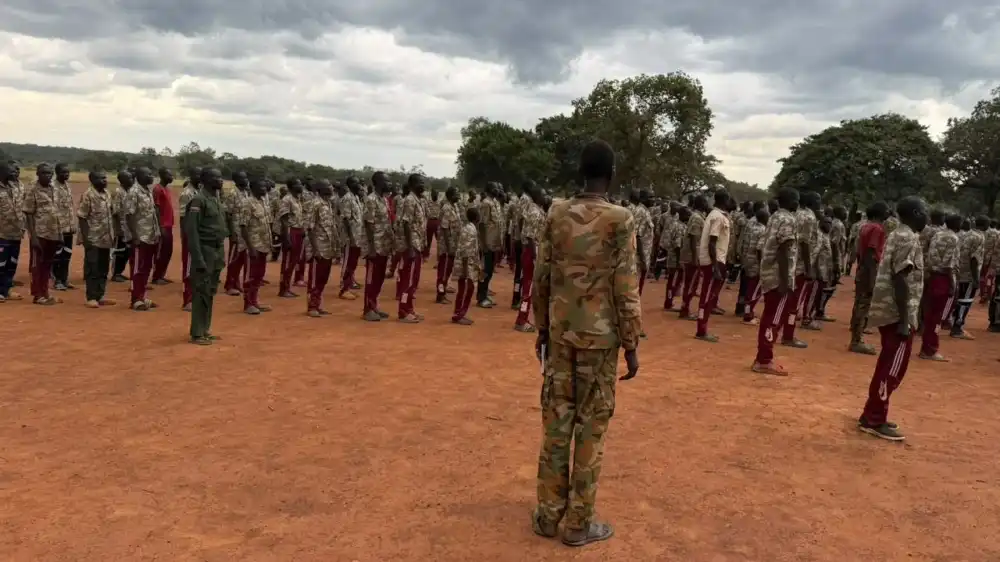
(Photo Credit: UNMISS)
WAU – At 13, Marko* should be in school, making friends, and dreaming about his future.
Instead, amid insecurity and economic hardship, he saw joining the police as a way to earn money while also protecting his community.
“I joined the training to get money and a gun to protect my community and our cows from armed raiders from neighbouring communities,” he explained.
Marko was among 700 police recruits in training when a government-led verification team identified him as underage and removed him from the process.
His story reflects a troubling reality: when insecurity threatens livelihoods and opportunities are scarce, children may view armed institutions as sources of protection and survival.
But, even when children volunteer, they must never be recruited.
Marko was among 54 children identified and removed from the National Police Service recruitment processes during the screening exercise across Greater Bahr El Ghazal, supported by the United Nations Mission in South Sudan and UNICEF.
The exercise contributes to efforts to prevent the six grave violations against children in armed conflict: recruitment and use, killing and maiming, rape and other sexual violence, abduction, attacks on schools and hospitals, and denial of humanitarian access.
“We look to see if there are any underage recruits. Once identified, their age needs to be verified. If they are found to be underage, they must be documented, removed, and released,” said Oluku Andrew, National Coordinator for the Release of Children Associated with Armed Forces and Groups at the National Disarmament, Demobilization and Reintegration Commission.
Conducted across Northern Bahr El Ghazal, Warrap, and Western Bahr El Ghazal States, the exercise brought together the DDR Commission, UNMISS Child Protection, and United Nations Police to strengthen age verification and prevent child recruitment.
For some children, removal marked the start of a longer protection process. In Kuajok, seven children received initial assessments to identify their needs and guide referrals, family reintegration, and follow-up support.
Meanwhile, awareness sessions on child protection and preventing underage recruitment reached 7,351 participants, particularly newly recruited police personnel.
“I was shocked to see children as young as six to eight years old being trained as police officers. It is something I have never encountered in my career,” said Erasmus Migyikra, UNMISS Child Protection Officer.
He stressed that preventing recruitment also requires understanding why children are drawn to armed groups: some seek protection, while others seek economic opportunities.
The findings prompted further engagement with senior police leadership, reaffirming the National Police Service's commitment to preventing child recruitment and to strengthening cooperation with UNMISS and national child protection mechanisms.
The initiative supports South Sudan's Comprehensive Action Plan to end and prevent grave violations against children in armed conflict by conducting screening, training, and awareness-raising within security institutions.
But for children like Marko, protection must go beyond preventing recruitment. It means access to education, support for their families, and safer communities where they no longer feel compelled to seek security through a gun.
No child should have to carry a weapon to feel safe, to support their family, or to protect their community. Every child deserves a future beyond conflict.
*Marko's name has been changed to protect his identity.
--
By Busang Davies Maruping
Older news items
- AUC Chairperson received H.E. Ambassador Baak Valentino Akol Wol, Permanent Representative of the Republic of South Sudan - 17/11/2026 19:04
- Drones account for nearly three-quarters of Sudan war deaths this year, UN says - 17/11/2026 19:01
- In South Sudan, New Lifelines for Mothers and Babies - 17/11/2026 18:58
- Knowledge Management Series for Health 2026: A double shield in the first year of life (November 2026) - 17/11/2026 18:51
- South Sudan postpones first national elections again, to February 2027 - 14/11/2026 20:29
Latest news items (all categories):
- China’s next stage of modernization is beyond infrastructure - 17/11/2026 19:50
- Who will feed China: How technology and land policy are reshaping Chinese agriculture - 17/11/2026 19:23
- Warmth measured in small things - 17/11/2026 19:19
- UK: West Bromwich church mourns South Sudanese priest - 17/11/2026 19:11
- UNMISS-supported screening identifies 54 children among police recruits - 17/11/2026 19:07
See also (all categories):
Random articles (all categories):
- Sudan opens borders with South - The Australian - 07/10/2012 14:54
- الحكومة الانتقالية هل هي الحل للطموحات الشعب الجنوبي - 15/03/2014 19:32
- Regrettable Death of Greatest Poet and Singer John Adhok - 24/10/2008 20:03
- Press Statement by the Political Parties Leadership Forum Meeting (Juba 16-17 Feb 2011) - 18/02/2011 08:26
- Rwanda, Burundi 2 Other Countries Join Uganda in Opposing Kenya's Oil Deal - 22/11/2023 05:26
Popular articles:
- Who is the darkest person in the world, according to Guinness World Record? - 25/10/2022 02:34 - Read 151809 times
- School exam results in South Sudan show decline - 01/04/2012 17:58 - Read 28566 times
- Top 10 weakest currency exchange rates in Africa in 2023 - 19/07/2023 00:24 - Read 25659 times
- No oil in troubled waters - 25/03/2014 15:02 - Read 24835 times
- NDSU student from South Sudan receives scholarship - In-Forum - 29/09/2012 01:44 - Read 22820 times