
Download Report (PDF | 10.26 MB)
Somali children dream of a better Somalia and are looking to have a Somalia that is free from conflict, where there is peace and where they will feel safe.
Somali children have big dreams, with many wanting to be teachers, engineers, doctors, and much more, to contribute to their community.
Unfortunately, Somalia for decades has endured cycles of conflicts, political transitions and climate shocks, and droughts and floods that have reshaped livelihoods and displaced millions. The context is fragile and sensitive, with children being born in the conflicts and transitioning into adulthood while still in conflict. Despite these challenges, the country remains committed to rebuilding and has hope for a peaceful Somalia not marred by the narratives of conflict.
The co-existence of the realities of fragility and stability is reflected in many parts of Southern Somalia, where the impacts of armed conflict and economic hardship are most acutely shaping the future of entire generations. As a result of the conflict, many of the children face challenges such as separation from their families, while others find community with armed actors and, as a result, are recruited and used as children.
South Sudan, on the other hand, is one of the youngest countries in East Africa. With its capital city in Juba, the country is home to many ethnic groups, languages and rich cultural traditions. Many of the children in South Sudan have great dreams. Some want to become teachers, nurses, doctors, and pilots. They enjoy spending time with their families, going to school, and having their dreams come true just like children around the world.
However, unfortunately, South Sudan remains one of the world’s most fragile humanitarian contexts. Millions of children face daily threats to their survival and development: from violence, displacement and acute food insecurity to disease outbreaks and periodic flooding that repeatedly disrupts schools, health services, and livelihoods. Many children are affected by the six grave violations and, due to the prolonged conflicts, have been separated from their families and communities, making them more vulnerable to recruitment and use by armed groups.
Children in both countries have not experienced any life other than one where they consistently look over their shoulders and live in fear, wondering when the conflicts will cease. The long-term effects of being in conflict environments were expressed in their storytelling and narratives as they shared their lived experiences.
Save the Children is very keen on ensuring that children meaningfully participate, not only as survivors of violence but as rights-holders capable of contributing to society. Article 12 of the United Nations Convention on the Rights of the Child (UNCRC) guarantees the participation of children. The same is also reflected in the African Charter on the Rights and Welfare of the Child (ACRWC), which provides for the right to child participation, principally, in Articles 4(2) and 7.
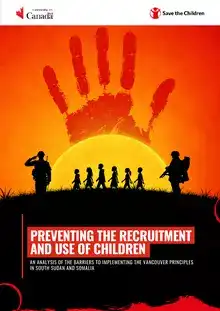
Save the Children meaningfully engaged with the children from Somalia and South Sudan through child-friendly and appropriate discussions. The consultations were conducted on site to gather their perspectives on the recruitment and use of children. Through Focus Group Discussions (FGDs) and other child-friendly approaches and methods, the team was able to assess the children’s knowledge of the Vancouver Principles and grave violations as well as discuss the barriers to preventing recruitment and use of children in Somalia and South Sudan.
The children shared their experiences, concerns, and recommendations. They focused on practical realities and everyday experiences of conflict and protection.
Newer articles:
- 2027 AFCON (Q): South Sudan will deliver against Malawi – N’Sengi Biembe - 25/09/2026 12:39
- The Health Workforce Gap: A Barrier to Universal Health Coverage in South Sudan - 25/09/2026 12:36
- Kiir Dissolves South Sudan Unity Government, Names Caretaker Cabinet Ahead of December Polls - 23/09/2026 12:15
- South Sudan MPs to get a car as a gift because they voted for the Electoral Law wanted by the President - 23/09/2026 12:12
- What South Sudan’s mothers teach us about political authority - 23/09/2026 12:10
Older news items
- Egypt says it backs South Sudan’s Fula dam after review, renews objections to Ethiopia’s GERD - 21/09/2026 13:57
- UK: South Sudanese teen who piloted ‘mega dinghy’ across English Channel with 165 migrants onboard jailed - 21/09/2026 13:55
- Violence in western Ethiopia leaves 12 dead, dozens wounded: MSF - 21/09/2026 13:51
- Vietnamese peacekeepers bid a heartfelt farewell to South Sudan - 21/09/2026 13:48
- Bangladeshi peacekeeper dies of electrocution in South Sudan - 21/09/2026 13:46
Latest news items (all categories):
- SPLM-IO High Military Command - Call For A Generals' Command Conference - 14/10/2026 19:37
- SOUTH SUDAN: BEYOND THE POLITICAL EXCITEMENTA Civic and Institutional Accountability Statement - 14/10/2026 19:32
- South Korean FM Cho Calls for Attention to Safety of Hanbit Unit in Meeting with South Sudanese Envoy - 14/10/2026 15:54
- Why is South Africa still pursuing a 7-year-old oil deal in South Sudan? - 14/10/2026 15:36
- As South Sudan plans for elections, a town counts the cost of war - 14/10/2026 15:30
See also (all categories):
Random articles (all categories):
- Wau prisoners take charge of their food supply - 25/07/2023 06:19
- Sudan's Bashir, wanted by ICC, applies for US visa - 19/05/2016 08:41
- Time for Dr Riek Machar to restrategise - 12/08/2016 15:57
- Sudanese army repulses fresh rebel attack in South Kordofan - 05/05/2013 20:20
- South Sudan to roll out school learning through radio due to COVID-19 - 09/04/2020 07:40
Popular articles:
- Who is the darkest person in the world, according to Guinness World Record? - 25/10/2022 02:34 - Read 150929 times
- School exam results in South Sudan show decline - 01/04/2012 17:58 - Read 28232 times
- Top 10 weakest currency exchange rates in Africa in 2023 - 19/07/2023 00:24 - Read 25334 times
- No oil in troubled waters - 25/03/2014 15:02 - Read 24562 times
- NDSU student from South Sudan receives scholarship - In-Forum - 29/09/2012 01:44 - Read 22527 times
