
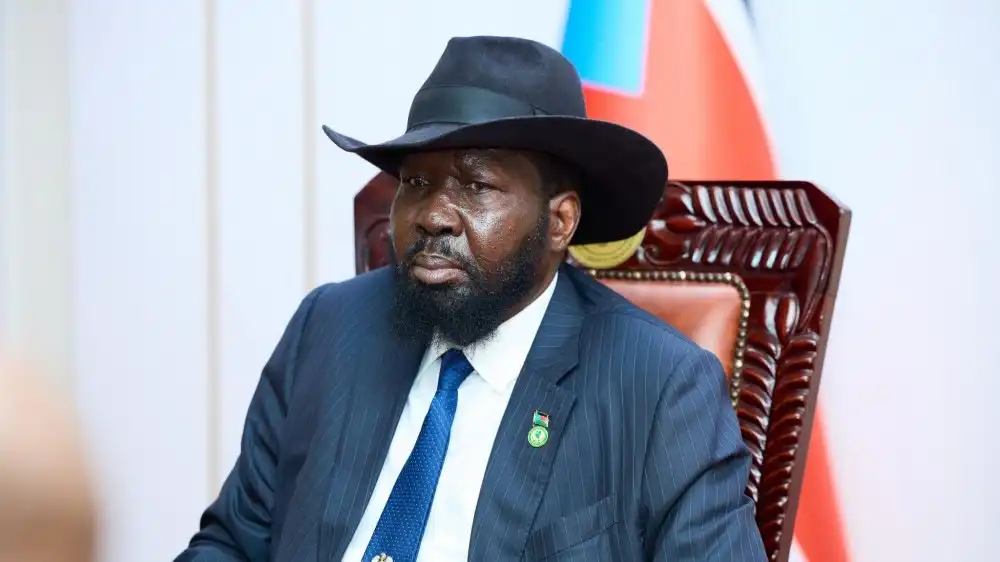
President Salva Kiir (File/Archive)
JUBA — South Sudanese President Salva Kiir Mayardit has dissolved the country’s transitional unity government and appointed a caretaker administration to oversee preparations for general elections scheduled for December 22, 2026.
The sweeping changes announced in Juba on Tuesday removed the five vice presidents, the Council of Ministers, the transitional parliament and the leadership of all 10 states and three administrative areas.
The dissolution effectively ends the Revitalised Transitional Government of National Unity, established under the 2018 peace agreement that ended a five-year civil war between forces loyal to Kiir and those aligned with his longtime rival, Riek Machar.
Kiir remains president and, under recently amended electoral laws, retains full constitutional authority until an elected successor takes office.
Who is out?
Those relieved of their positions include First Vice President Riek Machar Teny and vice presidents James Wani Igga, Taban Deng Gai, Hussein Abdelbagi Akol and Rebecca Nyandeng Garang.
Machar’s removal formalises his exclusion from an administration in which he had already been politically marginalised. The opposition leader has been under house arrest since March 2025 and is on trial on charges including treason and murder, which he denies.
The 35-member national cabinet and its deputy ministers were also dissolved. The Transitional National Legislative Assembly and Council of States were disbanded, while the governors of the 10 states and chief administrators of Abyei, Greater Pibor and Ruweng were relieved.
Who is in?
Kiir appointed Joseph Ngeri Pachiko as presidential adviser on governance and named a reduced caretaker cabinet.
Africano Mande Gedima was appointed Minister of Presidential Affairs, while Martin Elia Lomoro retained the Cabinet Affairs portfolio.
Cecilia Adeng Manyok was named Minister of Foreign Affairs and International Cooperation, Ayor Akuoch Anok took Defence and Veterans Affairs, and Rizik Zakaria Hassan was appointed Interior Minister.
Other appointments included Dr Wek Mamer Kuol as Justice and Constitutional Affairs Minister, Isaac Mamur Obete as National Security Minister and Athian Diing Athian as Minister of Finance and Planning.
Awow Daniel Chuang was placed in charge of Petroleum, Dr Labanya Margret Mathya was named Trade and Industry Minister, and Ateny Wek Ateny retained the Information, Communication, Technology and Postal Services portfolio.
Michael Makuei was appointed Minister of East African Community Affairs, while Stephen Par took the Peacebuilding portfolio.
Kiir also appointed Marial Chanuong as Deputy Defence Minister, Marial Gumke as Deputy Interior Minister and Philip Jada Nathania as Deputy Foreign Affairs Minister.
Gieth Kon Mathiang was named director general of the National Communication Authority, Mosety Kat Majok was appointed head of the South Sudan Civil Aviation Authority, and Rizik Dominic Samuel became commissioner general of the South Sudan Revenue Authority.
New caretaker governors were also appointed across the country, including Jadala Wani for Central Equatoria, Louis Lobong Lojore for Eastern Equatoria, Moses Majok Gatluak for Jonglei and James Koang Chol for Upper Nile.
Justice Charles Abyei Jok was appointed chief administrator of Abyei, Joseph Baboya took charge of Greater Pibor, and Daniel Makuei Tiyar was named chief administrator of Ruweng.
Election laws changed
The dissolution followed Kiir’s approval of amendments to the National Elections Act removing the completion of a permanent constitution and a national census as requirements for holding elections.
The legislation also reduces the National Legislative Assembly from 650 to 270 members, state assemblies from 100 to 58 members and legislative councils in administrative areas to 20 members. Voter registration, however, has yet to begin.
South Sudan has not held a national election since gaining independence from Sudan in 2011. The polls have repeatedly been postponed because of conflict, political disputes and delays in implementing the 2018 peace agreement.
Questions remain over whether the December vote can be organised credibly within three months. Kiir last week dismissed the chairperson of the National Elections Commission without publicly giving a reason, while opposition parties and international observers have raised concerns about political tensions, incomplete preparations and continuing violence.
The caretaker administration will now oversee the election period, but the dissolution also removes the power-sharing structure that brought Kiir, Machar and other former rivals into one government. That could sharpen concerns about the inclusiveness of the electoral process and the future of the 2018 peace agreement.
Newer articles:
- South Sudan opposition, rights groups doubt December polls will be free and fair - 25/09/2026 12:54
- Türkiye Diyanet Foundation provides clean water to thousands in South Sudan - 25/09/2026 12:51
- Nepali peacekeepers help UN strengthen early warning, civilian protection in South Sudan - 25/09/2026 12:40
- 2027 AFCON (Q): South Sudan will deliver against Malawi – N’Sengi Biembe - 25/09/2026 12:39
- The Health Workforce Gap: A Barrier to Universal Health Coverage in South Sudan - 25/09/2026 12:36
Older news items
- South Sudan MPs to get a car as a gift because they voted for the Electoral Law wanted by the President - 23/09/2026 12:12
- What South Sudan’s mothers teach us about political authority - 23/09/2026 12:10
- Preventing the Recruitment and Use of Children: An Analysis of the Barriers to Implementing the Vancouver Principles in South Sudan and Somalia - 23/09/2026 12:07
- Egypt says it backs South Sudan’s Fula dam after review, renews objections to Ethiopia’s GERD - 21/09/2026 13:57
- UK: South Sudanese teen who piloted ‘mega dinghy’ across English Channel with 165 migrants onboard jailed - 21/09/2026 13:55
Latest news items (all categories):
- SPLM-IO High Military Command - Call For A Generals' Command Conference - 14/10/2026 19:37
- SOUTH SUDAN: BEYOND THE POLITICAL EXCITEMENTA Civic and Institutional Accountability Statement - 14/10/2026 19:32
- South Korean FM Cho Calls for Attention to Safety of Hanbit Unit in Meeting with South Sudanese Envoy - 14/10/2026 15:54
- Why is South Africa still pursuing a 7-year-old oil deal in South Sudan? - 14/10/2026 15:36
- As South Sudan plans for elections, a town counts the cost of war - 14/10/2026 15:30
See also (all categories):
Random articles (all categories):
- UN: South Sudan pulls police out of disputed Abyei - USA TODAY - 12/05/2012 04:11
- إعفاء محافظ مقاطعة فنيكانق - حسابات الربح والخسارة - 05/03/2011 10:30
- South Sudan Infographic (September 2019) - 11/10/2019 10:05
- Escalation of fighting in South Sudan 'very worrying' - 16/03/2017 01:57
- Sudan appoints former rebel leader Mini Arko Minawi as Darfur governor - 03/05/2021 03:20
Popular articles:
- Who is the darkest person in the world, according to Guinness World Record? - 25/10/2022 02:34 - Read 150928 times
- School exam results in South Sudan show decline - 01/04/2012 17:58 - Read 28232 times
- Top 10 weakest currency exchange rates in Africa in 2023 - 19/07/2023 00:24 - Read 25334 times
- No oil in troubled waters - 25/03/2014 15:02 - Read 24562 times
- NDSU student from South Sudan receives scholarship - In-Forum - 29/09/2012 01:44 - Read 22527 times
