
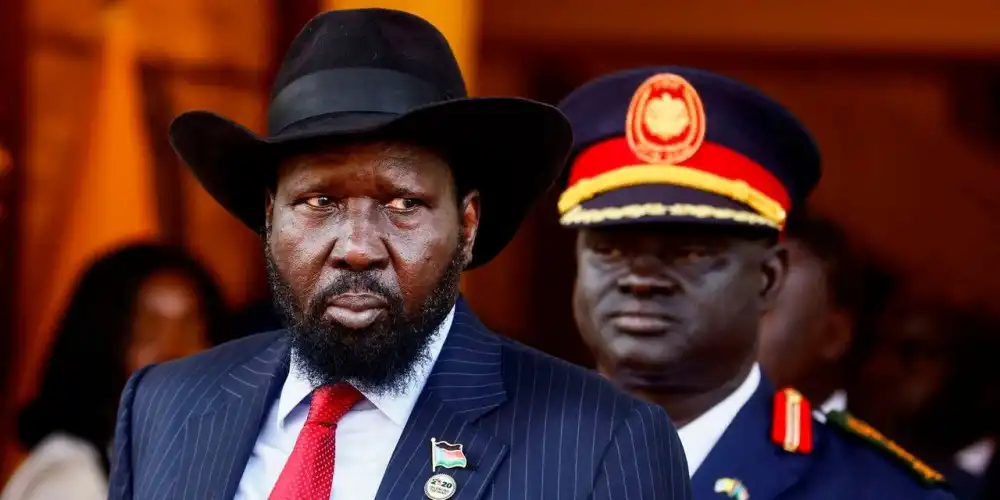
South Sudan's President Salva Kiir at the Presidential Palace in Juba, South Sudan (Photo Credit: Reuters)
Political and human rights organisations have expressed fears about the conduct of free and fair elections in South Sudan on December 22, following the dissolution of the Revitalized Transitional Government of National Unity on Tuesday.
In a series of decrees, President Salva Kiir named a caretaker administration that will steer the country into the first-ever general election. They include a presidential adviser, 13 caretaker ministers, 10 state caretaker governors, deputy ministers, chief administrators, undersecretaries, and heads of key national institutions.
The dissolution gave executive power to President Kiir, the presidential candidate for the ruling Sudan People's Liberation Movement (SPLM). No prominent figures have announced plans to challenge him in the December poll.
On September 21, President Kiir signed into law the National Elections Act, 2012 (Amendment) Bill, 2026, giving himself to remain in office with full constitutional powers throughout the electoral period.
But human rights watchdog Amnesty International, in a statement on Tuesday, raised concerns about the legitimacy of the polling process due to many unmet requirements in the final stretch.
“Ahead of these long-awaited and historic elections, South Sudanese authorities must ensure that a conducive environment exists for people to vote and stand in elections, including respect for and enjoyment of human rights, and freedom from discrimination and arbitrary or unnecessary and disproportionate restrictions,” said Amnesty’s regional director for East and Southern Africa, Tigere Chagutah.
“The legitimacy of any election depends not only on whether it is held, but on whether people can exercise their rights freely, safely and equally.”
Mr Chagutah said that for years, Amnesty International and other organisations have documented “repressive tactics deployed by the South Sudanese authorities to silence dissent, detain critics, and restrict freedom of expression and the right to protest.”
“At this pivotal moment, we call on the South Sudanese authorities to immediately guarantee the rights to freedom of expression, association, and peaceful assembly; end the intimidation of journalists, civil society actors and political opponents; and create conditions that enable all South Sudanese to participate in public affairs freely and without fear.”
In August, the UN Commission on Human Rights in South Sudan warned that elections conducted without adequate safeguards could fuel renewed conflict and increase the risk of serious human rights violations and atrocity crimes.
In July, amid concerns about procedures, legality and legitimacy, President Kiir signed into law amendments to the 2018 peace agreement removing critical electoral preconditions, including a national population and housing census and the adoption of a permanent constitution, deferring both processes until after elections.
Investigative organisation Sentry warned that the prerequisites for credible elections -- census, permanent constitution, voter register, and independent elections commission – were missing.
Brian Adeba, senior policy adviser at The Sentry, said “Kiir acted unilaterally, without the consent of the other signatories to the peace agreement. Holding elections under these conditions risks turning a promised democratic transition into another source of instability and conflict, trapping South Sudan in a cycle of endless strife.”
Opposition SPLM-in-Opposition of detained former First Vice-President Riek Machar rejected Kiir’s planned inter-party dialogue scheduled for September 24.
Oyet Nathaniel Pierino, acting chairman of the party, said elections were likely to be a “sham,” as not all parties are involved in the planning.
“The SPLM-IO rejects the interparty dialogue organised and funded by President Kiir. The interparty dialogue is not a dialogue; it is a meeting of President Kiir and his allies, most of whom are ministers,” Mr Pierino said.
“Any dialogue to resolve the conflict in South Sudan and bring peace must be mediated inclusively with the participation of Dr Riek Machar Ateny and non- signatories and must take place in a free environment, a neutral venue with non- partisan facilitators.”
Machar has been under house arrest since March 2025 and is on trial on charges including treason and murder, which he denies.
The elections have previously been postponed twice, while key provisions of the 2018 peace agreement—including voter registration, the unification of rival forces and the adoption of a permanent constitution—remain incomplete.
The sacking of National Elections Commission chairperson Prof Abednego Akok Kacuol on September 15 has deepened public mistrust of the process, coming three months before the polls. No reason was publicly given, and Gabriel Bol Deng Majok, formerly the commission’s secretary-general, was named as his replacement.
Kenya has been a central mediator and pillar in South Sudan’s journey from the 2005 Comprehensive Peace Agreement that led to independence, through subsequent regional mediation efforts, and continuing today via high-level initiatives such as the Tumaini Initiative aimed at inclusive governance and upcoming elections.
Former Vice-President Kalonzo Musyoka has played a longstanding, central diplomatic role in South Sudan peace processes, notably serving as Kenya’s Special Envoy to South Sudan and contributing crucially to the 2005 Comprehensive Peace Agreement and the 2020 Transitional Unity Government.
Kenya supported South Sudan's self-determination process through the negotiation of the 2015 and 2018 peace agreements and the mediation of the 2024 Tumaini Initiative.
Retired Lieutenant General Lazaro Sumbeiywo led the talks that produced Sudan's Comprehensive Peace Agreement in 2005, leading to South Sudan's independence.
Concerns have been raised over the caretaker administration’s ability to hold the country together, amid heightened insecurity in parts of the country.
The body that oversees implementation of the 2018 peace agreement, the Reconstituted Joint Monitoring and Evaluation Commission (RJMEC), said South Sudan had entered a "critical phase".
Lt-Gen Sumbeiywo, who was in 2024 appointed by Kenyan President William Ruto to lead the Tumaini Initiative in Nairobi, said South Sudan would require more time to prepare for elections, including registration of voters.
“If they don’t do the US or Kenya-style elections but they do South Sudan’s type of elections, we wish them well,” Gen Sumbeiywo said. “Except that South Sudan is not fully prepared for elections, as there is no single registered person. There is no election register because there are no records. The last time they voted was when they voted for independence before 2011.”
As of August 31, 2026, Kenya hosted 213,122 registered refugees and asylum-seekers from South Sudan, according to data from the Government of Kenya and UNHCR Operational Data Portal. They make up 33.3 percent of Kenya's total refugee population.
The European Union stated it has no available funding to support South Sudan's planned December elections. EU Ambassador to Pelle Enarsson noted that Juba has not presented a clear, detailed budget or formal funding request outlining what resources are required.
The NEC needs $250 million (Sh32.38 billion) for the polls, but domestic disbursements have fallen drastically short of operational necessities.
Newer articles:
- Pharaohs arrive in Juba ahead of South Sudan clash - 28/09/2026 12:10
- Kiir Opens Election Talks, Rules Out Further Delays to South Sudan Vote - 25/09/2026 13:04
- NPM endorses Issa Muzamil Makelele to challenge Kiir in 2026 election - 25/09/2026 13:02
- Rights group calls on South Sudan to protect civic space ahead of elections - 25/09/2026 12:59
- Nuba Christian and Muslim leaders call for end to Sudan war - 25/09/2026 12:56
Older news items
- Türkiye Diyanet Foundation provides clean water to thousands in South Sudan - 25/09/2026 12:51
- Nepali peacekeepers help UN strengthen early warning, civilian protection in South Sudan - 25/09/2026 12:40
- 2027 AFCON (Q): South Sudan will deliver against Malawi – N’Sengi Biembe - 25/09/2026 12:39
- The Health Workforce Gap: A Barrier to Universal Health Coverage in South Sudan - 25/09/2026 12:36
- Kiir Dissolves South Sudan Unity Government, Names Caretaker Cabinet Ahead of December Polls - 23/09/2026 12:15
Latest news items (all categories):
- Meet the innovators transforming food systems in South Sudan - 16/10/2026 13:28
- Rwandan Peacekeepers Conduct Two-day Free Medical Outreach In South Sudan - 16/10/2026 13:22
- ‘Citizens’ Talk’ in Terekeka creates community platform for shared solutions to complex challenges - 16/10/2026 13:18
- South Sudanese Refugees in Sudan Dashboard as of 30 September 2026 - 16/10/2026 13:12
- مفوضية اللاجئين: 324 ألف شخص وصلوا إلى السودان من جنوب السودان خلال 18 شهرًا - 16/10/2026 13:06
See also (all categories):
Random articles (all categories):
- Malakal from the air - 19/04/2007 21:31
- South Sudan conflict: Artists sing for peace - 25/07/2016 10:59
- South Sudan Kiir’s visit to Khartoum will likely be postponed: official - 28/08/2013 00:20
- Former NBA player Luol Deng the man behind rise of South Sudan basketball - 29/08/2023 07:54
- Video: South Sudan Hopes New Mining Law Will Unearth Treasures - 05/07/2013 16:48
Popular articles:
- Who is the darkest person in the world, according to Guinness World Record? - 25/10/2022 02:34 - Read 151002 times
- School exam results in South Sudan show decline - 01/04/2012 17:58 - Read 28262 times
- Top 10 weakest currency exchange rates in Africa in 2023 - 19/07/2023 00:24 - Read 25362 times
- No oil in troubled waters - 25/03/2014 15:02 - Read 24587 times
- NDSU student from South Sudan receives scholarship - In-Forum - 29/09/2012 01:44 - Read 22554 times
