
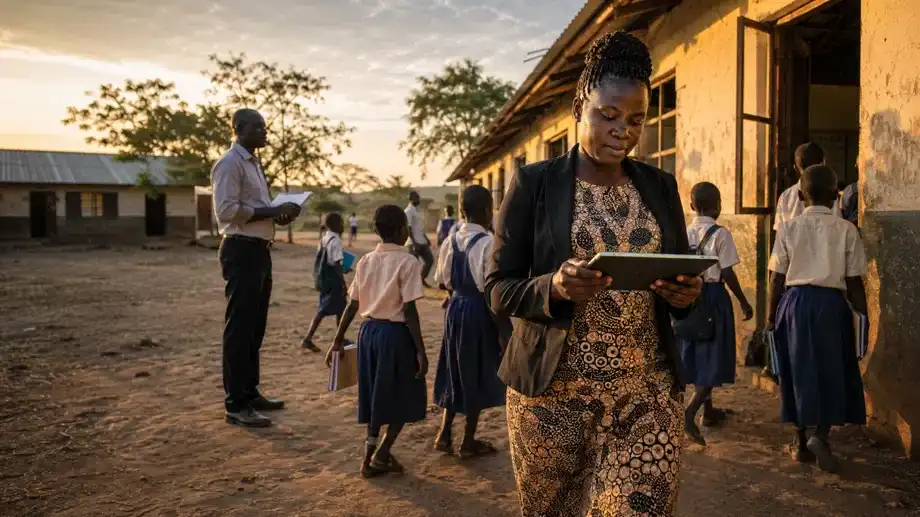
(Representative Image - AI Generated)
South Sudan is developing its first monitoring system for the 2023–2027 education strategy to track results, expose neglected areas and improve coordination. Its impact will depend on reliable data, sustained national ownership and whether policymakers use the findings to redirect resources and correct underperformance.
South Sudan is building its first dedicated monitoring system for the General Education Strategic Plan (GESP) 2023–2027, an initiative that could reshape how the country evaluates education programmes, distributes scarce resources and identifies children and schools receiving inadequate support.
Developed by the government with technical assistance from UNESCO, the system is intended to connect national education targets with measurable results. It will give the Ministry of General Education and Instruction, development partners and civil society organisations a shared framework for tracking implementation, uncovering gaps and avoiding duplicated interventions.
The initiative addresses a longstanding weakness in South Sudan's education planning. Policies and projects have been introduced for years, but authorities have lacked a unified tool for determining whether those efforts are producing meaningful improvements in classrooms. The success of the new framework will therefore depend not simply on collecting information, but on whether institutions use the evidence to revise policies, budgets and programmes.
Taking Education Policy Beyond Targets and Promises
Approved in 2023 with UNESCO's support, the GESP establishes South Sudan's education priorities through 2027. It guides the government and organisations working across the sector, including UN agencies, non-governmental organisations and civil society groups.
Many activities associated with the strategy are already underway. However, fragmented reporting has made it difficult to compare their contribution with national targets or determine which communities remain underserved. A project may report the number of teachers trained, classrooms constructed or learning materials distributed without demonstrating whether attendance, teaching quality or learning conditions improved.
A national monitoring system could help policymakers distinguish between activities and outcomes. It could reveal whether programmes are progressing on schedule, whether investments are reaching intended beneficiaries and whether results differ across locations.
The framework may also provide South Sudan with greater institutional continuity. A consistently maintained database could preserve evidence across projects and policy cycles, reducing reliance on separate reports produced by individual organisations. This would allow future education plans to be based on recorded performance rather than incomplete or incompatible assessments.
The indicators selected for the system will be crucial. If monitoring concentrates only on easily counted outputs, it may overlook important questions about educational quality, retention, equity and the experiences of children outside the formal school system.
Mapping Education Support to Expose Neglected Areas
The system's foundations were discussed during a four-day consultation facilitated by UNESCO in Juba from August 18 to 21, 2026. Around 30 representatives from the government, UN agencies, NGOs and civil society participated.
Working groups mapped education initiatives being implemented across South Sudan and examined progress under the strategic plan. The exercise also exposed gaps in programme coverage, allowing stakeholders to identify places where children, teachers or schools may be receiving insufficient assistance.
This mapping could improve coordination in a sector involving numerous public and development actors. Without a shared overview, organisations may unintentionally operate similar projects in the same accessible locations while remote or less visible communities attract limited support.
For children and families, better monitoring could make unmet needs more visible in national planning. Teachers could receive more targeted professional or material support, while school administrators may gain a clearer channel for reporting local constraints. At the same time, additional data demands could burden frontline workers if the reporting system becomes overly complicated.
The available information does not specify which regions or population groups face the largest gaps, nor does it provide figures on enrolment, completion, learning outcomes or out-of-school children. Such disaggregated data will be necessary if the framework is expected to reveal inequality rather than merely produce nationwide averages.
Stronger Evidence for Policymakers and Development Partners
For policymakers, the system could strengthen three connected functions: planning, budgeting and accountability. Officials would be better positioned to determine which programmes should be expanded, redesigned or discontinued. Evidence on underserved areas could also support more targeted allocation of government funding and external assistance.
George Mogga Bengamin, Director General for Planning and Budgeting at the Ministry of General Education and Instruction, described the initiative as a milestone. He said South Sudan had developed education plans since 2005 but had not previously established a tool capable of tracking performance and measuring outcomes.
For development partners, the framework could provide a common reference point for evaluating programmes and coordinating financial or technical assistance. It may reduce duplication and enable organisations to place new interventions where the evidence indicates the greatest need.
Civil society organisations could use the findings to advocate for neglected communities and assess whether national commitments are being delivered. Smaller organisations, however, may face difficulties if participation requires costly technology or advanced reporting capacity. The framework will need procedures that allow a broad range of stakeholders to contribute.
A nationally led monitoring system could also strengthen government ownership of education information. Yet international partners often operate under separate reporting obligations. Aligning those requirements with the national framework will be essential if South Sudan is to avoid replacing existing fragmentation with another administrative layer.
From Collecting Data to Correcting Performance
The decisive test will be what happens when monitoring reveals poor results. A system that produces reports without influencing budgets, implementation or political decisions would offer limited practical value.
Several operational questions remain unanswered. The available material does not explain how data will be verified, how frequently results will be updated, what financing will sustain the system or whether findings will be made public. It is also unclear how communities will be able to question incomplete or inaccurate information.
Leadership, coordination, technical capacity and national ownership were treated as core design issues during the Juba consultation. Participants concluded the meeting with agreed actions and a timeline for developing the framework over the coming months, although detailed milestones and an operational date were not disclosed.
Policymakers and partners should now watch for the adoption of measurable indicators, clear institutional responsibilities and procedures for responding to underperformance. The system must also balance the need for detailed evidence with the realities facing schools and local administrators.
South Sudan's initiative cannot by itself resolve the country's education challenges. It can, however, create a clearer national picture of where programmes are working and where support remains inadequate. Its ultimate impact will be measured not by how much data it collects, but by whether that evidence produces better decisions, stronger accountability and more equitable educational opportunities.
Newer articles:
- South Sudan’s gamble: Betting on black gold amid the ballot - 04/09/2026 17:11
- Clashes in southern Sudan leave at least 21 dead, medical group says - 04/09/2026 17:08
- Tanzania, South Sudan Seek Closer Agricultural Cooperation to Boost Food Security - 02/09/2026 17:20
- Adut Kiir in Luanda as South Sudan Moves to Deepen Ties With Angola - 02/09/2026 17:18
- 2 Carmelites Survive Ambush On Highway Where Bandits Killed Catholic Sisters in South Sudan - 02/09/2026 17:08
Older news items
- ‘It’s not part of Kenya’ – South Sudan VP Taban Deng renews claim over disputed Ilemi Triangle - 31/08/2026 11:11
- Families search for missing loved ones as conflict shatters Sudan, South Sudan - 31/08/2026 11:03
- Armed raid on cattle camp kills at least 49 in South Sudan - 31/08/2026 11:01
- UNESCO supports South Sudan to establish its first education sector monitoring system - 31/08/2026 10:58
- Why Kenya-South Sudan trade corridor remains unfinished despite years of promises - 28/08/2026 12:44
Latest news items (all categories):
- China’s new Long March: Why its modernization is a demanding journey - 21/10/2026 12:31
- Drone attack in disputed Sudan-South Sudan border region kills at least 153 - 21/10/2026 12:17
- South Korea - 'Smart camp' system built at Hanbit Unit in South Sudan - 21/10/2026 12:09
- Sudanese refugees in Gorom camp, South Sudan, struggle for water, medicines, security - 21/10/2026 12:05
- South Sudan: A Testing Ground For Democracy While Citizens Struggle To Survive - 19/10/2026 14:31
See also (all categories):
Random articles (all categories):
- South Sudan Government Objects to War Crimes Court - 03/10/2018 14:14
- Darfur: Rapid Support Forces, Allied Militias Rape Dozens - Human Rights Watch - 17/08/2023 04:29
- India-Africa to hold a military drill next week - 16/03/2023 00:28
- South Sudan, UN sign development cooperation framework - 17/11/2022 07:33
- South Sudan rebels call for ceasefire to honour peacetalks in Addis - 20/12/2017 07:28
Popular articles:
- Who is the darkest person in the world, according to Guinness World Record? - 25/10/2022 02:34 - Read 151141 times
- School exam results in South Sudan show decline - 01/04/2012 17:58 - Read 28320 times
- Top 10 weakest currency exchange rates in Africa in 2023 - 19/07/2023 00:24 - Read 25412 times
- No oil in troubled waters - 25/03/2014 15:02 - Read 24638 times
- NDSU student from South Sudan receives scholarship - In-Forum - 29/09/2012 01:44 - Read 22609 times
