
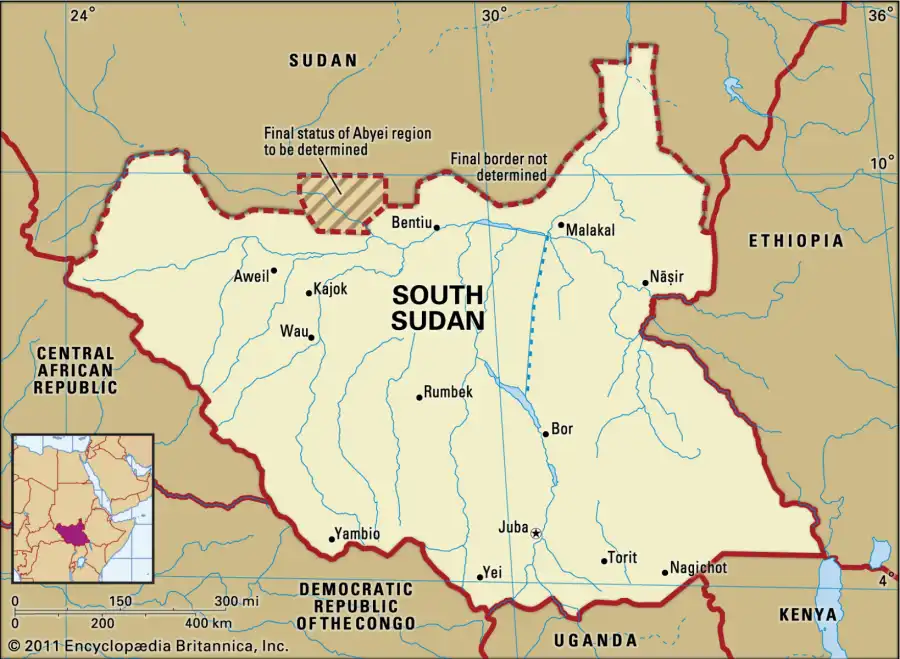
South Sudan is geographically landlocked, economically fragile and heavily dependent on oil. As the country approaches elections scheduled for December 22, 2026, its investment outlook will depend less on the headline recovery in oil production than on whether political stability can be sustained.
The macroeconomic headlines are, for once, not entirely dreadful. After a catastrophic 24.5 percent contraction in 2024, Fitch Solutions projects real Gross Domestic Product) GDP growth of 17.1 percent in 2026, driven by the partial restoration of oil exports through Sudan’s pipeline network following a year-long shutdown. The restart of the Petrodar pipeline has returned production from a nadir of 60,000 barrels/day to approximately 150,000 barrel per day (bpd), still less than half the 350,000 bpd, achieved at independence in 2011. This uptick will ease some exchange rate pressure and provide breathing room for a government that has watched its citizens slide into extreme poverty, now affecting nearly 91 percent of the population.
Yet the recovery is a mirage unless viewed through the lens of politics. The December elections should be viewed not only as a political milestone but also as a critical test of South Sudan’s fragile peace arrangement. The 2018 Revitalised Agreement has been extended three times, and its core provisions, including the unification of 83,000 members of the armed forces, remain largely unimplemented. Political tensions between President Salva Kiir and Vice-President Riek Machar, whose detention in February 2026 has intensified fighting in Jonglei state, suggest that under deteriorating political scenario, the election could become a catalyst for renewed fragmentation rather than a vehicle for political transition. Investors pricing this environment must understand that the macroeconomic tailwinds are hostage to a political process that could turn violent at any moment.
The great pipeline stakes
South Sudan’s fiscal architecture rests on a single, vulnerable artery: the pipeline through Sudan to Port Sudan. This is not merely an infrastructure risk but an existential one as oil accounts for the bulk of government revenue and export earnings, disruption to the pipeline simultaneously weakens the fiscal position, constrains foreign-exchange availability and intensifies pressure on the exchange rate and inflation. The February 2024 rupture, caused by Sudan’s civil war, cut government oil revenue by roughly two-thirds, forcing the government to rely on prepayment financing arrangements that have encumbered future output.
The 2026 restart depends on three precarious conditions: Sudan’s army clearing sediment and corrosion from the pipeline, restraint by the Rapid Support Forces near the terminals, and a tariff settlement with Khartoum that revives the US$9.10/barrel transit fee structure. Industry reporting suggests the first two are plausible, but the third remains unresolved. Even in a best-case scenario, net cash to government is estimated below US$25/barrel against a Brent reference above US$80, after deductions for transit fees, operator cost recovery, and amortisation of prior prepayment debt. The pipeline disruption therefore creates not only an immediate revenue shock but also an intertemporal fiscal problem: financing today’s shortfall through oil-backed prepayments reduces the government’s future fiscal space. The World Bank’s latest debt sustainability analysis, based on data from December 2021, already assessed South Sudan as at high risk of debt distress, with three of four key indicators breaching thresholds through the medium term. The contingent liability stress test adds a further 5 percent of GDP to account for potential legacy arrears. This is not a balance sheet that can absorb another pipeline shock.
Election scenarios and the investment return spectrum
The forthcoming election is not a binary between continuity and change; it is a spectrum of instability. Investors should scenario-plan accordingly.
The baseline scenario, managed continuity, assumes President Kiir retains control through a flawed but non-violent process. In this world, oil production continues its recovery, reaching perhaps 175,000-200,000 bpd by late 2027, as Fitch Solutions projects growth of 8-9 percent in that year. However, this scenario still carries elevated risk. The fiscal drag from salary arrears—estimated at 10-14 months for the military and civil service—will persist, fuelling predatory taxation and localised violence. Investors in the mining sector, where US companies have shown interest, will continue to face opaque decision-making and weak institutional accountability.
The U.S. Embassy in Juba has explicitly warned that American firms “simply do not trust the South Sudanese investment climate”. Expected returns here would be high, in the 20-30 percent range for frontier market private equity or infrastructure, but would require a contractual structure that routes revenues through offshore escrow accounts or third-party guarantee mechanisms. Even then, the risk of expropriation or contract renegotiation remains significant.
The downside scenario, a post-election violence and fragmentation, is more likely than the political class admits. The detention of Machar and the presence of Ugandan troops in the south have already punctured the peace agreement. If the elections are perceived as illegitimate, or if Kiir’s succession becomes a live issue, he is advanced in age and reportedly in poor health, the country could fracture along ethnic lines. In this scenario, oil production would again be disrupted, possibly for years.
The Lamu corridor pipeline through Kenya, proposed since 2012, remains at the feasibility stage, leaving no operational alternative. The fiscal position would collapse, and the government would likely resort to further monetised deficits, triggering hyperinflation and currency depreciation that has already seen the South Sudanese pound lose more than 90 percent of its dollar value. Expected returns under this scenario are irrelevant; the investment would be a total loss. The only rational position is a short-dated, highly collateralised trade, such as oil-backed financing with a tight maturity structure—but even that carries counterparty risk given the government’s track record of encumbering future output.
Pricing the unpriceable
How should an investor price these risks? The market does not offer a sovereign credit default swap on South Sudan, nor a liquid forward curve for its crude. But the shadow price is visible in the operational reality. War risk premia on tanker calls at Bashayer have been placed at multiples of comparable Gulf of Aden lifting risk. Insurance costs alone can erase the margin on a cargo of Dar Blend.
What is needed is a framework that applies a “conflict premium” to all cash flows. A discounted cash flow model for an oil project, for illustrative purpose, should apply a cost of capital of 25-30 percent in the managed-continuity scenario, and assume zero cash flow in the event of a major disruption.
The government’s reliance on prepayment financing, with Afrexim bank and affiliates having provided cumulative facilities above US$2 billion since 2018, means that a significant share of post-2024 oil receipts is already encumbered. Investors must therefore assess not just the headline production figure, but the “net-net” cash flow that reaches the treasury, which is considerably lower.
Moreover, the lack of transparency is a pricing mechanism in itself. The U.S. has blocked further capital inflow over mining governance gaps, and the South Sudanese government’s own Mining Act, enacted in 2012, remains poorly implemented. The absence of a stock exchange, a tiny banking system, and the country’s presence on the FATF grey list all add to the friction. These are not temporary hurdles; they are structural features that will require a decade of reform to dismantle.
The diplomat’s dilemma
For the prudent investor, the December election is not a catalyst for entry but a signal for extreme caution. The window of opportunity, if it exists, lies not in the oil sector, where the fiscal terms are opaque and the pipeline risk existential, but in niche areas that provide essential services. For instance, telecommunications, logistics, and agricultural processing offer the potential for US$-denominated returns that are less exposed to the politics of the pipeline. The EU and UAE have already signalled interest in boosting food security, and the country’s vast agricultural land, only 5 percent currently cultivated, represents a genuine opportunity if stability holds.
But the key takeaway is this: South Sudan’s economy is not a play on oil; it is a play on the longevity of a power-sharing agreement that has been extended three times and is now fraying. The World Bank’s framework rightly notes that the outlook hinges on “restoring political and macroeconomic stability, strengthening governance, and managing natural resources transparently”. None of these conditions are imminent. The election is more likely to expose these weaknesses than to resolve them.
For investors, South Sudan should therefore be treated not simply as a frontier oil market, but as a high-risk political economy in which investment returns are contingent on the durability of the peace agreement, the security of oil infrastructure and the government’s capacity to manage oil revenues transparently. Until these conditions improve, selective and highly structured investments are likely to offer a more defensible risk-return proposition than broad exposure to the economy
Newer articles:
- Uganda, South Sudan agree to pursue individuals behind Moyo border violence - 07/09/2026 17:54
- New reservoir offers innovative solution to South Sudan cattle beef - 07/09/2026 17:51
- Deadly attack and drought emergency underline South Sudan challenges - 07/09/2026 17:41
- World Heritage status for South Sudan parks will be a boon for the birds - 07/09/2026 17:38
- South Sudan seeks Huawei support for digitalisation - 04/09/2026 17:16
Older news items
- Clashes in southern Sudan leave at least 21 dead, medical group says - 04/09/2026 17:08
- Tanzania, South Sudan Seek Closer Agricultural Cooperation to Boost Food Security - 02/09/2026 17:20
- Adut Kiir in Luanda as South Sudan Moves to Deepen Ties With Angola - 02/09/2026 17:18
- 2 Carmelites Survive Ambush On Highway Where Bandits Killed Catholic Sisters in South Sudan - 02/09/2026 17:08
- New Monitoring System Could Reshape Education Planning and Resource Allocation in South Sudan - 02/09/2026 17:05
Latest news items (all categories):
- China’s new Long March: Why its modernization is a demanding journey - 21/10/2026 12:31
- Drone attack in disputed Sudan-South Sudan border region kills at least 153 - 21/10/2026 12:17
- South Korea - 'Smart camp' system built at Hanbit Unit in South Sudan - 21/10/2026 12:09
- Sudanese refugees in Gorom camp, South Sudan, struggle for water, medicines, security - 21/10/2026 12:05
- South Sudan: A Testing Ground For Democracy While Citizens Struggle To Survive - 19/10/2026 14:31
See also (all categories):
Random articles (all categories):
- Recruited but not ‘child soldiers’: Returning girls in South Sudan risk being left without support - 10/10/2018 22:56
- قاضية أمريكية تسمح بإنهاء وضع الحماية من الترحيل لمواطني جنوب السودان - 07/08/2026 21:45
- A call for prayer for South Sudan - 20/04/2026 14:45
- South Sudan: latest images reveal a global hotspot for biodiversity - 16/08/2019 03:59
- African Ambassadors Welcome Morocco’s Migration Policy, Express Readiness to Collaborate with Moroccan Authorities - 28/06/2022 00:00
Popular articles:
- Who is the darkest person in the world, according to Guinness World Record? - 25/10/2022 02:34 - Read 151139 times
- School exam results in South Sudan show decline - 01/04/2012 17:58 - Read 28320 times
- Top 10 weakest currency exchange rates in Africa in 2023 - 19/07/2023 00:24 - Read 25411 times
- No oil in troubled waters - 25/03/2014 15:02 - Read 24638 times
- NDSU student from South Sudan receives scholarship - In-Forum - 29/09/2012 01:44 - Read 22609 times
