
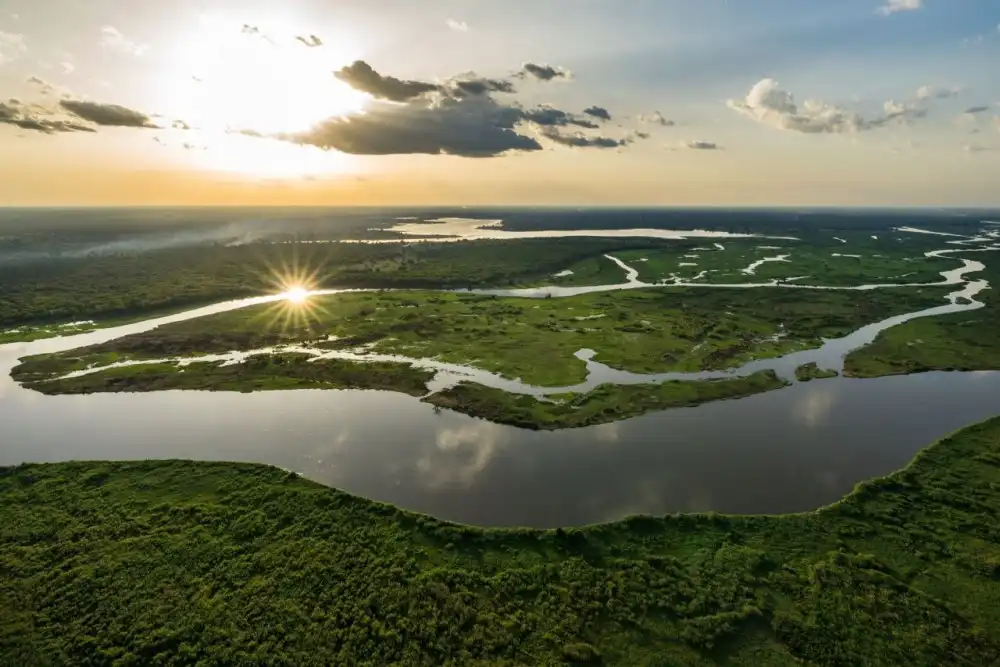
Wetlands at Boma-Badingilo Migratory Landscape, South Sudan (Image © Marcus Westberg)
- South Sudan’s Boma and Badingilo national parks are best known for the massive herds of antelope that migrate across them each year.
- But the landscape is also a key habitat for birds — resident species like shoebills, and those that migrate between southern and northern parts of Africa.
- In July, the parks and surrounding areas were designated a UNESCO World Heritage Site, which conservationists hope will attract support to conserve the region’s rich biodiversity.
The onset of the rains in South Sudan around April each year is accompanied by a remarkable avian spectacle. “There are so many storks that they kind of look like flies in the sky,” said Megan Claase, a conservation manager with African Parks, the organization that manages the Boma and Badingilo national parks in partnership with the South Sudanese government.
The vast flocks congregating in the skies above Boma and Badingilo include African openbills (Anastomus lamelligerus), Abdim’s storks (Ciconia abdimii), and other birds moving across Africa in sync with the changing seasons.
“I think it’s a very productive system after the first rains,” Claase told Mongabay, citing as an example the large blooms of winged alates that emerge from termite holes and are eaten by a wide variety of birds, including the storks.
“It’s just such a haven for migratory species.”
As the rains persist and much of the landscape becomes waterlogged, an abundance of invertebrate food is produced, Claase said. That includes snails and other mollusks eaten by the openbills, named for the curious gap in their bills that help them to grip their slippery prey.
The Boma and Badingilo parks and surrounding areas are all part of a massive interconnected ecosystem of wetlands, swamps, woodlands, and grassy plains, which Claase said lies at the heart of Africa’s largest intact savanna system. This landscape, around the size of North Korea, is home to an estimated 6 million antelopes, among them white-eared kob (Kobus kob leucotis) and Mongalla gazelle (Eudorcas albonotata).
In July, the area was added to the list of UNESCO World Heritage Sites.
The listing will help to raise its profile, and hopefully encourage investment in conservation. This could also prove a boon for the protection of migratory birds, including those, like the openbills and Abdim’s storks, that arrive from elsewhere in Africa.

It’s known from one key study that Abdim’s storks that spend part of the year in Southern and East Africa use South Sudan as a “staging area” on their northward journey to breeding sites in the Sahel. It’s still unclear where exactly the openbills are coming from.
Ornithologist Jonah Gula, based at the University of KwaZulu-Natal in South Africa, and his colleagues have documented up to 70,000 African openbill nests in western Zambia’s Barotse floodplain, on the Zambezi River, more than 2,000 kilometers (1,240 miles) southwest of Boma-Badingilo. He told Mongabay, however, that there’s no evidence suggesting these or other populations in Southern Africa are the ones migrating across the equator to reach South Sudan during the Southern Hemisphere winter.
“It is true that the number of openbills in South Sudan, especially the Sudd, fluctuates hugely between seasons,” Gula told Mongabay. “Surveys in 1979-1981 demonstrated this in the Sudd, but where they come and go is a mystery that really deserves more research.”
The Sudd is a giant wetland to the northwest of Boma and Badingilo, recognized by the Ramsar Convention for its intact floodplains and swamps. These create suitable habitat for wildlife, including savanna elephants (Loxodonta africana), gazelles, and around 470 bird species.
Among these are charismatic birds known as shoebills (Balaeniceps rex), a species with enormous hooked bills. They’re listed as vulnerable to extinction due to their rarity, as well as hunting, habitat loss, and nest disturbances elsewhere across their range.
In South Sudan, shoebills appear to have a safe haven. These large gray birds, which are related to pelicans, have been recorded in “healthy” numbers not only in the Sudd, but also in the Goum swamp, in the northern part of Boma, and in Gambella National Park, in neighboring Ethiopia, according to Claase.
“You can do a single flight [over Goum] and see up to 40 [shoebills],” she said.

Among the smaller, more colorful migratory birds that Claase has seen arriving in Boma and Badingilo in April are woodland kingfishers (Halcyon senegalensis). These birds, whose strident and melodious calls ring through their woodland homes, spend their lives in pursuit of summer.
Like the Abdim’s storks, recent research shows the kingfishers follow the movements of the intertropical convergence zone (ITCZ), a weather phenomenon that shifts north and south of the equator at different times of the year. It brings seasonal rains and abundant food, like insects, small snakes, and frogs, which are sought out by these nonfishing kingfishers.
Between 2016 and 2019, ecologist Dayo Osinubi and colleagues, who are not part of the conservation work in Boma-Badingilo, attached tiny tracking devices to the backs of 20 woodland kingfishers in South Africa’s northern Limpopo province.
The team later retrieved five of the trackers, whose data showed the kingfishers repeatedly travelled more than 4,000 km (2,500 mi) to South Sudan and back again to the same nesting sites in the same trees in South Africa.
Although the tagged kingfishers spent their time farther north of Boma-Badingilo, individuals from this Southern African subspecies, H. s. cyanoleuca, are very likely stopping off there too, Osinubi said.
“If I had the opportunity to tag them up there [in Boma or Badingilo] and see where in South Africa they go specifically, [I would, in order to] just start drawing these strong lines of connection between sites,” Osinubi said.

Osinubi isn’t the only researcher keen to find out how birds migrating within Africa are using this landscape. Another is Mark van Niekerk, regional director for the International Crane Foundation.
It’s unclear whether black crowned cranes (Balearica pavonina), listed as vulnerable, migrate to South Sudan during the breeding season from other parts of the region, such as Zakouma National Park in Chad, van Niekerk said.
His organization plans to fit satellite trackers to some cranes in Zakouma to ascertain whether they move to the Sudd or elsewhere in the Boma-Badingilo landscape to breed.
“We will be undertaking more aerial surveys in South Sudan going forward, and are engaging with community-based conservation organizations to fill our knowledge gaps,” van Niekerk said.
He also welcomed the designation of Boma-Badingilo as a World Heritage Site: “Since birds are mobile, conserving large contiguous landscapes is critical.”
Citations:
Jensen, F. P., Falk, K., & Petersen, B. S. (2006). Migration routes and staging areas of Abdim’s Storks Ciconia abdimii identified by satellite telemetry. Ostrich–Journal of African Ornithology, 77(3-4), 210-219. doi:10.2989/00306520609485535
Gula, J., Burnett, M. J., Kyle, K., Makhathini, N., Ngozi, L., & Downs, C. T. (2024). Breeding biology of a globally significant population of African Openbills (Anastomus lamelligerus) in Zambia. Waterbirds, 47(1), 1-12. doi:10.1675/063.047.0108
Rime, Y., Osinubi, S. T., Liechti, F., Helm, B., & Nussbaumer, R. (2025). Small intra-tropical long-distance migratory birds track rainy seasons across hemispheres. Proceedings of the Royal Society B: Biological Sciences, 292(2039), 20242633. doi:10.1098/rspb.2024.2633
Newer articles:
- The AU and the struggle for transitional justice in South Sudan - 07/09/2026 17:59
- A year after a deadly attack on two boys, Melbourne’s South Sudanese community remains in fear - 07/09/2026 17:57
- Uganda, South Sudan agree to pursue individuals behind Moyo border violence - 07/09/2026 17:54
- New reservoir offers innovative solution to South Sudan cattle beef - 07/09/2026 17:51
- Deadly attack and drought emergency underline South Sudan challenges - 07/09/2026 17:41
Older news items
- South Sudan seeks Huawei support for digitalisation - 04/09/2026 17:16
- South Sudan’s gamble: Betting on black gold amid the ballot - 04/09/2026 17:11
- Clashes in southern Sudan leave at least 21 dead, medical group says - 04/09/2026 17:08
- Tanzania, South Sudan Seek Closer Agricultural Cooperation to Boost Food Security - 02/09/2026 17:20
- Adut Kiir in Luanda as South Sudan Moves to Deepen Ties With Angola - 02/09/2026 17:18
Latest news items (all categories):
- China’s new Long March: Why its modernization is a demanding journey - 21/10/2026 12:31
- Drone attack in disputed Sudan-South Sudan border region kills at least 153 - 21/10/2026 12:17
- South Korea - 'Smart camp' system built at Hanbit Unit in South Sudan - 21/10/2026 12:09
- Sudanese refugees in Gorom camp, South Sudan, struggle for water, medicines, security - 21/10/2026 12:05
- South Sudan: A Testing Ground For Democracy While Citizens Struggle To Survive - 19/10/2026 14:31
See also (all categories):
Random articles (all categories):
- ‘We are all traumatised’: an interview with South Sudan’s senior churchman - 28/11/2019 06:22
- South Sudan faces suspension from EAC over default - 06/10/2019 09:46
- Vacancy Advertisements (2 Positions): P4 Education Specialist ECW, P4, Amman - Jordan (MENARO) & Education Specialist EAC, P4, Amman - Jordan (MENARO) - 18/07/2017 19:13
- NO REVANGE,VENGEANCE OR GRUDGE - 27/06/2010 02:44
- Kiir fires Warrap governor, appoints a successor - 29/01/2021 01:21
Popular articles:
- Who is the darkest person in the world, according to Guinness World Record? - 25/10/2022 02:34 - Read 151141 times
- School exam results in South Sudan show decline - 01/04/2012 17:58 - Read 28320 times
- Top 10 weakest currency exchange rates in Africa in 2023 - 19/07/2023 00:24 - Read 25412 times
- No oil in troubled waters - 25/03/2014 15:02 - Read 24638 times
- NDSU student from South Sudan receives scholarship - In-Forum - 29/09/2012 01:44 - Read 22609 times
