
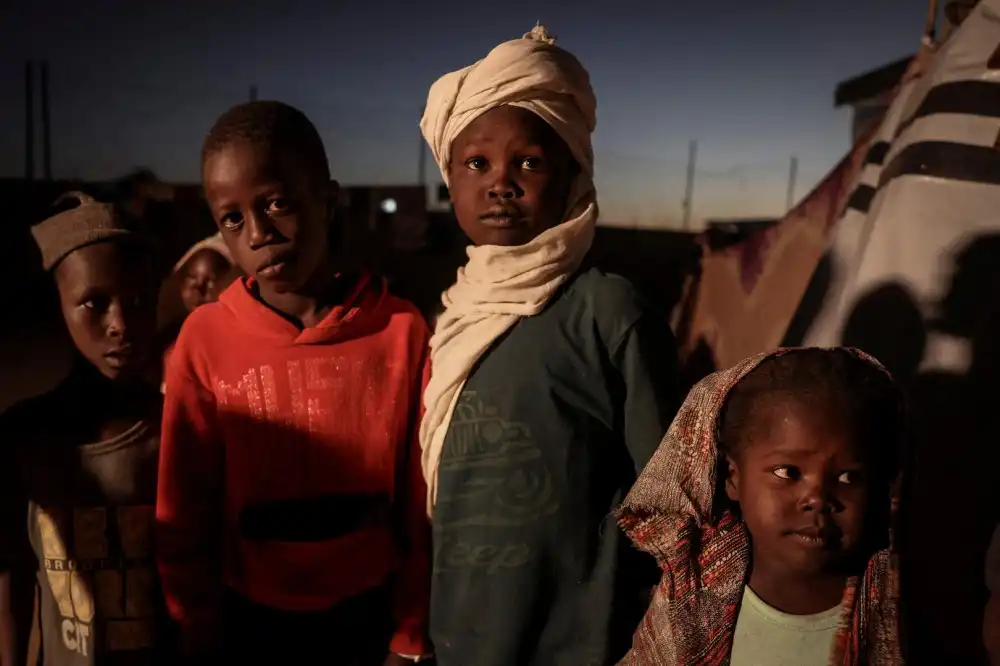
Sudanese refugee children from Al-Fashir at the Tine transit camp (© Reuters)
Conflict, displacement, flooding, economic instability, weak institutions, food insecurity and climate change do not occur one after another – they occur simultaneously.
Nowhere in the world is that truth more prescient than in South Sudan, one of the world’s most complex examples of protracted fragility.
The United Nations Office for the Co-ordination of Human Affairs (OCHA)’s Eastern Africa El Niño Preparedness Alert from August this year warns of a stronger El Niño expected during late 2026, bringing increased risks of both drought and flooding across the region.
For South Sudan, El Niño multiplies the harm of existing fragility – pushing already-vulnerable communities ever nearer to their breaking point.
The latest findings from April of this year showed that acute food insecurity in South Sudan is alarmingly high and continues to increase, with 7.8 million people facing extreme hunger.
In some areas, conditions have worsened, with 73,300 people now facing starvation.
The statistics do not reflect the human story behind each number. Women, girls and children remaining resilient when the choice has been taken away.
Hunger is only one element of the emergency. South Sudan is also grappling with its largest ever cholera outbreak while simultaneously coping with the risk of Ebola spreading from neighbouring Democratic Republic of Congo.
Less than half of the population has access to primary healthcare – with treatable illnesses rapidly becoming a life-or-death situation without nearby clinics or staff to treat them.
Right when needs are reaching critical levels, humanitarian resources are shrinking. Around the world, aid budgets are being cut and development funding is under pressure.
The direct consequences are fewer health services, decreased necessities like food and water, reduced protection for women and girls and fewer opportunities to help communities prepare for the next shock before disaster strikes.
Despite the scale of need, the situation in South Sudan receives limited international attention.
Those of us working in Oxfam and other humanitarian organisations on the ground have seen firsthand the dangers of abandoning those most vulnerable during climate shocks – which will only continue to spread without immediate global action.
In 15 years, South Sudan has taught the world that resilience is deeply human. It lives in women who rebuild households for their young children after every flood; in communities that continue sharing scarce resources and in local leaders who continue mediating peace under impossible circumstances.
Is the international community willing to match that resilience with the resources, political will and climate action needed?
For many people in Ireland, South Sudan can seem distant enough to disassociate. We must not forget that the forces driving the climate emergency are global and our leaders have a role to play.
Countries such as South Sudan, which have contributed least to global emissions, are paying the highest price for a crisis they did little to create.
Resilience should never become a justification for asking people to endure endless crises and ignoring El Niño’s stark warnings.
South Sudan may be a fragile nation, but its resolve remains unbroken. We must act now to ensure its people’s dignified survival.
Shabnam Baloch is country director of Oxfam South Sudan
Newer articles:
- Ethiopia and Eritrea cut diplomatic ties as northern conflict escalates - 02/10/2026 13:09
- United Arab Emirates: A Year On, South Sudanese Critic Remains in Detention - 30/09/2026 15:29
- Ramaphosa urges caution as AU supports South Sudan elections - 30/09/2026 15:26
- Kenya backs South Sudan ahead of December election - 30/09/2026 15:23
- Israel-bound plane lands in Saudi Arabia after pilot allegedly tries to crash it - 30/09/2026 15:20
Older news items
- Abyei market reopens after deadly Sudan-South Sudan border violence - 30/09/2026 15:14
- Egypt coach Hossam Hassan satisfied with big win over South Sudan - 30/09/2026 15:12
- Bringing Health Services Closer to Communities: The Contribution of the Boma Health Initiative to Primary Health Care Delivery - 30/09/2026 15:10
- Uganda Begins $121m South Sudan Power Interconnection Project - 28/09/2026 12:14
- Ethiopia accuses Eritrea, Sudan of backing Tigray rebels amid clashes - 28/09/2026 12:12
Latest news items (all categories):
- China’s new Long March: Why its modernization is a demanding journey - 21/10/2026 12:31
- Drone attack in disputed Sudan-South Sudan border region kills at least 153 - 21/10/2026 12:17
- South Korea - 'Smart camp' system built at Hanbit Unit in South Sudan - 21/10/2026 12:09
- Sudanese refugees in Gorom camp, South Sudan, struggle for water, medicines, security - 21/10/2026 12:05
- South Sudan: A Testing Ground For Democracy While Citizens Struggle To Survive - 19/10/2026 14:31
See also (all categories):
Random articles (all categories):
- South Sudan’s energy minister promises electricity for major towns - 13/10/2017 10:55
- South Sudan: Vice President Launches Country-Wide Polio Vaccination Campaign - 25/10/2013 17:46
- CPA Adjustment and Quest for Southern Sudan Development - 21/02/2008 18:33
- ‘Depression, anxiety common in South Sudan’ - 09/10/2020 04:08
- Generation of “Congratulation Messages” (Part Two) - 26/07/2020 13:27
Popular articles:
- Who is the darkest person in the world, according to Guinness World Record? - 25/10/2022 02:34 - Read 151145 times
- School exam results in South Sudan show decline - 01/04/2012 17:58 - Read 28321 times
- Top 10 weakest currency exchange rates in Africa in 2023 - 19/07/2023 00:24 - Read 25413 times
- No oil in troubled waters - 25/03/2014 15:02 - Read 24640 times
- NDSU student from South Sudan receives scholarship - In-Forum - 29/09/2012 01:44 - Read 22610 times
