
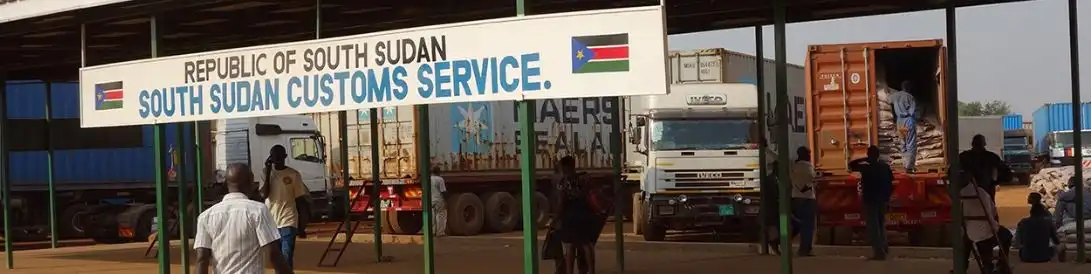
South Sudan Custom Services (Photo Credit: UNMISS Media / Twitter/X)
Kenya and South Sudan have renewed efforts to revive trade between the two countries, but a key transport corridor that has been discussed for more than a decade remains unfinished.
The Lokichokio-Nadapal-Juba corridor was envisioned as a direct and more efficient connection between Kenya and South Sudan, potentially reducing the distance and cost of transporting goods between the two countries.
But years after the project was first proposed, the route remains incomplete, while traders continue to rely on longer routes through Uganda.
The problem dates back to 2015, when Kenya and South Sudan proposed construction of the 11-kilometre Nadapal-Nakodok section as part of a wider 600-kilometre highway linking Eldoret to South Sudan. The entire project was estimated at $700 million, with the short border section expected to take only three months to complete.
South Sudan's civil war, however, disrupted the plans and construction stalled.
The project has since featured repeatedly in discussions between Nairobi and Juba, with successive commitments failing to translate into a completed corridor.
By late 2024, the two countries had missed a World Bank deadline for submitting technical reports on the road project, leaving its future uncertain.
Kenya's Roads Principal Secretary at the time appealed to communities in the border region to give the two governments room to resolve the political and technical disagreements delaying construction.
As of late July 2026, Kenya had completed its section of the road from Nairobi to Nadapal, but the South Sudan side through Kapoeta and Torit was still facing delays.
This is despite a June 2024 announcement that construction of the Juba-Torit-Nadapal highway would begin with World Bank financing.
The unfinished road means that South Sudan, a landlocked country, continues to depend heavily on longer transport routes through Uganda to access Kenya's Mombasa port and other regional markets.
South Sudanese officials have continued to describe the Nadapal route as a priority, arguing that completing it would provide a more direct connection to Kenya and create opportunities to increase trade and economic activity.
The consequences of the delays are already being felt by businesses and transporters.
The route through Uganda adds distance to journeys, increasing transportation costs and making trade between Kenya and South Sudan more expensive and less efficient. Traders also face insecurity, illegal roadblocks, extortion and harassment along parts of the route.
These challenges have become a separate focus of recent talks between Nairobi and Juba.
In late July, Kenya and South Sudan agreed on a joint framework aimed at reducing harassment of truckers after identifying more than 11 security checkpoints between the Uganda-South Sudan border and the interior.
South Sudan committed to engaging its military and other security agencies to address the harassment of East African truckers, while the two countries agreed to work towards reducing the number of checkpoints.
The measures came as part of broader efforts to improve trade between the two countries, including discussions on banking access for South Sudanese businesses and the movement of people.
However, the checkpoint agreement does not resolve the fundamental infrastructure problem.
The Nadapal corridor has been promised at the highest political levels for years. In 2023, President William Ruto and South Sudan President Salva Kiir agreed to complete the 11-kilometre Nadapal-Nakodok road and leverage the African Continental Free Trade Area to boost trade between the two countries.
Kenya has completed its side, while South Sudan's section remains delayed. At the same time, insecurity around the border continues to discourage traders and disrupt movement, while the proliferation of checkpoints and allegations of harassment add further costs to cross-border commerce.
The latest Kenya-South Sudan talks offer some progress, particularly on addressing the treatment of truckers. But the larger trade problem remains unresolved.
Until the missing sections of the Lokichokio-Nadapal-Juba corridor are completed and the security environment improves, traders will continue to face longer routes and higher costs, while Kenya and South Sudan risk missing the economic opportunities that a direct and reliable trade corridor could unlock.
Newer articles:
- New Monitoring System Could Reshape Education Planning and Resource Allocation in South Sudan - 02/09/2026 17:05
- ‘It’s not part of Kenya’ – South Sudan VP Taban Deng renews claim over disputed Ilemi Triangle - 31/08/2026 11:11
- Families search for missing loved ones as conflict shatters Sudan, South Sudan - 31/08/2026 11:03
- Armed raid on cattle camp kills at least 49 in South Sudan - 31/08/2026 11:01
- UNESCO supports South Sudan to establish its first education sector monitoring system - 31/08/2026 10:58
Older news items
- UN says floods displace 168 families, damage 271 homes in southern Sudan - 28/08/2026 12:41
- Pace, space, and shooting: How South Sudan edged hard-fighting Guinea - 28/08/2026 12:36
- South Sudan Nexus Digest Issue #2 | June - July 2026 - 28/08/2026 12:35
- South Sudan vows probe after two Ethiopian peacekeepers killed in Jonglei ambush; Ethiopia, UN and Egypt condemn attack - 26/08/2026 13:06
- Dozens killed in rebel attacks on Sudan’s Kordofan, medical group says - 26/08/2026 13:03
Latest news items (all categories):
- U.S. condemns WFP attack, looting of humanitarian assistance in South Sudan - 12/10/2026 14:49
- South Sudan President Bans Officials From Foreign Travel Without Approval After Kenya Visit - 12/10/2026 14:47
- At least 72 Sudanese miners killed in air strike: Rights monitor - 12/10/2026 14:44
- Why did deadly communal clashes erupt in South Sudan, leaving 71 people dead? - 12/10/2026 14:40
- UPDF commissions new medical facilities in South Sudan - 12/10/2026 14:36
See also (all categories):
Random articles (all categories):
- Refugees Say South Sudan Should Have Federalist Government - 06/12/2017 16:10
- South Sudan deploys team to smoke out criminals on Juba highway - 25/08/2021 01:19
- Sudan Lets Christians March for Jesus Again - 29/12/2019 02:24
- South Sudan doubles primary enrollments, but still has work to do - Bikya Masr - 13/09/2012 05:33
- Total Confirms Plans To Resume South Sudan Exploration - 03/02/2012 10:41
Popular articles:
- Who is the darkest person in the world, according to Guinness World Record? - 25/10/2022 02:34 - Read 150898 times
- School exam results in South Sudan show decline - 01/04/2012 17:58 - Read 28220 times
- Top 10 weakest currency exchange rates in Africa in 2023 - 19/07/2023 00:24 - Read 25323 times
- No oil in troubled waters - 25/03/2014 15:02 - Read 24552 times
- NDSU student from South Sudan receives scholarship - In-Forum - 29/09/2012 01:44 - Read 22518 times
