
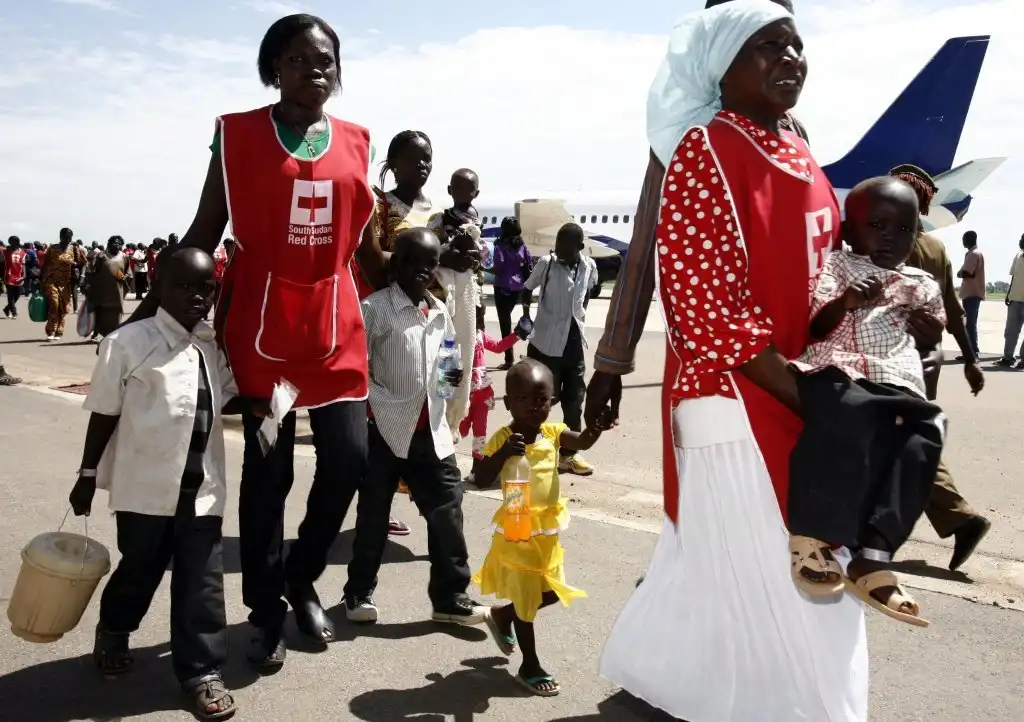
File photo: Displaced people from South Sudan, stranded in Kosti airport, arrive at Juba airport (Photo: EPA / ANSA)
After fleeing the war in South Sudan in 2016 and waiting six years in Egypt for a chance at resettlement, Alex James Ganya eventually gave up waiting and moved on to Libya. From there he spoke to InfoMigrants about the illness, poverty and exploitation that have marked his journey so far.
Alex James Ganya is one of thousands of Sudanese and South Sudanese asylum seekers in Libya whose situation is declining amid cuts to humanitarian aid and limited access to healthcare and protection.
According to current estimates provided by the UN Refugee Agency UNHCR (last updated August 1, 2026), there are around 93,743 registered Sudanese asylum seekers in Libya and around 2,110 from South Sudan. Sudanese nationals registered by UNHCR account for roughly 84 percent of the total asylum-seeker and refugee population in Libya.
It was the civil war in Juba, South Sudan, that first forced Ganya to flee his homeland. His journey took him first to Sudan, and then on to Egypt. Ganya waited six years in Egypt, hoping for a resettlement opportunity through the UN Refugee Agency (UNHCR) but his opportunity never came, he told InfoMigrants over the phone from Libya where he now resides.
Ganya initially fled civil war in Juba, South Sudan, in 2016 after being wounded. More conflict in Sudan took him on to Egypt. There, Ganya worked as an English teacher in Sudanese schools, but he says his income was not enough to cover his basic living expenses. Reports of discrimination and deportations in Egypt, in particular towards Black African people, are also making the situation for many, even when registered as a refugee there, feel precarious.
After six years, Ganya decided to move on to Libya. There, he said he hoped to access better medical treatment for his leg, injured in Sudan, and find a fresh start. He also hoped that he might be able to journey on to Europe.
Regional conflict reignited
Over the years, Sudan and South Sudan have been wracked by conflict. What is known as the second civil war broke out in 1983 between the more developed north of the country (now known as Sudan) and the less-developed south, now known as South Sudan. After a peace treaty was eventually signed in 2005, the south worked its way towards an independence referendum in 2011, where they broke away from Sudan.
But just two years later, in 2013, a third conflict broke out within South Sudan, raging until 2018, notes the Council on Foreign Relations, an independent think tank, in its blog on the country. This conflict was partly fuelled by ethnic conflict and partly by a power struggle between two of South Sudan's most powerful people, President Salva Kiir and his former First Vice President Riek Machar, who was dismissed by Kiir in 2013, kicking off another round of fighting, which lasted on and off until 2018, before reigniting in 2025 and 2026.
According to the CFR, "Ten million South Sudanese—nearly 84 percent of the population—need humanitarian assistance, as reports of airstrikes on civilian areas, sexual violence, and forced recruitment have escalated since March 2025. Over two million people remain internally displaced, with hundreds of thousands more sheltering as refugees in neighboring countries, even as South Sudan continues to host over one million refugees fleeing from Sudan’s civil war."
Some of those displaced people went to Chad or Egypt, like Ganya, others have since traveled on to Libya, as displacement continues and funding shortages worsen, thousands of refugees in Libya now also face harsh humanitarian conditions. Basic needs are increasing while the ability of aid organizations to respond is diminishing, turning daily life into a struggle for survival for many.
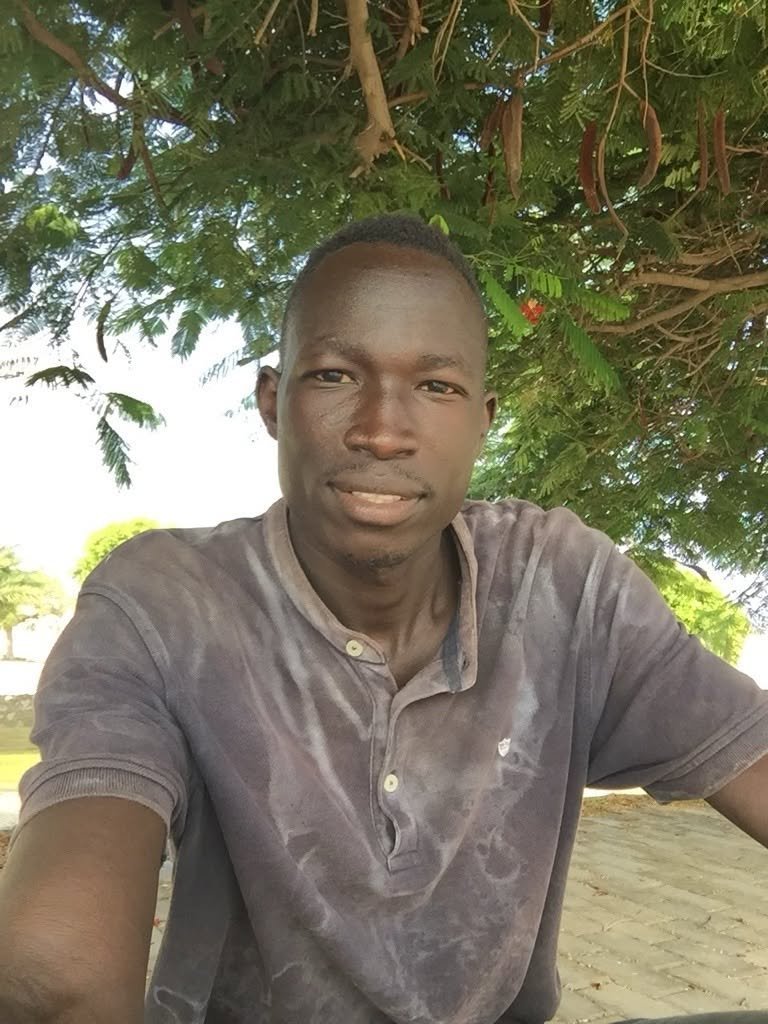
Alex James Ganya contacted InfoMigrants via our Facebook page and said he wanted to tell his story, he spoke to our Sudanese colleague in the Arabic service | Photo: Alex James Ganya
Ganya's tale: Displacement, illness and fraud
Like many others in his situation, Ganya told InfoMigrants: "I am stuck in Libya, and I never imagined things would become this bad. I cannot return to Sudan because it is not safe, and most of the time I cannot even move because of my health condition."
Now 31, Ganya explained that he had to leave behind his pregnant wife and his ten-year-old daughter in South Sudan. In search of better-paid work. He says he couldn't afford the costs of medical bills in Egypt for his injured legs.
In Egypt, where he sought treatment for his injured leg, he couldn't afford the costs of medical bills. At first, the UNHCR referred him to the Catholic charity Caritas, but he said they did not really solve the problems he had. That's when he decided to travel to Libya, believing that healthcare and opportunities there would be better. Instead, he encountered major difficulties accessing hospitals and medical care, and says his health condition has become even more complicated than it was in Egypt.
Ganya initially fractured his leg after being wounded. He later developed complications in the form of a coagulated blood collection (hematoma), which affected his ability to move. Over time, he continued to experience persistent knee pain, especially in cold weather. Diagnostic examinations revealed the presence of small loose bodies and cartilage fragments inside the joint, some of which had shifted from their original position, causing ongoing pain and reduced mobility, particularly during the winter months.
In Libya, Ganya says that Black Africans like him face discrimination. He also claims that he was defrauded by a man he met at the station on arrival. This man, says Ganya, offered to smuggle him to Libya for around 2,000 Libyan dinars (around 273 euros). Ganya handed over the money, but says the man disappeared and cut off all contact. Ganya never recovered his funds.
Struggling Without Healthcare or Protection
In Libya, Ganya tried to get work in people's houses, but said people here too often exploited him. Ganya says that often those he agreed to work for would pay him less than at first agreed, or withhold his wages altogether.
Many migrants find themselves exploited and abused in Libya. The most common labor-related abuses reported by migrants in Libya include "economic exploitation, forced labor, non-payment or delayed payment of wages, confiscation of personal documents, working in unsafe conditions, and exposure to threats or violence," Ganya told InfoMigrants.
"I paid approximately 700 dollars (around 613 euros) to reach Libya from Egypt. But we witnessed many cases where migrants were taken and held against their will. They were forced to pay money to be released, and some were subjected to beatings until their families sent the payments demanded."
Ganya says he does not dare demand his rights out of fear of getting into trouble and says that, due to his status, he cannot turn to the police or seek protection in Libya, although he is registered as a refugee with the UNHCR in both Egypt and Sudan.
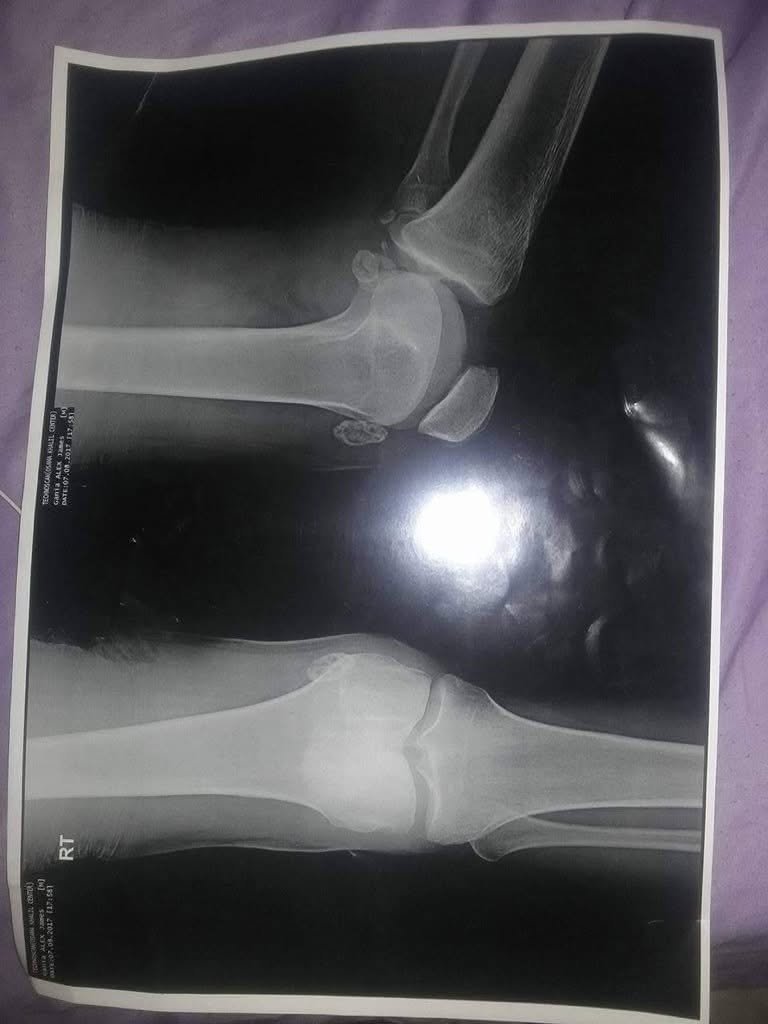
A photo taken by Alex James Ganya of an X-ray of his injury while he was in Egypt in 2013 | Source: Photo provided by Alex James Ganya
"I am sick and need surgery. I hoped I would find treatment, but it has become very difficult. In winter, I cannot move or work because of my condition, and I feel as though my life stops with every passing day.
All I want is treatment and to regain my ability to walk. I dream of reaching Europe, not only for medical care but also to continue my education, build a future, make my mother proud, and support my family. I had to leave school after my father's death, but I have never abandoned my dream of education."
Alex's story is not an isolated case. According to UNHCR data, by the end of December 2025, there were 41.6 million refugees worldwide, 9 million asylum seekers, and 68.7 million internally displaced people due to conflict and violence. In addition, approximately 4.5 million stateless people lacked access to fundamental rights such as education, healthcare, employment, and freedom of movement.
This article was translated from the Arabic original using an AI translator -- Copilot and Google and slightly reworked for language, context and clarity for the English version. It was cross-checked by the Arabic author to make sure that the English version remains accurate.
Newer articles:
- UN: As elections near, South Sudan risks new atrocity crimes - 21/08/2026 16:55
- What does it mean for Haiti and South Sudan if their citizens are forced to return? - 21/08/2026 16:53
- SOUTH SUDAN: Cardinal Challenges New Priests to Promote Peace - 21/08/2026 16:51
- South Sudan releases Ugandan drivers, trucks seized for military use - 21/08/2026 16:49
- SMART Survey Report for Abyei Administrative Area, June 2026 - 21/08/2026 16:43
Older news items
- UNMISS patrol to Pading finds displaced families struggling to rebuild after conflict - 19/08/2026 13:26
- South Sudan, New Zealand stun at the FIBA Women’s Olympic Pre-Qualifying Tournament 2026 - 19/08/2026 13:20
- War, natural disasters ravage South Sudan - 19/08/2026 13:17
- Kenyan truckers threaten to boycott DRC, S. Sudan as insecurity persists - 19/08/2026 13:13
- South Sudan release official first-round fixtures for 2026-27 Premier League - 19/08/2026 13:10
Latest news items (all categories):
- China’s new Long March: Why its modernization is a demanding journey - 21/10/2026 12:31
- Drone attack in disputed Sudan-South Sudan border region kills at least 153 - 21/10/2026 12:17
- South Korea - 'Smart camp' system built at Hanbit Unit in South Sudan - 21/10/2026 12:09
- Sudanese refugees in Gorom camp, South Sudan, struggle for water, medicines, security - 21/10/2026 12:05
- South Sudan: A Testing Ground For Democracy While Citizens Struggle To Survive - 19/10/2026 14:31
See also (all categories):
Random articles (all categories):
- Telcos in South Sudan increase tariffs amid exchange rate hike - 24/10/2024 11:07
- Sudan's Bashir vows to punish South - SBS - 19/04/2012 12:00
- South Sudan's Salva Kiir sacks entire cabinet - 23/07/2013 16:22
- South Sudan officials have stolen $4 billion: president - Chicago Tribune - 04/06/2012 16:14
- UN warns of economic downturn in South Sudan amid Sudan conflict - 03/08/2023 07:08
Popular articles:
- Who is the darkest person in the world, according to Guinness World Record? - 25/10/2022 02:34 - Read 151177 times
- School exam results in South Sudan show decline - 01/04/2012 17:58 - Read 28328 times
- Top 10 weakest currency exchange rates in Africa in 2023 - 19/07/2023 00:24 - Read 25424 times
- No oil in troubled waters - 25/03/2014 15:02 - Read 24647 times
- NDSU student from South Sudan receives scholarship - In-Forum - 29/09/2012 01:44 - Read 22618 times
