
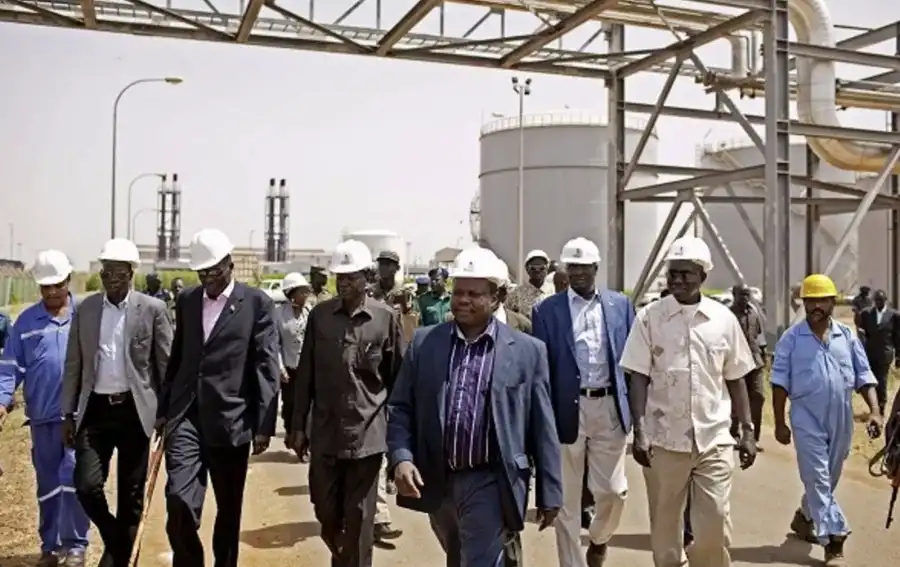
South Sudanese officials inspect facilities at the Paloich oil field. The government is pursuing reforms aimed at attracting new investment into oil production, refining, natural gas and power infrastructure (Photo Credit: VanGuard)
South Sudan is stepping up efforts to attract fresh investment into its energy industry as the government seeks to rebuild oil production, strengthen domestic fuel security and position the country as one of Africa’s leading frontier markets.
The renewed investment drive followed a working visit to Juba by the African Energy Chamber, which met government officials and industry stakeholders to identify reforms capable of unlocking new capital across the upstream, midstream and downstream segments of the petroleum industry.
The discussions focused on improving regulatory certainty, reducing barriers to investment and creating a more predictable operating environment for international and regional energy companies.
For South Sudan, the initiative represents a fresh attempt to convert its substantial petroleum reserves into production growth, infrastructure development and wider economic benefits.
Unlocking a Major African Oil Frontier
South Sudan holds an estimated 3.5 billion barrels of proven oil reserves, making it one of the continent’s most resource-rich but underdeveloped hydrocarbon markets.
It is also East Africa’s only major oil-producing country, with production led by national oil company Nilepet and joint operating companies including Dar Petroleum Operating Company, Greater Nile Petroleum Operating Company and Sudd Petroleum Operating Company.
China National Petroleum Corporation operates Greater Nile Petroleum Operating Company, while South Africa’s Strategic Fuel Fund holds a 90 per cent stake in the Block B2 concession.
The fund is expected to advance exploration activities while also evaluating opportunities for refining development.
Despite this resource base, insufficient investment has limited South Sudan’s ability to develop new fields, maintain infrastructure and raise production to levels required to support economic recovery.
Current output is estimated at between 70,000 and 100,000 barrels per day.
Between August and November 2026, total production is projected at approximately 8.5 million to 12.2 million barrels.
The government is now seeking to increase these volumes by attracting investment into exploration, field redevelopment, storage, transportation and refining.
Oil Recovery Becomes an Economic Priority
Oil remains the foundation of South Sudan’s economy and the country’s principal source of public revenue and foreign exchange.
That dependence has made production recovery a national economic priority.
Higher output could provide the government with additional fiscal resources while strengthening exports and supporting investment in transport, electricity, healthcare and other public infrastructure.
However, the government’s ambitions go beyond exporting more crude.
South Sudan also wants to address domestic fuel shortages, limited power generation and the absence of sufficient refining capacity.
Although the country produces crude oil, it remains heavily dependent on imported petroleum products, exposing the economy to high transport costs, supply disruptions and fluctuations in global fuel prices.
New downstream investment could allow South Sudan to process more of its crude domestically, retain greater value from its resources and develop local storage and distribution systems.
Government Promises Investment Reforms
During the meetings in Juba, officials committed to reducing obstacles that have slowed project development and discouraged capital inflows.
The proposed reforms are expected to focus on clearer regulatory procedures, faster approvals, stronger institutional coordination and more predictable commercial terms.
Energy projects typically require significant capital and long development periods, meaning investors will closely assess the stability of fiscal policies, the enforceability of contracts and the security of infrastructure.
South Sudan will therefore need to demonstrate that it can provide an operating environment in which companies can manage risk and execute projects efficiently.
The government believes improved regulatory clarity could help the country compete more effectively with other African markets seeking exploration and infrastructure investment.
Across the continent, countries including Namibia, Uganda, Senegal, Angola, Nigeria and Côte d’Ivoire are competing for increasingly selective energy capital.
South Sudan’s advantage lies in its established production base and large undeveloped reserves. Its challenge is to convince investors that projects can be delivered under stable and transparent conditions.
Gas and Power Opportunities Emerge
The discussions also examined opportunities beyond crude oil production.
Natural gas, power generation and supporting infrastructure were identified as key areas capable of advancing economic diversification and improving energy access.
Associated gas from oil fields could be captured and used for electricity generation instead of being wasted or left undeveloped.
Gas-to-power projects could provide more reliable electricity for households, businesses and public institutions while reducing dependence on costly diesel generation.
Improved power supply would also support the growth of agriculture, manufacturing, mining and other productive sectors.
For a country facing significant electricity shortages, energy investment could therefore deliver benefits far beyond the petroleum industry.
Local Content Takes Centre Stage
Strengthening local participation formed another major part of the Juba engagement.
The government and the African Energy Chamber discussed ways to ensure that future oil and gas projects create employment, develop domestic skills and support South Sudanese businesses.
The objective is to build local value chains around the energy industry so that investment generates economic benefits beyond government revenue.
This could include greater use of local contractors, workforce training, technical education and partnerships between international companies and domestic firms.
A stronger local content programme could help create a new generation of South Sudanese engineers, technicians, geoscientists and entrepreneurs.
However, the success of such policies will depend on whether they are implemented in a way that supports investment while gradually developing domestic capacity.
AEC to Promote South Sudan Globally
The African Energy Chamber said it would support South Sudan by promoting the country’s investment opportunities to the global energy community.
The organisation plans to connect government officials and industry leaders with operators, financiers, service companies and infrastructure investors.
AEC Executive Chairman NJ Ayuk said South Sudan had the resources required to become one of Africa’s most attractive frontier markets, but stressed that sustained engagement with investors would be essential.
“South Sudan possesses the resource potential to become one of Africa’s most compelling frontier investment destinations, but attracting capital requires sustained engagement with the global investment community,” Ayuk said.
“The Chamber will champion South Sudan’s opportunities on the international stage, connecting investors with government and industry leaders while supporting reforms that create a stable, competitive and investable energy sector capable of delivering long-term growth.”
The Chamber’s support could provide South Sudan with greater visibility at international energy and investment forums, where governments increasingly compete to present bankable projects.
Execution Will Determine Success
South Sudan’s renewed investment campaign comes at a critical time for the country’s economy.
The resources are available, the production history is established and the need for capital is clear.
The decisive question is whether the government can translate its reform commitments into measurable improvements in the business environment.
Investors will look for faster approvals, clearer regulations, reliable commercial agreements and greater confidence in project security.
They will also assess whether infrastructure challenges can be addressed and whether new projects can move from licensing to production within realistic timelines.
If these reforms are successfully implemented, South Sudan could move beyond restoring output and begin building a more integrated energy industry.
That would mean not only producing and exporting more oil, but also developing refining, gas, electricity and local service industries.
For Juba, the broader objective is to turn natural resources into sustained economic growth, employment and energy security.
The latest engagement with the African Energy Chamber signals that South Sudan is ready to make a stronger case to investors. The next test will be converting that message into capital commitments and projects on the ground.
Newer articles:
- South Sudan dismisses reports of new visa rules, says immigration policy unchanged - 20/07/2026 19:02
- South Sudan inaugurates Egyptian-funded groundwater station at Juba University - 20/07/2026 19:00
- South Sudan Launches National Spectrum Management and 5G Strategy Development - 20/07/2026 18:58
- “Our children are dying like flowers falling”: A mother’s plea for peace in Bangolo - 20/07/2026 18:55
- The African Development Bank Group to provide $13 million to bolster Ebola response-outbreak in Democratic Republic of the Congo, South Sudan and Uganda - 20/07/2026 18:53
Older news items
- Qatar: Prime Minister and Minister of Foreign Affairs Meets South Sudanese President's National Security Advisor - 17/07/2026 14:13
- South Sudan: Humanitarian Access Snapshot - June 2026 - 17/07/2026 14:08
- Kenya and South Sudan seek to strengthen bilateral ties through enhanced security collaboration - 15/07/2026 15:24
- Sudan Rejects South Sudan’s Decision to Include Abyei in Electoral Constituencies, Calling It a Breach of Existing Agreements - 15/07/2026 15:20
- Regional race against Ebola as Congo outbreak accelerates towards South Sudan - 15/07/2026 15:17
Latest news items (all categories):
- Ramaphosa presses Kiir to implement peace deal ahead of South Sudan’s first elections - 09/10/2026 12:19
- South Sudan steps up Ebola alert after Kenya case - 09/10/2026 12:17
- Laotian man deported by U.S. to South Sudan leaves for Laos after year in detention - 09/10/2026 12:14
- Bullet and blast injuries … and a constant need for blood: inside South Sudan’s overwhelmed trauma wards - 09/10/2026 12:10
- MTN South Sudan and Regulator Pledge Cooperation to Expand Connectivity - 09/10/2026 12:01
See also (all categories):
Random articles (all categories):
- Massage therapists offer relief from war in South Sudan - 14/04/2016 06:16
- Sudan's Bashir empowers old army ally, tightens grip - 11/12/2013 06:22
- EU launches €208M development program in South Sudan - 18/02/2022 01:03
- UNICEF - Vacancy Announcement : Logistics Officer, NO-A, (TA), Yambio - 18/04/2016 11:53
- Southern Sudan doctors and paramedics announcement - 04/09/2009 16:02
Popular articles:
- Who is the darkest person in the world, according to Guinness World Record? - 25/10/2022 02:34 - Read 150840 times
- School exam results in South Sudan show decline - 01/04/2012 17:58 - Read 28206 times
- Top 10 weakest currency exchange rates in Africa in 2023 - 19/07/2023 00:24 - Read 25313 times
- No oil in troubled waters - 25/03/2014 15:02 - Read 24539 times
- NDSU student from South Sudan receives scholarship - In-Forum - 29/09/2012 01:44 - Read 22502 times
