
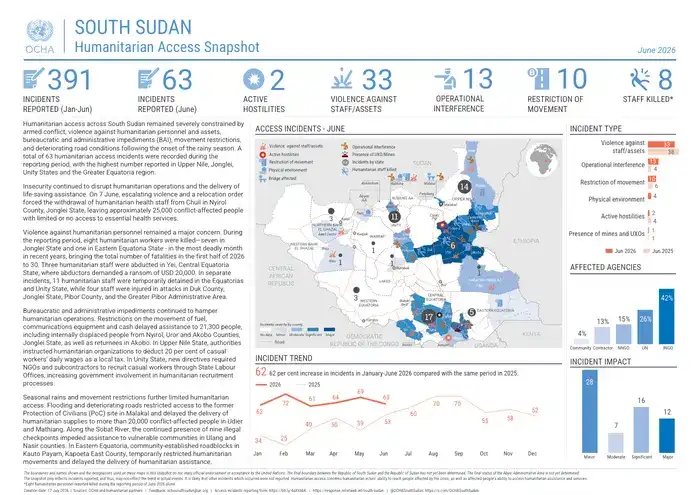
Humanitarian access across South Sudan remained severely constrained by armed conflict, violence against humanitarian personnel and assets, bureaucratic and administrative impediments (BAI), movement restrictions, and deteriorating road conditions following the onset of the rainy season. A total of 63 humanitarian access incidents were recorded during the reporting period, with the highest number reported in Upper Nile, Jonglei, Unity States and the the Greater Equatoria region.
Insecurity continued to disrupt humanitarian operations and the delivery of life-saving assistance. On 7 June, escalating violence and a relocation order forced the withdrawal of humanitarian health staff from Chuil in Nyirol County, Jonglei State, leaving approximately 25,000 conflict-affected people with limited or no access to essential health services.
Violence against humanitarian personnel remained a major concern. During the reporting period, eight humanitarian workers were killed—seven in Jonglei State and one in Eastern Equatoria State - in the most deadly month in recent years, bringing the total number of fatalities in the first half of 2026 to 30. Three humanitarian staff were abducted in Yei, Central Equatoria State, where abductors demanded a ransom of USD 20,000. In separate incidents, 11 humanitarian staff were temporarily detained in the Equatorias and Unity State, while four staff were injured in attacks in Duk County, Jonglei State, Pibor County, and the Greater Pibor Administrative Area.
Bureaucratic and administrative impediments continued to hamper humanitarian operations. Restrictions on the movement of fuel, communications equipment and cash delayed assistance to 21,300 people, including internally displaced people from Nyirol, Uror and Akobo Counties, Jonglei State, as well as returnees in Akobo. In Upper Nile State, authorities instructed humanitarian organizations to deduct 20 per cent of casual workers' daily wages as a local tax. In Unity State, new directives required NGOs and subcontractors to recruit casual workers through State Labour Offices, increasing government involvement in humanitarian recruitment processes.
Seasonal rains and movement restrictions further limited humanitarian access. Flooding and deteriorating roads restricted access to the former Protection of Civilians (PoC) site in Malakal and delayed the delivery of humanitarian supplies to more than 20,000 conflict-affected people in Udier and Mathiang. Along the Sobat River, the continued presence of nine illegal checkpoints impeded assistance to vulnerable communities in Ulang and Nasir counties. In Eastern Equatoria, community-established roadblocks in Kauto Payam, Kapoeta East County, temporarily restricted humanitarian movements and delayed the delivery of humanitarian assistance.
- UN Office for the Coordination of Humanitarian Affairs
- To learn more about OCHA's activities, please visit https://www.unocha.org/.
Source: https://reliefweb.int/report/south-sudan/south-sudan-humanitarian-access-snapshot-june-2026
Newer articles:
- South Sudan Launches National Spectrum Management and 5G Strategy Development - 20/07/2026 18:58
- “Our children are dying like flowers falling”: A mother’s plea for peace in Bangolo - 20/07/2026 18:55
- The African Development Bank Group to provide $13 million to bolster Ebola response-outbreak in Democratic Republic of the Congo, South Sudan and Uganda - 20/07/2026 18:53
- South Sudan launches new energy investment push to revive oil production - 17/07/2026 14:17
- Qatar: Prime Minister and Minister of Foreign Affairs Meets South Sudanese President's National Security Advisor - 17/07/2026 14:13
Older news items
- Kenya and South Sudan seek to strengthen bilateral ties through enhanced security collaboration - 15/07/2026 15:24
- Sudan Rejects South Sudan’s Decision to Include Abyei in Electoral Constituencies, Calling It a Breach of Existing Agreements - 15/07/2026 15:20
- Regional race against Ebola as Congo outbreak accelerates towards South Sudan - 15/07/2026 15:17
- UNHCR South Sudan Population Overview of Refugees and Asylum-seekers (As of 30 June 2026) - 15/07/2026 15:10
- South Sudan resumes oil-backed financing - 11/07/2026 13:33
Latest news items (all categories):
- Why Kenya-South Sudan trade corridor remains unfinished despite years of promises - 28/08/2026 12:44
- UN says floods displace 168 families, damage 271 homes in southern Sudan - 28/08/2026 12:41
- Pace, space, and shooting: How South Sudan edged hard-fighting Guinea - 28/08/2026 12:36
- South Sudan Nexus Digest Issue #2 | June - July 2026 - 28/08/2026 12:35
- مجلس الأمن يدين هجوماً على بعثة حفظ السلام في جنوب السودان - 28/08/2026 12:32
See also (all categories):
Random articles (all categories):
- Misson Hope South Sudan Gets Storefront - KELOLAND TV - 07/05/2012 05:11
- UNICEF - Vacancy Announcement - Education Specialist (NO-C) FT, Pibor, Education Officers (NO-B), FT, Juba, Kuajok & Torit - 12/02/2019 12:44
- UN implicates S.Sudan rebel leader in aid chopper downing - 09/09/2014 22:41
- South Sudan: How warring parties play international donors - 20/03/2019 08:18
- Nigerian President, Buhari Promises To Help South Sudan Fight Terrorism - 14/05/2022 00:28
Popular articles:
- Who is the darkest person in the world, according to Guinness World Record? - 25/10/2022 02:34 - Read 148944 times
- School exam results in South Sudan show decline - 01/04/2012 17:58 - Read 28008 times
- Top 10 weakest currency exchange rates in Africa in 2023 - 19/07/2023 00:24 - Read 25088 times
- No oil in troubled waters - 25/03/2014 15:02 - Read 24398 times
- NDSU student from South Sudan receives scholarship - In-Forum - 29/09/2012 01:44 - Read 22344 times
