
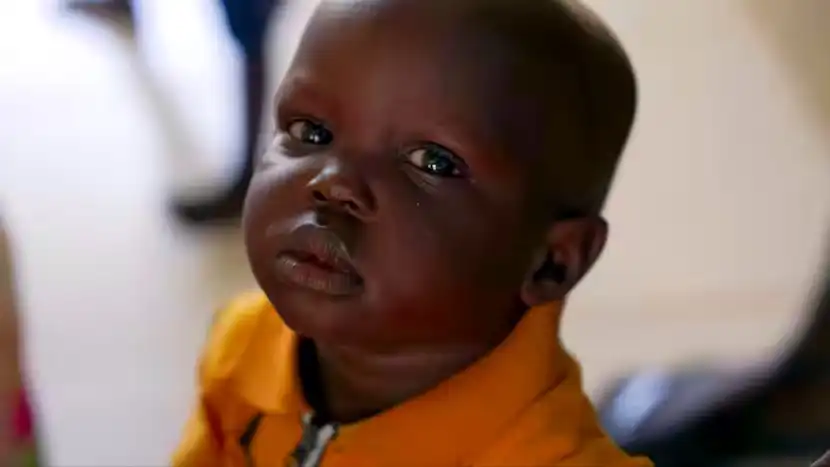
South Sudan is said to be on the brink of famine (Credit: ITV News)
ITV News has travelled to a region in South Sudan declared IPC5 - catastrophic malnutrition. The only other place in the world with this level of food insecurity is Gaza. The governor of the Upper Nile region says they are close to a famine. Senior International Correspondent John Irvine has this special report
The villages have been left to fend for themselves, but can’t.
They are situated in a remote part of eastern South Sudan and are among the few places in the world designated as category five on the world’s hunger scale. There is no category six.
We’re in Upper Nile State, where a child’s upper arm is the giveaway.
If it’s thin enough for a medic’s measuring tape to enter the red zone, then the boy or girl is suffering from acute malnutrition.
Throughout our visit, we saw too much red tape.
“We are on the brink of a famine. There is no doubt,” the state governor, James Koang Khuol, told me before we left the South Sudanese capital, Juba, to get here.
The region is so remote that, travelling from the Middle East, it took four flights and a four-hour boat ride up the White Nile to reach here.
The great river bisects the country, and in the worst-hit parts of Upper Nile state, it is the only reliable lifeline left.
South Sudan is the world’s youngest nation, but for 13 of the 15 years since it gained independence in 2011, it has been blighted by civil war or strife.
The biggest tribe forms the rump of the government, but there’s continuous tension with other tribes and that frequently leads to conflict.
Upper Nile state saw more violence back in February, and that is one of the main drivers behind this crisis because the international aid agencies are no longer operating in the areas affected.
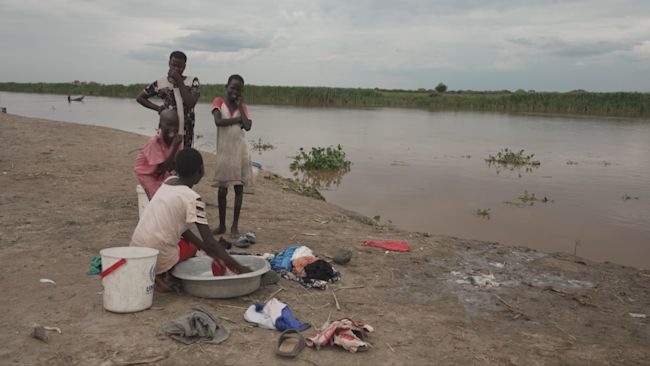
South Sudan has also seen violence along the Nile (Credit: ITV News)
Those are the places we went to. Over the years, they’ve become totally reliant on aid, and now that it’s no longer arriving, these communities are withering.
Many of the villagers are trapped because they’re too poor to go elsewhere, and if they do, they risk not being welcome for tribal reasons.
So they stay put and struggle to provide for themselves and their children.
There are no hospital wards full of malnourished babies because the hospitals aren’t up to providing inpatient care.
So local nurses set up clinics to receive concerned mothers and their young, hungry children. They give them what medicines they can, then send them home.
Another big factor in the dwindling aid supply across the state is cuts in the aid budgets of rich nations like the US and the UK. Cutbacks have consequences that are visible here.
Ending the conflict is South Sudan’s best hope, but the UK is now less invested than it was when it came to peacemaking.
Cuts in the aid budget also mean cuts in the peace and reconciliation budget.
Newer articles:
- Renewed insecurity and rising displacement in South Sudan’s Jonglei put thousands at grave risk, UNHCR warns - 05/06/2026 17:41
- St. Theresa Mission Hospital launches Ebola awareness campaign - 05/06/2026 17:38
- UNMISS helps plant hope among youth on World Environment Day - 05/06/2026 17:35
- The Voice of Responsibility: How Young South Sudanese are Saying No to Violence Through Music, Drama, and Digital Content - 03/06/2026 16:56
- Peace fails if it is not defended. The UN’s peacekeepers cannot do this alone - 03/06/2026 16:39
Older news items
- Volleyball Cranes defeat South Sudan to maintain perfect start - 03/06/2026 16:30
- 'I've seen love': South Sudan bishop applauds Canadians during first visit - 03/06/2026 16:26
- Area-Based Coordination in South Sudan: Upper Nile - Fact Sheet (as of April 2026) - 03/06/2026 16:23
- UNMISS Says Budget Pressures Force Base Closures Despite Ongoing Violence - 01/06/2026 19:43
- U.S. Blames South Sudan Leaders for Lack of Peace Progress, Supports Renewal of UN Sanctions - 01/06/2026 14:36
Latest news items (all categories):
- Ramaphosa presses Kiir to implement peace deal ahead of South Sudan’s first elections - 09/10/2026 12:19
- South Sudan steps up Ebola alert after Kenya case - 09/10/2026 12:17
- Laotian man deported by U.S. to South Sudan leaves for Laos after year in detention - 09/10/2026 12:14
- Bullet and blast injuries … and a constant need for blood: inside South Sudan’s overwhelmed trauma wards - 09/10/2026 12:10
- MTN South Sudan and Regulator Pledge Cooperation to Expand Connectivity - 09/10/2026 12:01
See also (all categories):
Random articles (all categories):
- An Aid Worker Was Raped In South Sudan And The U.N. Did Almost Nothing About It - 25/07/2015 07:36
- The Solutions To Our Problems Are Well Written In The Musical Book - 01/02/2021 12:03
- Sudan: Khartoum Speaks About Limited Clashes With South Sudan Army in Heglig - 04/08/2013 19:00
- South Sudan troops in disputed Abyei threaten peace - 28/03/2014 18:22
- UNFPA In Conjunction With MOH Carrying Out Fistula Operations In Aweil, South Sudan - 22/04/2017 12:53
Popular articles:
- Who is the darkest person in the world, according to Guinness World Record? - 25/10/2022 02:34 - Read 150817 times
- School exam results in South Sudan show decline - 01/04/2012 17:58 - Read 28204 times
- Top 10 weakest currency exchange rates in Africa in 2023 - 19/07/2023 00:24 - Read 25311 times
- No oil in troubled waters - 25/03/2014 15:02 - Read 24537 times
- NDSU student from South Sudan receives scholarship - In-Forum - 29/09/2012 01:44 - Read 22500 times
