
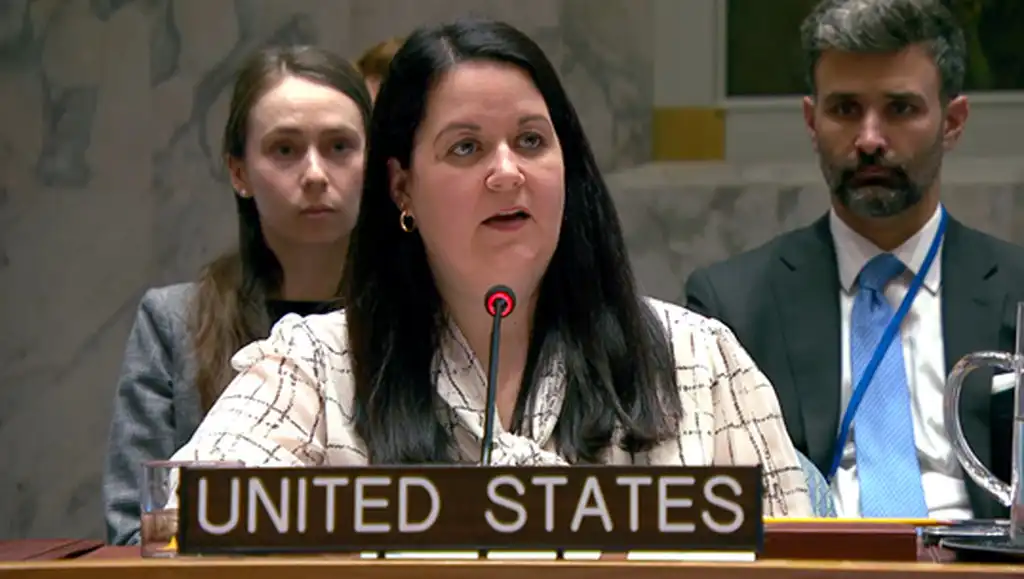
Jennifer Locetta, the U.S. Alternative Representative for Special Political Affairs (Photo Credit: The American Times)
By: Alfadil Attiya Abuanja
June 1, 2026 — The United States has welcomed the United Nations Security Council's decision to renew sanctions on South Sudan for another year, while sharply criticizing the country's leadership for failing to advance the peace process and improve security conditions.
Speaking before the Security Council on Monday, Jennifer Locetta, the U.S. Alternative Representative for Special Political Affairs, said Washington supported the extension of the South Sudan sanctions regime, including the arms embargo, travel ban, asset freeze measures, and the mandate of the UN Panel of Experts.
The United States also welcomed efforts to review the sanctions benchmarks to better reflect current conditions in South Sudan and said it looked forward to recommendations from the UN Secretary-General, the UN Mission in South Sudan (UNMISS), and the Panel of Experts.
However, Locetta expressed concern over what she described as a lack of progress toward meeting the benchmarks and a worsening political and security situation in the country.
"The lack of progress is due to a lack of political will by President Kiir, as well as other South Sudanese leaders," she told the Council.
The U.S. diplomat called on South Sudan's leaders to return to direct dialogue and take immediate steps to reduce tensions and violence. She questioned claims that meaningful dialogue was taking place while one of the signatories to the 2018 peace agreement remained under house arrest and on trial.
Locetta said the Security Council could not accept actions that obstruct the peace process, threaten transitional arrangements, or undermine South Sudan's political transition.
She urged the transitional government to restore peace by declaring a national ceasefire, releasing detainees, rejecting violence as a political tool, and ensuring public revenues are used to support citizens.
The U.S. representative also criticized governance failures in South Sudan, arguing that many of the grievances that fueled the struggle for independence continue under the country's current leadership.
"For years prior to South Sudan's independence, the Sudan People's Liberation Movement claimed to seek the end of marginalization of the southern Sudanese by leaders in Khartoum," she said. "Through bad governance and misuse of revenue, that marginalization continues, imposed by South Sudan's own leaders."
The Security Council's renewal of sanctions comes amid growing concerns over political tensions, insecurity, and delays in implementing key provisions of South Sudan's peace agreement.
Newer articles:
- 'Brink of famine': Why South Sudan’s children are paying the price of war - 03/06/2026 16:34
- Volleyball Cranes defeat South Sudan to maintain perfect start - 03/06/2026 16:30
- 'I've seen love': South Sudan bishop applauds Canadians during first visit - 03/06/2026 16:26
- Area-Based Coordination in South Sudan: Upper Nile - Fact Sheet (as of April 2026) - 03/06/2026 16:23
- UNMISS Says Budget Pressures Force Base Closures Despite Ongoing Violence - 01/06/2026 19:43
Older news items
- South Sudan: Renewal of UN arms embargo is key to protecting civilians - 01/06/2026 14:34
- South Sudan U17 Girls Kicks Off Training Ahead of CECAFA Tournament - 01/06/2026 14:30
- DR Congo, South Sudan and Uganda banned from attending World Cup 2026 Tournament in the U.S - 01/06/2026 14:28
- UN Security Council Urges Sudan, South Sudan to Revive Abyei Peace Process amid Rising Violence - 29/05/2026 20:28
- South Sudan MPs Receive $5,000 Medical Allowance as Civil Servants Go Months Without Salaries - 29/05/2026 19:57
Latest news items (all categories):
- Western Equatoria prepares for voter registration - 14/09/2026 15:11
- South Sudanese Women Reclaim Their Lives after Fistula Surgery - 14/09/2026 15:10
- Digitel Launches Voice and Social Media Bundles in South Sudan - 14/09/2026 15:07
- Nearly 100,000 displaced in Sudan’s Blue Nile state since January amid fighting: UN agency - 14/09/2026 15:03
- جنوب السودان يرفض طلبًا لـ”حميدتي” بمنحه الحصة الأكبر من عائدات النفط - 14/09/2026 14:51
See also (all categories):
Random articles (all categories):
- IGAD Sets New Conditions for South Sudan Rebel Leader - 26/03/2018 20:58
- S.Sudan crisis 'deteriorates' after six months of war - 15/06/2014 10:00
- South Sudan leader urges opposition groups to genuinely implement peace deal - 23/05/2019 11:02
- War-torn South Sudan starvation levels 'alarming': UN - 29/03/2016 05:53
- New book - 'Don't Look Back': Author Achut Deng's journey of survival from South Sudan to America - 19/12/2022 07:20
Popular articles:
- Who is the darkest person in the world, according to Guinness World Record? - 25/10/2022 02:34 - Read 149555 times
- School exam results in South Sudan show decline - 01/04/2012 17:58 - Read 28111 times
- Top 10 weakest currency exchange rates in Africa in 2023 - 19/07/2023 00:24 - Read 25191 times
- No oil in troubled waters - 25/03/2014 15:02 - Read 24460 times
- NDSU student from South Sudan receives scholarship - In-Forum - 29/09/2012 01:44 - Read 22414 times
