
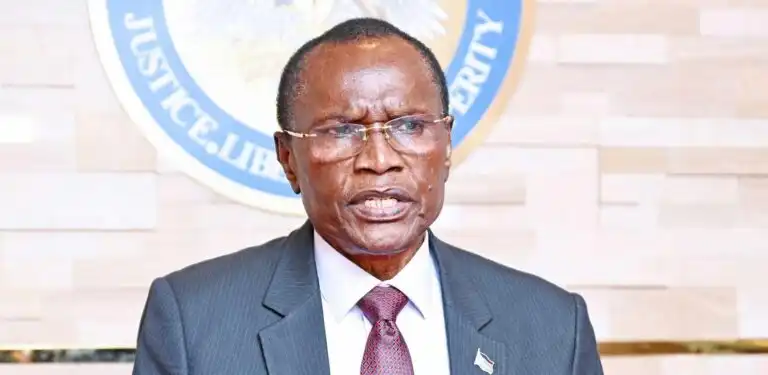
Foreign Minister James Pitia Morgan (Photo Credit: Alfadil Attiya Abuanja / File)
By: Alfadil Attiya Abuanja
South Sudan’s Ministry of Foreign Affairs on Thursday rejected a recent U.S. State Department statement criticising the implementation of the country’s peace agreement, as well as new visa restrictions targeting government officials and sanctions imposed on Crawford Capital Ltd.
Washington accused the company, which operates a digital revenue collection platform in South Sudan, of siphoning funds from the country’s treasury. The firm is reportedly linked to politically connected individuals, including members of President Salva Kiir Mayardit’s family.
The United States did not publicly identify the South Sudanese officials affected by the visa restrictions. Under U.S. law, visa records are generally confidential unless individuals are designated under separate sanctions authorities.
In a statement issued in Juba, the foreign ministry said it had “received with grave concern” remarks made on May 12 by the U.S. State Department regarding the implementation of the Revitalised Agreement on the Resolution of the Conflict in the Republic of South Sudan (R-ARCSS), along with the sanctions and visa measures.
The ministry condemned what it described as a mischaracterisation of the peace process and urged Washington and international partners to engage “constructively” with the parties to the agreement in support of elections and democratic transition efforts.
It also dismissed allegations that humanitarian assistance funds had been misappropriated, calling them “recycled and unsubstantiated claims.”
According to the ministry, the visa restrictions would negatively affect ordinary South Sudanese citizens, including students and athletes benefiting from scholarships in the United States, whom it described as among Washington’s longstanding partners and friends.
On the security situation, the ministry defended operations carried out by the South Sudan People’s Defence Forces in northern Jonglei State, saying the military acted in self-defence following attacks by opposition forces and armed youth groups between December 2025 and March 2026.
The government rejected allegations of human rights abuses and ethnic targeting as “unfounded” and lacking credible evidence, insisting that the army exercised restraint and prioritised civilian protection during the operations.
The ministry further disclosed that Foreign Minister James Pitia Morgan had met with U.S. Ambassador Michael J. Adler to discuss bilateral relations and ways to improve cooperation between the two countries.
Juba warned that the U.S. statement risked encouraging armed groups that remain outside the peace process and reiterated President Kiir’s appeal for holdout groups to join the agreement ahead of elections scheduled for December 2026.
The latest measures increase pressure from Washington on South Sudan’s political leadership at a sensitive time for the country, where the 2018 peace agreement that ended a five-year civil war remains only partially implemented.
Long-delayed elections are currently scheduled for Dec. 22, 2026, amid unresolved disputes over security arrangements, power-sharing, and governance structures that continue to raise fears of renewed instability.
Newer articles:
- UNMISS shores up patrols in Nasir as communities cautiously return - 18/05/2026 12:04
- Canada Opposes Extradition of Cobourg Man to South Sudan - 18/05/2026 11:59
- Sudanese army captures key town near Ethiopian border from RSF - 18/05/2026 11:55
- WHO Weekly Situation Update on Ongoing Health Emergency Events in South Sudan - Week #: 19 ; Date: 15th May 2026 - 18/05/2026 11:50
- UN Emergency Relief Coordinator Allocates $12 Million for South Sudan Crisis - 15/05/2026 15:22
Older news items
- Kiir to Deliver National Address as SPLM Marks 43rd Anniversary - 15/05/2026 15:06
- CES Cabinet Approves Measures to Improve Orphanage Welfare and Health Services - 15/05/2026 14:39
- United States Increases Pressure on South Sudan Over Peace Delays - 15/05/2026 14:22
- Mass Deportations from Sudan Add Pressure on South Sudan’s Humanitarian Crisis - 15/05/2026 14:12
- More than 61 killed in South Kordofan tribal clashes, Sudan Doctors Network says - 15/05/2026 14:05
Latest news items (all categories):
- Op-Ed - Breaking the Double-Standard Lens on China's Population Shifts - 23/10/2026 14:23
- South Sudan ceasefire monitors warn of rising violence ahead of December elections - 23/10/2026 13:39
- UNMISS SRSG visits Malakal, emphasizes that peace begins with collective action - 23/10/2026 13:36
- How Technology is Accelerating South Sudan’s Next Oil Discovery - 23/10/2026 13:34
- South Sudan’s Patriot make case in their opener against Urunani - 23/10/2026 13:12
See also (all categories):
Random articles (all categories):
- Latest News(Arabic) - 27/02/2007 11:16
- South Sudan instructs NGOs to fire foreign workers, hire locals - 17/09/2014 15:53
- Ban urges South Sudan leaders to ‘give up war’ and forge a political agreement - 13/07/2015 14:40
- The Horn Of Africa States: What Does The EAC Actually Represent – OpEd - 18/03/2026 11:55
- South Sudan to mobilize psychiatrists to counsel health workers dealing with COVID-19 - 12/07/2020 11:07
Popular articles:
- Who is the darkest person in the world, according to Guinness World Record? - 25/10/2022 02:34 - Read 151205 times
- School exam results in South Sudan show decline - 01/04/2012 17:58 - Read 28345 times
- Top 10 weakest currency exchange rates in Africa in 2023 - 19/07/2023 00:24 - Read 25443 times
- No oil in troubled waters - 25/03/2014 15:02 - Read 24662 times
- NDSU student from South Sudan receives scholarship - In-Forum - 29/09/2012 01:44 - Read 22635 times
