
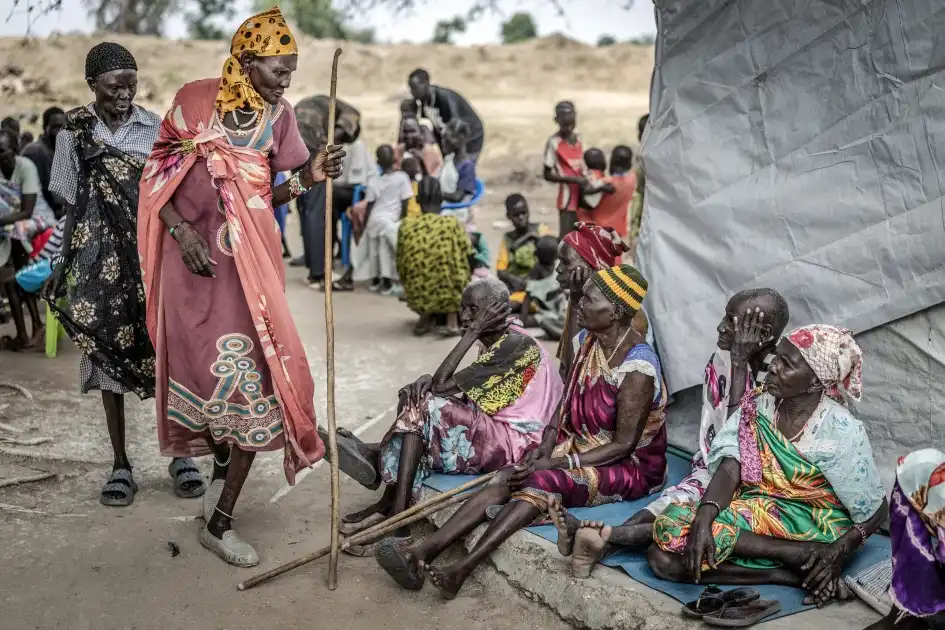
(Photo Credit: Citizen Digital)
By Diing Deng Mou
For years, South Sudan has been described as a fragile state struggling toward peace. This framing is convenient—and wrong. What is unfolding is not a slow or imperfect transition. It is a deliberate political system in which crisis is manufactured, deadlines are manipulated, and elections are indefinitely deferred.
These delays are routinely justified as necessary responses to insecurity, lack of preparedness, or incomplete reforms. But this explanation collapses under scrutiny. The same conditions cited to delay elections are repeatedly reproduced at the very moments when another election deadline approaches. Violence escalates, mediation begins, timelines are extended—and the incumbents remain in power.
This is not dysfunction. It is design.
The pattern began in 2013. In 2013, as the country prepares for its first post-independence elections, a political dispute within the ruling SPLM elites escalated into civil war. The conflict did not simply disrupt the electoral process; it eliminated it. The war displaced millions, killed tens of thousands, and entrenched a politics of survival over progress.
Three years later, the cycle repeated itself. A peace deal had raised cautious hopes for elections in 2018. Instead, fighting erupted in Juba in July 2016, when forces loyal to President Salva Kiir and then–Vice President Riek Machar clashed at the presidential palace. The government collapsed, war resumed, and elections were once again postponed—this time in the name of restoring stability.
The 2018 revitalized agreement on the resolution of the conflict in South Sudan was presented as a reset—a credible pathway toward democratic governance. In reality, it has delivered serial extensions of a “transitional” period that never seems to end. Each delay is accompanied by familiar rhetoric: reforms are incomplete, security conditions are inadequate, and institutions are not ready.
Yet after years of extensions, those same institutions remain weak by design. Electoral bodies are underfunded or politicized. Security sector reforms are stalled. Legal frameworks are selectively implemented. The conditions used to justify delay are not being resolved—they are being maintained.
South Sudan’s leaders have turned postponement into policy.
The logic is straightforward. As elections approach, tensions are allowed to rise—or actively inflamed—until they trigger violence or the credible threat of it. Regional and international actors, fearing a return to full-scale war, intervene to stabilize the situation. Negotiations produce a new timeline. The immediate crisis is contained, but the political structure remains intact. Power is extended without a vote.
This cycle has now repeated itself for more than a decade.
For ordinary South Sudanese, the consequences are devastating. While political elites negotiate extensions in capital cities, the country sinks deeper into economic collapse. Inflation erodes livelihoods. Public servants go unpaid. Basic services—healthcare, education, and infrastructure—are barely functional. Insecurity remains widespread, often driven by local conflicts that are manipulated or ignored by national authorities. Millions remain displaced, excluded from any meaningful political process.
This is what “prolonged transition” looks like in practice: a population locked out of its own political future.
The AU and international community bear part of the responsibility. External actors continue to treat South Sudan as a crisis to be managed rather than a system to be confronted. At the United Nations Security Council, divisions among major powers have repeatedly shielded the government from meaningful pressure. Statements of concern are issued, but they are rarely backed by coordinated action.
The result is a permissive environment where delay carries no consequences.
There is a persistent fear that pushing too hard for elections could trigger instability. But this logic has been inverted. It is the absence of elections—the certainty that power will not change hands—that sustains the current cycle of crisis. Stability cannot be built on the indefinite suspension of democracy.
At some point, the language of pragmatism becomes an excuse for inaction.
South Sudan’s leaders understand this dynamic well. They rely on it. As long as the threat of renewed conflict is enough to secure another extension, there is little incentive to pursue genuine reform. The system rewards delay and punishes progress.
This is why calls for “more time” should be treated with skepticism. More time has been granted repeatedly. It has not produced elections. It has entrenched avoidance.
The question now is no longer whether South Sudan is ready for elections. It is whether its leaders are willing to risk them.
Across the country, the answer from citizens is increasingly clear. Civil society groups, youth movements, and reform advocates are rejecting another extension. Their demand is simple: the right to vote cannot be postponed indefinitely. It is not a technical issue. It is the foundation of political legitimacy.
If that demand continues to be ignored, the implications extend beyond South Sudan. International recognition of a government that repeatedly extends its mandate without elections raises a difficult question: at what point does engagement become endorsement?
There are no easy solutions. Elections alone will not resolve South Sudan’s deep political and social fractures. But the absence of elections guarantees their continuation.
A shift in international approach is overdue.
If South Sudan is to move beyond perpetual transition, external engagement must change. First, deadlines must be treated as binding, not flexible suggestions. Second, diplomatic engagement should be conditioned on measurable progress toward electoral preparation, including institutional readiness and legal reforms. Third, targeted sanctions and political pressure should be applied consistently to those who obstruct the process. Finally, regional mediation efforts must prioritize enforcement, not just agreement.
Most importantly, the assumption that delay equals stability must be abandoned.
South Sudan’s crisis is often described as a failure of peacebuilding. It is more accurately understood as the success of a political strategy—one that replaces democratic accountability with permanent transition.
The longer this strategy is tolerated, the more entrenched it becomes.
South Sudanese citizens have waited since 2011 to choose their leaders. They should not be asked to wait any longer.
The writer, Diing Deng Mou, is a South Sudanese political activist, former political prisoner, and presidential candidate. He is the co-founder and chairman of the 7 October Movement, a reform-oriented political movement advocating for democratic transition and accountable governance in South Sudan. He can be reached at
Newer articles:
- African Union Peace and Security Delegation Arrives in South Sudan - 24/04/2026 18:58
- South Sudan At The Edge Of A Promise: Can The Transition Hold - 24/04/2026 18:53
- Kiir Signs EAC Treaty Act - 24/04/2026 18:49
- Mission Aviation Fellowship family serves with care and connection in South Sudan - 24/04/2026 18:45
- South Sudan: Event Tracking Report: Jonglei State #105 (01 January - 17 April 2026) - 24/04/2026 18:41
Older news items
- Detained South Sudan Ex-Finance Minister's Daughter Dies in Nairobi - 22/04/2026 14:23
- South Sudan vows to hold long-delayed elections in December - 22/04/2026 14:20
- Liberia Calls for Fully Resourced Peacekeeping Mission in South Sudan - 22/04/2026 14:17
- UNMISS-supported mobile court provides long-awaited justice in southern Unity - 22/04/2026 14:14
- St. Vincent de Paul Parish offers trauma healing sessions for more than 300 people - 22/04/2026 14:05
Latest news items (all categories):
- South Sudan Opens 14 Oil Blocks, Courts Investors Ahead of SSOP 2026 - 26/10/2026 15:08
- Jambojet Explores South Sudan Expansion After Talks with Juba Regulator - 26/10/2026 15:05
- Kiir swears in 5 officials ahead of South Sudan elections - 26/10/2026 14:53
- South Sudan cattle battles leaves 10 dead: official - 26/10/2026 14:49
- Churches urge world 'not to forget South Sudan' ahead of first elections - 26/10/2026 14:47
See also (all categories):
Random articles (all categories):
- EAC 35pc common tariff to make meat, alcohol imports costly - 06/05/2022 04:30
- South Sudan U17 Girls Kicks Off Training Ahead of CECAFA Tournament - 01/06/2026 14:30
- Ethiopia, South Sudan sign 9 cooperation agreements - 24/02/2017 05:31
- Generous And Philanthropic Support Of Mrs. Achai Wiir Is Important - 09/11/2020 13:18
- South Sudan: Malaria preparedness vital as rains begin - 14/07/2017 01:10
Popular articles:
- Who is the darkest person in the world, according to Guinness World Record? - 25/10/2022 02:34 - Read 151299 times
- School exam results in South Sudan show decline - 01/04/2012 17:58 - Read 28391 times
- Top 10 weakest currency exchange rates in Africa in 2023 - 19/07/2023 00:24 - Read 25496 times
- No oil in troubled waters - 25/03/2014 15:02 - Read 24702 times
- NDSU student from South Sudan receives scholarship - In-Forum - 29/09/2012 01:44 - Read 22677 times
