
Download Report (PDF | 585.23 KB)
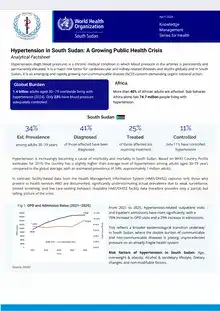
Hypertension (high blood pressure) is a chronic medical condition in which blood pressure in the arteries is persistently and permanently elevated. It is a major risk factor for cardiovascular and kidney-related illnesses and deaths globally and in South Sudan, it is an emerging and rapidly growing non-communicable disease (NCD) concern demanding urgent national action.
Hypertension is increasingly becoming a cause of morbidity and mortality in South Sudan. Based on WHO Country Profile estimates for 2019, the country has a slightly higher than average level of hypertension among adults aged 30–79 years compared to the global average, with an estimated prevalence of 34%, approximately 1 million adults.
In contrast, facility-based data from the Health Management Information System (HMIS/DHIS2) captures only those who present to health services AND are documented, significantly underestimating actual prevalence due to weak surveillance, limited screening, and low care-seeking behavior. Available HMIS/DHIS2 facility data therefore provides only a partial, but telling, picture of the crisis.
Newer articles:
- Lucy Kalanzi Had Close Ties with South Sudan’s President Kiir - 17/04/2026 13:46
- Greek man who served as South Sudan’s honorary consul to Cyprus charged with illegal arms brokering - 15/04/2026 17:05
- ARIPO hosts South Sudan delegation to promote intellectual property cooperation - 15/04/2026 17:03
- Fleeing Sudan's war, refugees rebuild their lives in Uganda - 15/04/2026 16:59
- Sweet Success: An African Development Bank grant propels a youth-led honey enterprise in South Sudan into an international supplier and job creator - 15/04/2026 16:50
Older news items
- South Sudan: Both Sides Blocking Aid, Displacing Civilians - 13/04/2026 14:33
- Ethiopia Seen Poised to Seal Air Services Agreement With South Sudan This Month - 13/04/2026 14:31
- UN Personnel Appointments: Ms. Kiki Gbeho of Ghana, Special Representative for South Sudan and Head of the United Nations Mission in South Sudan (UNMISS) - 13/04/2026 14:29
- Forgiveness and fruit in conflict-ravaged South Sudan - 13/04/2026 14:25
- Almost 4,500 Afrikaner farmers take Trump’s refugee offer - 13/04/2026 14:20
Latest news items (all categories):
- Canada helping to fund South Sudan vote despite growing repression - 05/10/2026 15:10
- UNMISS patrol reaches remote Ibba communities amidst heavy rains, insecurity, and growing health threats - 05/10/2026 15:07
- WFP Strongly Condemns Attack on Trucks in South Kordofan, Killing One Driver - 05/10/2026 15:03
- Advancing Women’s Land Rights through building capacity of customary institutions in Magwi County, South Sudan - 02/10/2026 13:18
- AU calls for release of political detainees ahead of South Sudan elections - 02/10/2026 13:15
See also (all categories):
Random articles (all categories):
- Sudan Crisis: Refugees Suffer In Primitive Camps Without Aid - Huffington Post - 17/07/2012 15:30
- South Sudan detainees ‘on the verge of death’ - 27/05/2016 02:54
- On the Edge: Aid Groups Predict Famine in South Sudan - 08/07/2014 01:46
- 57 killed in new South Sudan clashes: government - 12/01/2012 20:48
- Kiir urges Central Bank governor to improve economic situation - 06/10/2023 05:54
Popular articles:
- Who is the darkest person in the world, according to Guinness World Record? - 25/10/2022 02:34 - Read 150615 times
- School exam results in South Sudan show decline - 01/04/2012 17:58 - Read 28188 times
- Top 10 weakest currency exchange rates in Africa in 2023 - 19/07/2023 00:24 - Read 25299 times
- No oil in troubled waters - 25/03/2014 15:02 - Read 24530 times
- NDSU student from South Sudan receives scholarship - In-Forum - 29/09/2012 01:44 - Read 22487 times
