
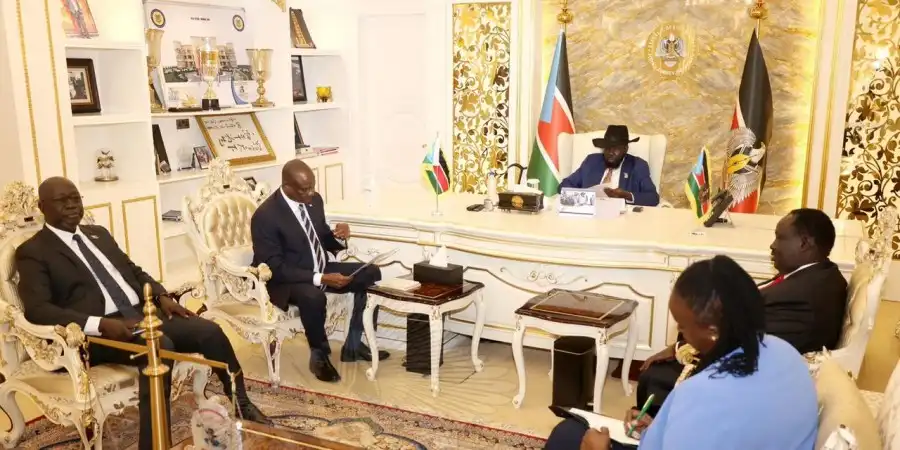
South Sudan’s President Salva Kiir (middle) meets with Vice President General Taban Deng Gai (second left), Presidential Adviser on Security Affairs Tut Gatluak Manime (right), and other officials at State House, Juba on March 25, 2026 (Photo Credit: The East African)
South Sudan’s Vice President for the Infrastructure cluster, Taban Deng Gai, met his boss, President Salva Kiir, after lamenting that he had not seen him for close to a year.
Mr Gai attended the swearing-in of new state officials at State House Juba, on Wednesday, where he also held talks with the President.
Among those sworn in was Peter Chaleman Cawach, appointed presidential adviser for peace. A member of the National Transitional Legislative Assembly, he is regarded as an influential elder with a record of mediation efforts, particularly in Upper Nile. His appointment is expected to bolster ongoing peace initiatives.
Joseph Nguen Monytuil was also sworn in as governor of Unity State, returning to a role he previously held. His earlier tenure was associated with relative stability in parts of the oil-rich region, raising expectations for continued progress in security and development.
President Kiir urged citizens to remain calm, united and committed to peace as the country navigates a fragile transition. He emphasised cooperation among political leaders and communities, and called on the new officials to prioritise service delivery and reconciliation.
“We have all witnessed what war does. We believe we should stop here,” Mr Kiir said. “We must find a way of getting solutions, and we must work together to solve our problems.”
In his remarks, the vice president urged the new officials to place peacebuilding at the centre of their work, and called on Unity State leaders to remove roadblocks that impede trade and economic activity.
Revolving doors
Separately, Mr Kiir appointed two information cadre officials to the President’s press wing.
Under Kiir’s administration, senior officials, including governors, advisers and deputies, are appointed by presidential decree, often in consultation with parties to the Revitalised Agreement on the Resolution of the Conflict in South Sudan. The 2018 power-sharing deal outlines how key positions are distributed among former rivals to end years of civil war.
Last month, Mr Kiir dismissed two senior aides after an incident in which he appointed a deceased individual to a committee tasked with leading discussions on elections scheduled for December.
Steward Soroba Budia’s appointment was announced in a presidential order dated January 30, but local media later reported that the United Democratic Party member had died five years earlier.
The incident sparked widespread mockery on social media.
In a statement that did not give reasons, the presidency said Mr Kiir had dismissed his press secretary, David Amour Major, and the chief administrator in the Ministry of Presidential Affairs, Valentino Dhel Maluet.
Budia had been a signatory to the 2018 peace agreement that ended the conflict following South Sudan’s independence in 2011.
Mr Kiir has fired or rotated numerous senior officials over the past 18 months, sometimes within days of their appointment, citing the need to improve governance, maintain political balance and sustain the peace process in a country still facing sporadic violence and economic strain.
He has also arrested and put Vice President Riek Machar on trial, raising concerns over the 2018 peace deal between the two men that underpins the country’s political stability.
Newer articles:
- Chinese peacekeepers to South Sudan (Wau) hold training courses on war-wound treatment skills - 30/03/2026 14:08
- Concern supports 30,000 people in South Sudan with healthcare and cash assistance - 30/03/2026 14:00
- South Sudan through to next stage of AFCON 2027 qualifiers - 30/03/2026 13:58
- Rationing power and diluting petrol - how African countries are coping with effects of Iran war - 27/03/2026 20:24
- UN Human Rights Council 61: UK Statement for the resolution on South Sudan - 27/03/2026 20:20
Older news items
- Uganda: Funding Gaps and Policy Shifts Raise Concerns Over Uganda's Refugee Response - 27/03/2026 20:06
- South Sudan humble Djibouti in Africa Cup of Nations qualifier - 27/03/2026 19:52
- Prison officers trained in human rights pave the way for a fairer and stronger justice system - 27/03/2026 19:49
- UN-backed mobile courts expand access to justice in South Sudan - 25/03/2026 12:48
- Khartoum accuses: “The capture of the border town of Kurmuk was facilitated by Ethiopia” - 25/03/2026 12:45
Latest news items (all categories):
- South Sudan Opens 14 Oil Blocks, Courts Investors Ahead of SSOP 2026 - 26/10/2026 15:08
- Jambojet Explores South Sudan Expansion After Talks with Juba Regulator - 26/10/2026 15:05
- Kiir swears in 5 officials ahead of South Sudan elections - 26/10/2026 14:53
- South Sudan cattle battles leaves 10 dead: official - 26/10/2026 14:49
- Churches urge world 'not to forget South Sudan' ahead of first elections - 26/10/2026 14:47
See also (all categories):
Random articles (all categories):
- South Sudan leaders must account for atrocities - 20/08/2016 15:20
- Collo Global Action - The Cold Blooded Massacre of Collo (Shilluk) Internally Displaced Persons in UNMISS Protection Camp in Malakal Upper Nile State, 18th February, 2016 - 20/02/2016 11:40
- Travellers to South Sudan to pay for quarantine - 21/03/2020 12:24
- China Expresses Concern Over Sudanese Conflict - ABC News - 19/04/2012 11:24
- Malakal minefields still a challenge - 29/07/2009 07:47
Popular articles:
- Who is the darkest person in the world, according to Guinness World Record? - 25/10/2022 02:34 - Read 151294 times
- School exam results in South Sudan show decline - 01/04/2012 17:58 - Read 28388 times
- Top 10 weakest currency exchange rates in Africa in 2023 - 19/07/2023 00:24 - Read 25493 times
- No oil in troubled waters - 25/03/2014 15:02 - Read 24697 times
- NDSU student from South Sudan receives scholarship - In-Forum - 29/09/2012 01:44 - Read 22673 times
