
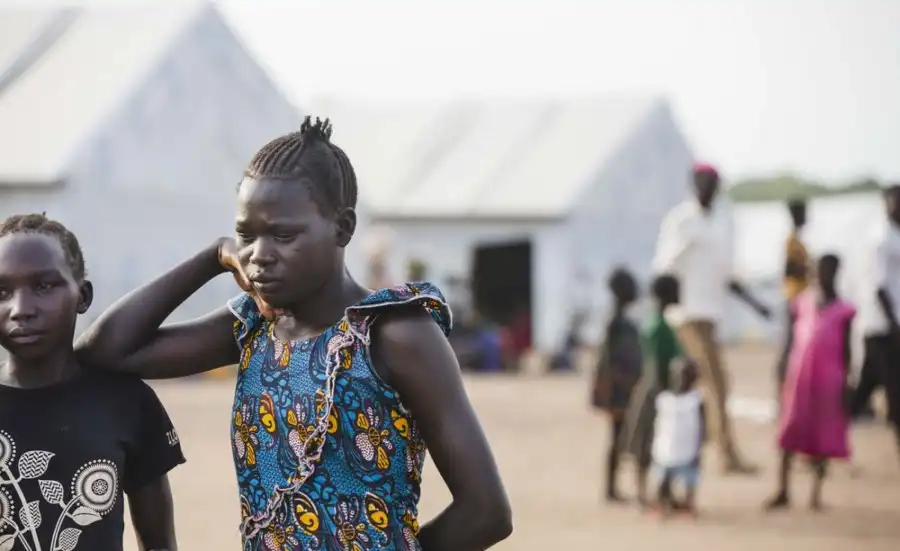
Refugees in Ugandas Imvepi Camp (United Nations Mission in South Sudan/Flickr)
Uganda's refugee response is entering a critical phase, with development partners warning that dwindling funding and policy changes could strain one of the world's most progressive asylum systems.
Speaking at the 25th Comprehensive Refugee Response Framework (CRRF) Steering Group meeting, the European Union ambassador, on behalf of development partners, stressed the need to align the refugee response with available resources, even if it requires difficult decisions.
Uganda hosts nearly two million refugees, mostly from the Democratic Republic of Congo, South Sudan, and Sudan, making it Africa's largest refugee-hosting country. Partners say the current model is no longer financially sustainable.
"The response must now be aligned with available resources to maximise impact," the envoy said, highlighting a tightening global funding environment and shifting donor priorities.
Pressure on essential services
Development partners raised concerns over the deteriorating state of services in refugee-hosting areas, particularly in health and education. Schools reopened in February amid uncertainty, with partners urging the government to urgently adopt an "education bridge plan" to ensure continuity of learning.
While partners are willing to provide short-term funding--including support backed by the World Bank--they stressed that such financing depends on a clear government strategy for sustainability.
"Funding recurrent costs without a sustainability plan is not possible for many development partners," the envoy said.
A similar call was made for a "health bridge plan," seeking clarity on how refugee services will transition into national systems while maintaining delivery standards.
Policy shift in refugee status determination
The meeting also addressed a policy change announced in February, in which Uganda ended prima facie recognition for new arrivals and introduced individual Refugee Status Determination (RSD).
While the government assured partners that this does not mark a retreat from its open-door policy, concerns remain over operational challenges. Prima facie recognition has historically enabled rapid processing, giving refugees immediate access to protection and services. Moving to individual assessments could slow processing, increase backlogs, and strain institutional capacity.
"Slower case processing risks overcrowding in transit centres and leaving vulnerable individuals in legal limbo," the statement noted.
Partners also warned that temporary status arrangements could undermine refugee self-reliance by creating uncertainty over land allocation and long-term integration.
Call for reforms and better coordination
Development partners urged the Office of the Prime Minister (OPM) to streamline operations and improve efficiency in light of both funding limits and the new RSD framework.
They noted that while recent funding injections are welcome, they are largely short-term and should not delay necessary reforms.
Concerns were also raised over bureaucratic delays in approving Memoranda of Understanding (MoUs) for NGOs, which are slowing delivery of essential services at a critical time.
At the same time, partners welcomed ongoing efforts to strengthen coordination under a proposed "One Coordination Model," aimed at reducing duplication and improving overall response effectiveness.
Urban integration and policy optimism
On policy, development partners expressed cautious optimism about the revised draft National Refugee Policy, particularly its recognition of urban refugees and plans to integrate them into municipal services. This is seen as a key step toward long-term solutions for refugees settling in urban areas.
However, partners warned that funding constraints threaten the CRRF Secretariat itself, potentially weakening coordination when it is most needed.
Push for durable solutions
Looking ahead, partners reaffirmed their support for durable solutions, including voluntary repatriation where conditions allow, and long-term integration and self-reliance initiatives. They also called for better implementation of development financing already pledged to refugee-hosting districts, noting that translating commitments into tangible results remains a major challenge.
 Uganda's approach--praised globally for granting refugees land, freedom of movement, and the right to work--is now at a crossroads, with partners urging swift, coordinated action to preserve these gains.
Key requests to government
Development partners requested updates from government on three critical areas: management and funding of the new refugee status determination process, progress on education and health transition plans, and resolution of bottlenecks affecting work permits and tax IDs for refugees.
Despite the challenges, partners reaffirmed their commitment to working with the government.
"Uganda's Development Partners remain committed to working hand in hand with the Government to deliver durable solutions," the envoy said.
Source: https://allafrica.com/stories/202603270033.html
Newer articles:
- Concern supports 30,000 people in South Sudan with healthcare and cash assistance - 30/03/2026 14:00
- South Sudan through to next stage of AFCON 2027 qualifiers - 30/03/2026 13:58
- Rationing power and diluting petrol - how African countries are coping with effects of Iran war - 27/03/2026 20:24
- UN Human Rights Council 61: UK Statement for the resolution on South Sudan - 27/03/2026 20:20
- South Sudan VP Taban Gai meets President Kiir for first time in a year - 27/03/2026 20:15
Older news items
- South Sudan humble Djibouti in Africa Cup of Nations qualifier - 27/03/2026 19:52
- Prison officers trained in human rights pave the way for a fairer and stronger justice system - 27/03/2026 19:49
- UN-backed mobile courts expand access to justice in South Sudan - 25/03/2026 12:48
- Khartoum accuses: “The capture of the border town of Kurmuk was facilitated by Ethiopia” - 25/03/2026 12:45
- The Women Disrupting Hate, From South Sudan to Myanmar - 25/03/2026 12:42
Latest news items (all categories):
- South Sudan can leverage China’s AI path to bridge the digital divide - 16/09/2026 16:04
- Credible Elections Are No Longer Possible in South Sudan - What Next? - 16/09/2026 15:59
- South Sudan's president replaces electoral chief three months before scheduled polls - 16/09/2026 15:56
- Turkish Airlines is pulling out of 5 African routes, including South Sudan - 16/09/2026 15:23
- ‘Super El Niño’ deepens hunger crisis in South Sudan – WFP - 16/09/2026 15:19
See also (all categories):
Random articles (all categories):
- 47 die in another round of SSudan tribal violence - 18/01/2012 02:58
- UNICEF - Consultancy Assignment, Young Child Feeding in Emergencies (IYCF-E) Consultant, UNICEF ESARO-Nairobi - 23/09/2015 08:08
- South Sudan inflation eases to 65.6 pct in December - 06/01/2012 15:53
- United Nations Mission in South Sudan (UNMISS) visits conflict-ridden Tonj East area to build trust and confidence - 17/09/2019 17:32
- Uganda starts constructing road to South Sudan - 21/08/2013 04:48
Popular articles:
- Who is the darkest person in the world, according to Guinness World Record? - 25/10/2022 02:34 - Read 149594 times
- School exam results in South Sudan show decline - 01/04/2012 17:58 - Read 28115 times
- Top 10 weakest currency exchange rates in Africa in 2023 - 19/07/2023 00:24 - Read 25198 times
- No oil in troubled waters - 25/03/2014 15:02 - Read 24464 times
- NDSU student from South Sudan receives scholarship - In-Forum - 29/09/2012 01:44 - Read 22416 times
