
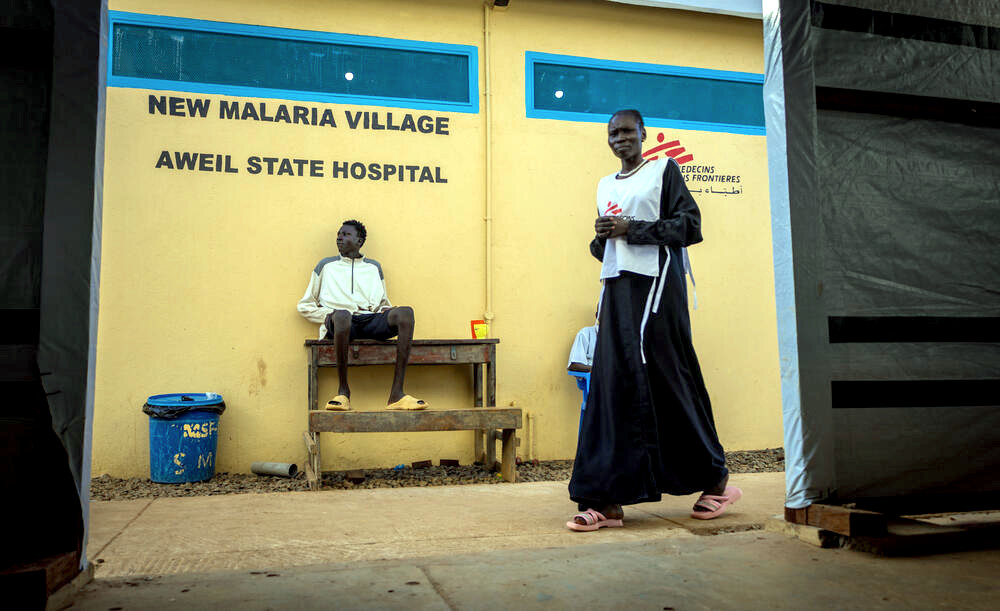
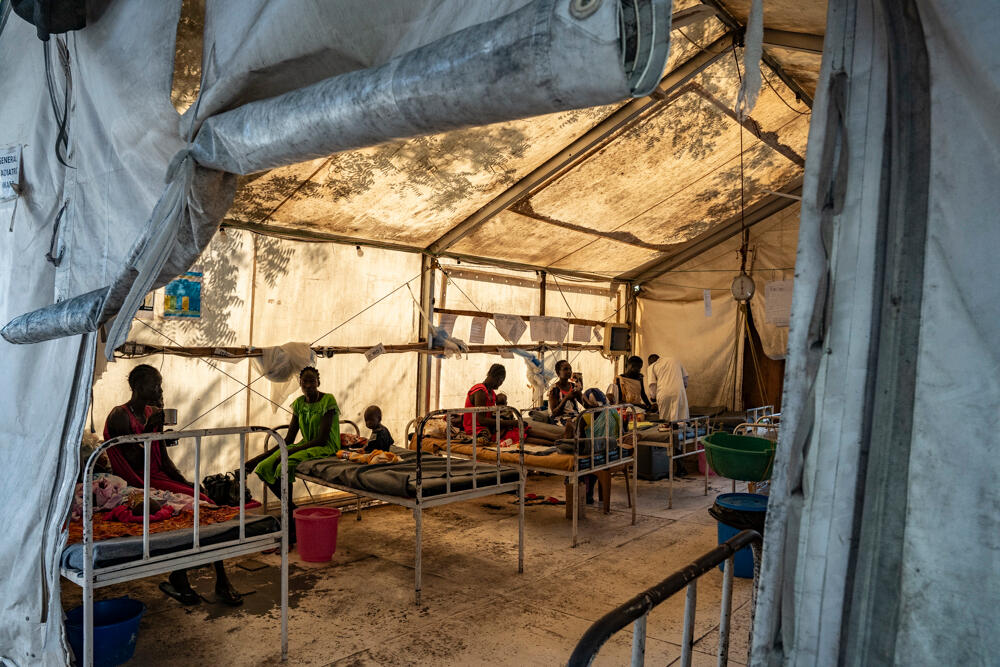
Children and caretakers at the paediatric inpatient ward in Old Fangak © Paula Casado Aguirregabiria/MSF
People in South Sudan are facing a “catastrophic” humanitarian situation while at the same time international interest and support continue to decline, says a new report by Médecins Sans Frontières / Doctors Without Borders (MSF).
“In every location where MSF works, our teams witness huge gaps in health services. Health facilities are either non-functional or severely under-resourced.
“Chronic shortages of medicine and staff mean that people are dying from preventable and treatable diseases. Health facilities need support on the ground not on paper.”
This year, violence between government and opposition forces, and non-state armed groups steeply increased, marking the worst escalation since the signing of the 2018 peace agreement.
Escalating violence, attacks on health facilities by all parties to the conflict, and access constraints are further impeding the delivery of healthcare and aid. According to UN, since January, new waves of violence have displaced over 320,000 people and 2,000 have been killed.
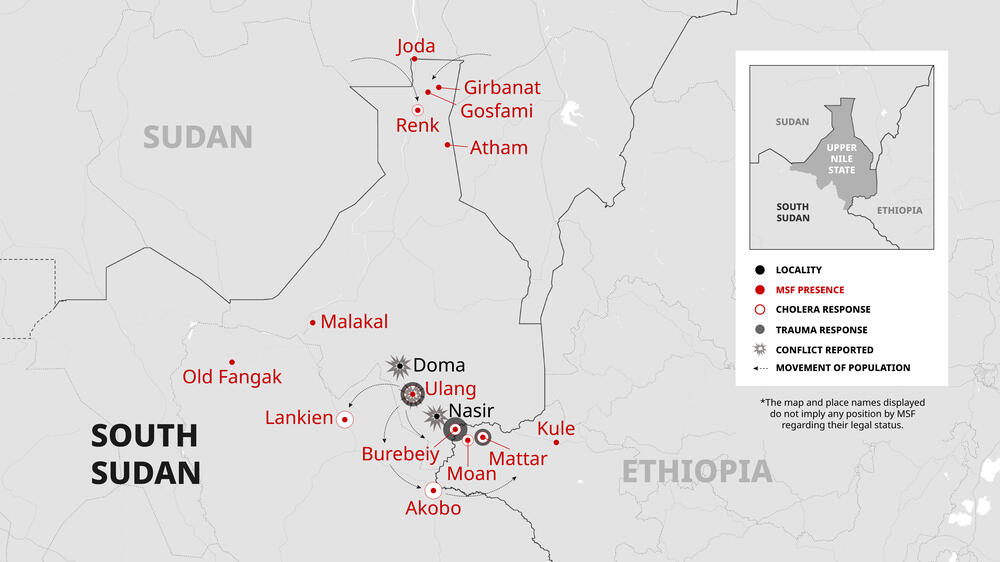
Map of MSF's activities in South Sudan (© MSF)
Targeted attacks on healthcare
In Malakal, between April and November 2025, MSF teams treated 141 trauma patients, including women and children, many with gunshot wounds.
In flagrant violation of international humanitarian law, 2025 also saw a sharp increase in attacks on health facilities by all parties to the conflict.
MSF alone experienced eight targeted attacks on its facilities and staff in Central Equatoria, Jonglei and Upper Nile states, forcing the closure of two hospitals in Ulang and Old Fangak.
On 3 December, our facility was hit by an airstrike in Pieri town, Jonglei State. On the same day, MSF teams witnessed more airstrikes in Lankien, where MSF also runs healthcare facilities.
Not enough medication
Communities are facing multiple overlapping crises: conflict, large-scale displacement, flooding, malnutrition, and disease outbreaks - including the largest cholera outbreak in the country’s history.
International support, however, continued to decline in 2025 despite people’s living situations and access to essential services getting worse.
The Health Sector Transformation Project (HSTP), a multi-donor initiative launched in July 2024, remains South Sudan’s main vehicle for healthcare delivery. Led by the South Sudanese government with the World Health Organization (WHO), UNICEF, and other partners, the project originally aimed to support 1,158 health facilities across 10 states and three administrative areas.
However, due to funding constraints, 816 facilities are currently supported under the programme, and even these still face persistent shortages of medicines and staff.
“I travelled from Keurdeng, it took one hour,” a female care-giver in Toch told MSF teams. “There is a small health facility [in Keurdeng], but it does not have all the medication - sometimes they finish supplies very fast. I took the child to the health centre, but there was no medication.”
Malaria remains a major challenge, continuing to be the leading cause of morbidity and mortality in South Sudan, particularly for women and children.
Despite this, for the second year in a row, 2025 saw nationwide stockouts of malaria drugs during peak season. Without timely treatment, malaria can quickly become deadly. Between January and September 2025, MSF teams treated 6,680 people with severe malaria who required hospitalisation.
South Sudan now
For years, people in South Sudan have faced some of the world’s highest medical and humanitarian needs. In 2025, the situation in South Sudan has worsened significantly.
Rising needs require urgent action: international donors must uphold their commitments to support health and humanitarian efforts, and shortcomings in existing programmes must be urgently addressed.
At a minimum, the timely delivery of essential medicines, supplies, and salaries for health workers need to be ensured. Amidst escalating violence, humanitarian access, protection of civilians, and respect for health facilities must be guaranteed.
MSF also calls on South Sudan’s government to raise the national health budget in line with its Abuja Declaration commitment of allocating 15 percent to health. Currently, only 1.3 percent of the national budget is allocated to health.
“The situation in the country is catastrophic,” says Lamberg. “The urgent needs of people in South Sudan demand coordinated action, renewed commitment, and genuine international solidarity. The world can’t look away, especially now.”
MSF in South Sudan
In July 2011, South Sudan became the world’s newest country after gaining independence from Sudan. The peace deal that led to the split also ended Africa’s longest-running civil war. But in December 2013, South Sudan civil war erupted again, forcing millions of people from their homes, leaving many without access to basic necessities, such as food, water and healthcare.
Although a peace deal was reached in 2018, the security situation remains volatile in many areas, with factional violence continuing to hit communities hard.
Source: https://msf.org.uk/article/msf-report-world-cant-look-away-south-sudan-especially-now
Newer articles:
- The town on the banks of the Nile that turned floods into fortune - 11/12/2025 14:06
- South Sudan says its troops are guarding strategic Heglig oil field in Sudan - 11/12/2025 10:00
- Military drone attack on Sudan oil field kills dozens and threatens South Sudan's economic lifeline - 10/12/2025 12:18
- South Sudan Slams Ruto’s Govt Over Mombasa Port New Tax - 10/12/2025 12:11
- In Depth: As foreign funds dry up, so do South Sudan’s hopes of stopping hunger crisis - 09/12/2025 18:07
Older news items
- What’s changed in Sudan after the Rapid Support Forces’ control of Heglig? - 09/12/2025 17:38
- “Do not distort the Word of God”: Cardinal Ameyu to Four Newly Ordained Deacons for Juba Archdiocese in South Sudan - 09/12/2025 17:23
- South Sudan - Rubkona County: Flood overview (December 2025) - 09/12/2025 17:13
- South Sudan & Senegal Football Federations To Sign Cooperation Agreement - 09/12/2025 17:08
- RSF seizes key Heglig oilfield as it pushes to expand control in Sudan - 08/12/2025 18:28
Latest news items (all categories):
- South Sudan Opens 14 Oil Blocks, Courts Investors Ahead of SSOP 2026 - 26/10/2026 15:08
- Jambojet Explores South Sudan Expansion After Talks with Juba Regulator - 26/10/2026 15:05
- Kiir swears in 5 officials ahead of South Sudan elections - 26/10/2026 14:53
- South Sudan cattle battles leaves 10 dead: official - 26/10/2026 14:49
- Churches urge world 'not to forget South Sudan' ahead of first elections - 26/10/2026 14:47
See also (all categories):
Random articles (all categories):
- South Sudan Refugees Hope for Peace - 28/10/2014 13:36
- Give me shelter - 13/05/2016 15:00
- South Sudan President threatens to exit Rome talks over slain nuns - 18/08/2021 16:19
- IGAD leaders discuss South Sudan, locusts invasion - 08/02/2020 16:00
- Sudan delays blockage of South Sudan oil flows for two weeks - 26/07/2013 15:12
Popular articles:
- Who is the darkest person in the world, according to Guinness World Record? - 25/10/2022 02:34 - Read 151297 times
- School exam results in South Sudan show decline - 01/04/2012 17:58 - Read 28390 times
- Top 10 weakest currency exchange rates in Africa in 2023 - 19/07/2023 00:24 - Read 25495 times
- No oil in troubled waters - 25/03/2014 15:02 - Read 24701 times
- NDSU student from South Sudan receives scholarship - In-Forum - 29/09/2012 01:44 - Read 22676 times
